


 Nivea Logo PNG
The Nivea logo is a cream jar symbol, instantly recognizable and loved by users. The emblem shows the completeness of the action and the contents of a single bottle, which contains all the necessary ingredients to care for different skin types.
Nivea traces its origins to 1882, when Paul Carl Beiersdorf founded a laboratory in Hamburg that produced medical dressings. His key product was an adhesive plaster, designed to fix bandages without bandages, with no initial focus beyond the pharmacy market.
In 1890, he sold the business to Oscar Troplowitz, who shifted the focus to skin care chemistry. Together with dermatologist Paul Gerson Unna, he explored new cosmetic formulations.
Around 1900, they built on Isaac Lifschütz’s work showing that lanolin can form stable water-in-oil emulsions. The result was a cream that did not separate and remained stable without preservatives, unlike earlier products.
In 1911, the cream was launched as Nivea, named from the Latin “niveus”. Early packaging used a yellow tin with floral decoration, and the product was marketed for the whole family through pharmacies and perfumeries.
After Troplowitz died in 1914, World War I disrupted exports and supply chains. Beiersdorf faced constraints similar to Henkel’s during the war.
In 1925, the brand introduced the blue tin, which improved shelf visibility and established a long-term visual code. In the 1930s, campaigns focused on healthy, active lifestyles, and in 1938, a sun care product appeared in a metal tube.
World War II brought partial nationalization, raw material shortages, and the loss of trademarks abroad, including in the US. Recovery required years of legal and commercial work.
From 1959, the range expanded with body milk, then men’s care in 1963, and broader lines in the 1980s. By the late 1990s, Nivea had achieved widespread recognition in Europe and, in the 2000s, expanded into Asia, Latin America, and Africa, competing with L’Oréal.
Meaning and History
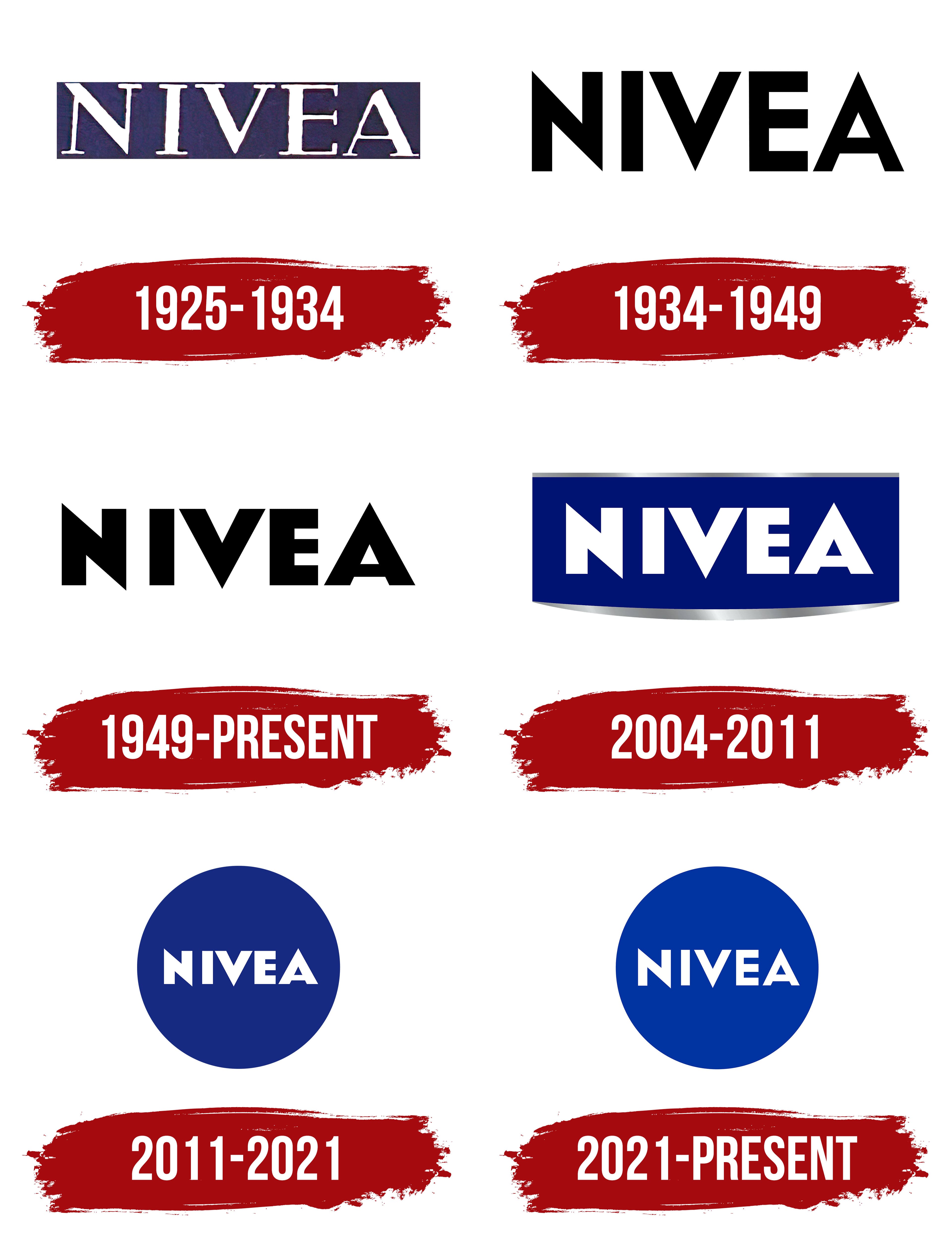
The company began considering a multilingual emblem after World War II, and by 1949, it had an updated brand name. Throughout its existence, the trademark has been updated three times. As a result, all versions are still relevant (except one).
What is Nivea?
Nivea is a German brand that offers body care products. Its product range includes a wide selection of hygiene products, from hand cream to cleansing preparations. It was launched under its current name in 1911. Its owner is Beiersdorf Global AG.
1925 – 1934

The Nivea brand, owned by the German multinational company Beiersdorf AG, was introduced in 1911. It introduced a lanolin-based cream. All jars looked the same: small and round, with the brand’s name on their lids. In the mid-1920s, the logo’s design changed: a contrasting font with long, thin serifs was used for the word. At the same time, the white inscription was set against a dark background to make it easier to see. For the same purpose, all glyphs were converted to uppercase.
1934 – 1949

In the 1930s, Nivea redesigned its official logo. The designers removed the serifs and made them spiky and aligned in height (previously, the “A” was lower than the other glyphs). The typeface’s overall structure resembled Motor Oil 1937 M54 Regular by justme54s, Mesmerize Semi Bold by Typodermic Fonts Inc., or Zeronero Black from Monocromo, but without the protruding “N” corners. A few more similar analogs: Steagal Bold from Insigne Design, Mesmerize Bold from Typodermic Fonts, and Journal Sans New Bold from ParaType. In the main version, the inscription was black.
1949 – 2021

During that period, the emblem had four variants, all based on the same spelling of the word “Nivea.” They differ only in color: black on white, blue on white, and white on blue in wide and narrow formats.
2004 – 2011
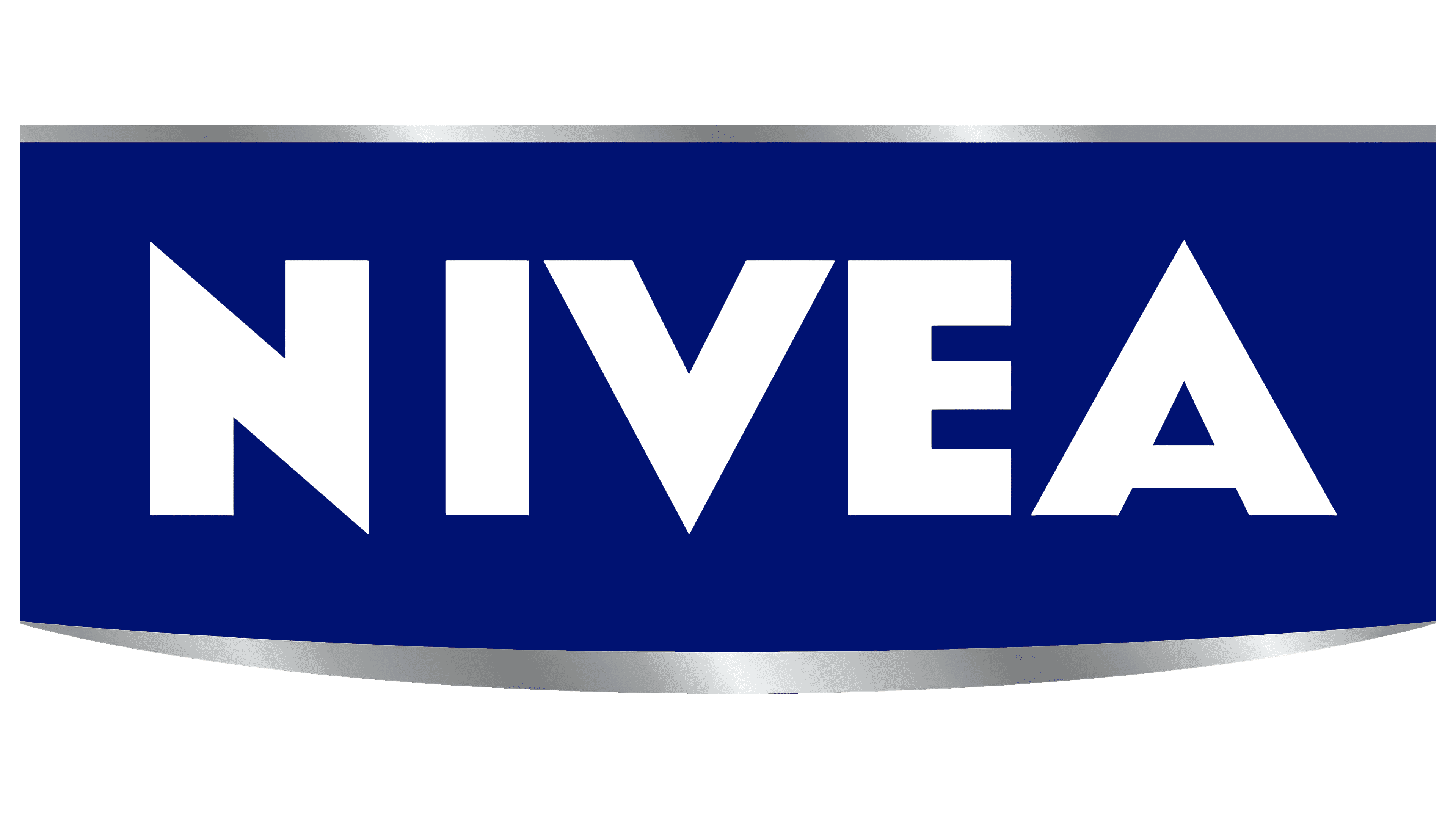
In 2004, the management decided to play with the shape of the legendary cream jar. To do this, the designers used a familiar design and added a thin, silvery line above and below it, as if it were a reflection of a metal container. The result is a 3D effect.
2011 – 2021
In this version, a jar of cream is presented on top. The logo features a flat blue box with the brand name.
2021 – today
As in the previous case, the Nivea logo follows the shape of the lid of a round jar of cream, the brand’s first product. Since then, the cosmetics range has expanded; the wordmark is placed inside the circle. And not just blue, but the can’s color. After the 2021 redesign, it became lighter and brighter to attract potential buyers. The inscription remained white. But the font has changed slightly: the letters are now thinner and more elegant than before. However, it remains a bold, grotesque design, with sharp corners where the diagonals meet other lines.
Font and Colors
All versions of the logo use the word “Nivea.” They contain no graphic elements. Some have a well-defined background: a circle, a narrow rectangle, or a wide rectangle.
The emblem uses a typeface reminiscent of the commercial type Eagle Bold, with pointed ends on the N, V, and A. The color scheme is stable: dark blue and white.