


 Norton Logo PNG
The Norton logo is as elegant and airy as the bikes themselves. The company treated the bikes as works of art, carefully considering every detail. The emblem tells about the friendly team that worked on the models.
James Lansdowne Norton was born in Birmingham in 1869. Trained first as a jeweler’s apprentice, he was drawn to mechanics from childhood and built a working steam engine model at the age of ten. In 1898, he opened a small workshop on Bradford Street, supplying parts for the bicycle trade.
The first Norton motorcycle, the Energette, appeared in 1902 with a 160 cc French Clément engine mounted in a bicycle frame. Peugeot engines followed. In 1907, Rem Fowler rode a Peugeot-powered Norton in the first Isle of Man Tourist Trophy and won the twin-cylinder class, giving the young company a strong public breakthrough.
In 1913, the business nearly collapsed after Norton fell ill following a trip to the Isle of Man. The company was liquidated and quickly restarted by R. Shelley and racer-tuner Dan O’Donovan. James Norton died on April 21, 1925, before the brand’s strongest period in racing. In 1927, Walter Moore developed the CS1 overhead-cam engine, and Alex Bennett won the TT on it. After Moore left for NSU in 1929, Joe Craig and Arthur Carroll refined an engine concept that stayed relevant for decades.
During the 1930s, Norton dominated motorcycle racing, winning 78 of 92 Grands Prix from 1930 to 1937 and seven of nine Senior TT races from 1931 to 1939. After World War II, the Manx and Featherbed frame kept the name competitive, with riders such as Geoff Duke and John Surtees. AMC acquired Norton in 1952. The Commando debuted in 1967 and sold more than 55,000 units before ending in 1977. Later came rotary models, Steve Hislop’s 1992 Senior TT win, and a 2020 revival under TVS Motor Company.
Meaning and History
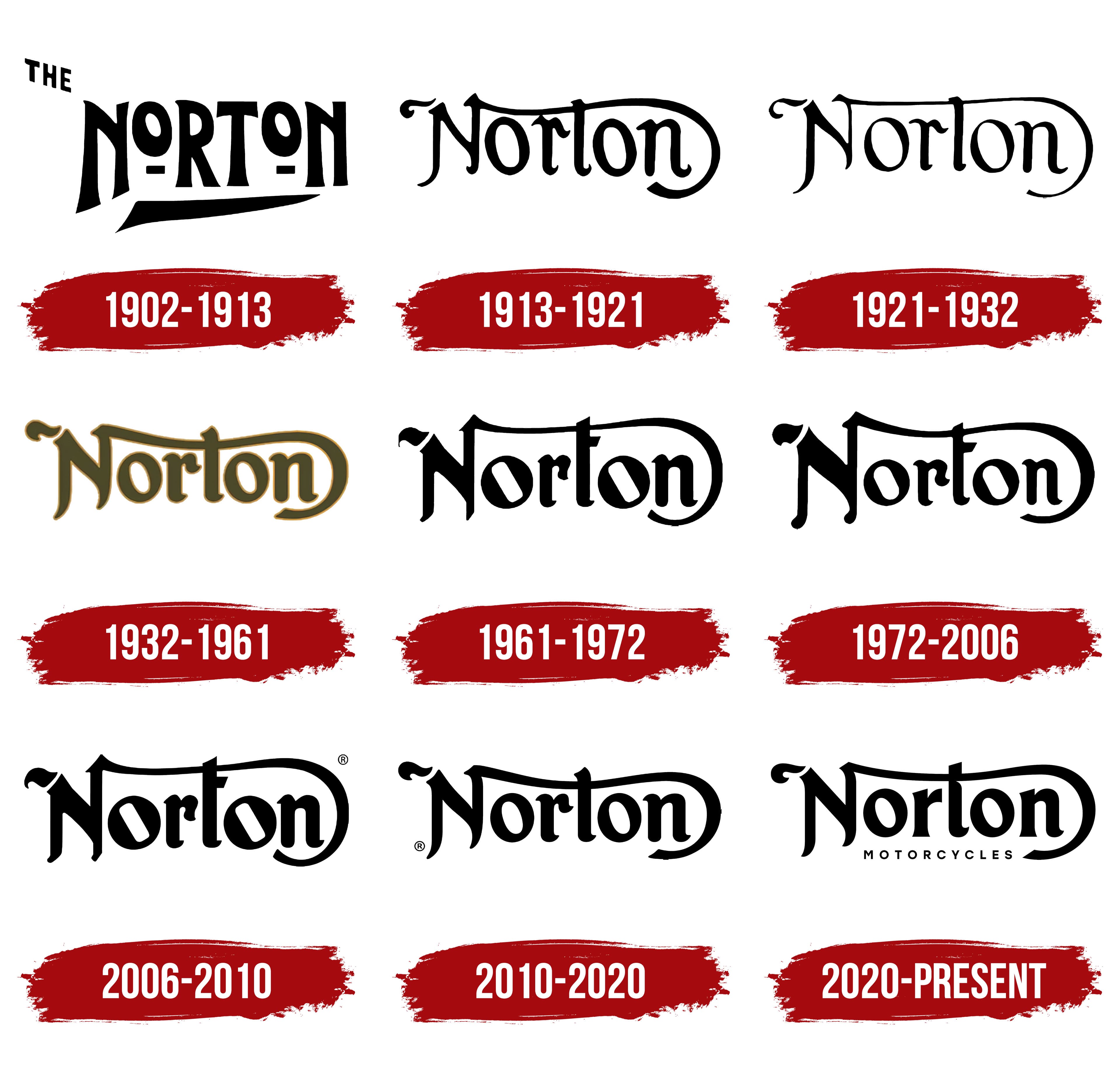
The company’s logo has undergone numerous minor changes, but the overall image and concept have remained largely unchanged since its inception. This is due to the owners’ desire to preserve the founder’s historical legacy. Norton himself worked on the logo alongside his daughter, Ethel. His vision for the company’s style, combined with the sophistication the heiress brought to the empire, makes the Norton Motorcycle Company unique.
What is Norton?
This company creates high-end motorcycles that combine classic craftsmanship with advanced technology, reflecting the rich heritage of British motorsport. Founded in Birmingham, England, it achieved significant racing success, especially at the Isle of Man TT, where its motorcycles won repeatedly. Models like the Commando and Dominator became industry legends thanks to their unique parallel-twin and rotary engines, aerodynamic designs, and excellent build quality.
1902 – 1913
The first logo consisted of disproportionate elements. The O’s in the name were reduced and raised upward.
Additionally, the company’s first motorcycles were powered by a motor-driven belt. The belt was mounted like a bicycle chain on two small wheels.
The lower underline of the inscription, in the form of an arrow, pointed to travel and roads, symbolizing a desire for development.
1913 – 1921
In 1913, the logo, which became legendary, was designed, consisting of elegant letters with a long-rung t that began at the edge of the N and, on the other side, wrapped around the whole word, descending in a curl over the edge of the last n. The emblem was called the curly N.
The sign showcased the elegance of the first motorcycles, built on bicycle frames and tires. Remotely reminiscent of the wheels, it hinted at the belt, which caused movement.
The top line, as if hugging the rest of the letters. This design represented protection and care for all employees. The firm became a second home, where new inventions of James Norton, who was the so-called “Pa. His children participated in the work, and since 1913, his best friend, Bob Shelley, has been in charge of the financial side. The emblem conveyed the spirit of family life that pervaded the workshop.
1921 – 1932

The company resumed motorcycle production after World War I. The logo of this period is shown as the most delicate and elegant of all. This is due to the small flow of bikes going on sale. There was a queue for them, as most of the products had been allocated to the state order.
1932 – 1961
The company’s fame was growing. The new logo noted it. The sign retained its original look, but the lines became thicker, and the gold replaced the black. The appearance of colors is practically the only case in the first 120 years of the brand’s history.
The noble metal is closely tied to Norton’s particular success during these years. Over seven years, from 1930 onward, the company’s motorcycles won 78 of 92 races and 7 of 9 Isle of Man Senior TT races, demonstrating absolute leadership. The new OHC engine, developed in 1930, was especially instrumental in its success.
That’s why the emblem shines with the gold of medals and cups. The thickening of the lines indicates the consolidation of positions and the growth of popularity.
1961 – 1972
The year 1960 was a special one in history. The first mass-produced Manxman superbike was launched. One of Norton’s most famous bikes. The 650cc twin-cylinder. It was exported to America, Europe, and even Australia.
An updated logo marked its appearance. In it, for the first time, the encompassing line no longer ended at the top t-stroke but instead became the final N, emphasizing the first letter. The change introduced a leading model, reminiscent of the founder’s last name and the brand’s legendary history.
The lowering of the t and the appearance of its top stroke below the wave also pointed to the special slimline frames developed in the 1960s. They reduced the distance between the rider’s knees, allowing for comfortable bike handling for shorter riders.
In addition to the slant, the two O’s got rectangular inner holes reminiscent of battery caps and bolts. The pairing emphasis spoke of two cylinders. The appearance of such models enabled the brand to keep pace with its multi-cylinder Italian competitors on the racetrack.
1972 – 2006
From 1953, Norton was owned by Associated Motorcycles, which went bankrupt in 1966 and was subsequently acquired by Norton-Villiers. In 1972, the government promised to sponsor BSA Triumph, which was on the verge of bankruptcy, if it merged with Norton and AMC. Thus, the Norton Villiers Triumph was born.
In connection with this, a new logo was developed. The lettering inside the loop became thinner and smaller, indicating a reduced share in the overall merger and lower revenues (since the formation of NVT did not improve the three firms’ financial situation).
2006 – 2010

In 1975, production was discontinued, and NVT was liquidated. The rights to Norton were divided among several owners, and the brand remained fragmented for a long time until Stuart James Garner became its full-time manager in 2008.
The logo of this period conveys hope for a successful future and evokes the ground beneath our feet. The letters of the inscription are more solid and stronger. They represent a brilliant beginning. Garner opened a major new factory and redesigned and launched updated models.
2010 – 2020
The company received a large government loan and planned to double production. Production of the 961 Commando and development of the Dominator SS are ongoing. Norton models are racing again.
The new logo shows quiet growth and stability. The sign is balanced and harmonious. The top line is again part of the letter ‘T’, reminiscent of the brand’s first very successful years.
2020 – today
In 2020, the major Indian concern acquired TVS Motor Company, making Norton a subsidiary. In this context, the logo’s embracing feature took on a different connotation, evoking the support and protection of a stronger partner.
For the first time, an addition appeared on the updated sign: a small inscription ‘Motorcycles’ below the name. This made the logo more understandable to modern buyers and added style, as TVS began hand-assembling luxury bikes.
Font and Colors
The logo’s main color is black. It captures the reliability, consistency, and power of superbikes. The shade conveys the company’s global fame and scale.
The font is Noelle Serif, a unique typeface characterized by the transformation of the letters N and T. It resembles Arabic script, lending it a distinctive quality that alludes to the legendary speed of the models and their racing victories.