


 Oral-B Logo
The Oral-B logo conveys care, cleanliness, and comfort. Its shape and color scheme evoke freshness, hygiene, and reliability, reflecting the brand’s identity in oral care.
Oral-B emerged from clinical practice in California, where periodontist Robert Hutson saw patients with gum damage caused by hard, cut bristles in the late 1940s. Earlier, in 1938, Henry Sargol introduced a prototype called Oral-B, but it never reached the market. Hutson refined the idea by using thin nylon filaments with rounded tips.
In 1949, Hutson founded Oral-B in Santa Clara and filed a trademark application. On January 13, 1950, he applied for a design patent, granted later that year as US 160,604. The first product, Oral-B 60, was named after its bristle tufts. Dentists drove distribution by recommending the brush directly to patients.
In 1958, Hutson secured a second patent covering soft, rounded nylon bristles designed for gentler cleaning and gum massage. Competitors such as Johnson & Johnson produced toothbrushes, but without comparable medical grounding in bristle design.
During the 1960s, Hutson sold the business to Cooper Laboratories. The range expanded to floss and fluoride toothpaste. NASA included Oral-B brushes in Apollo hygiene kits, with toothpaste adapted for zero-gravity use.
In 1984, Gillette acquired Oral-B. Through Braun, Gillette introduced electric toothbrushes, combining engineering with dental methodology. The Indicator brush followed in 1991, using fading bristles to signal when to replace it. In 2003, Stages targeted children with age-specific designs.
In 2005, Procter & Gamble acquired Gillette for about $57 billion, bringing Oral-B into its portfolio. In 2007, the brand was integrated with Crest under the Pro-Health platform.
Meaning and History
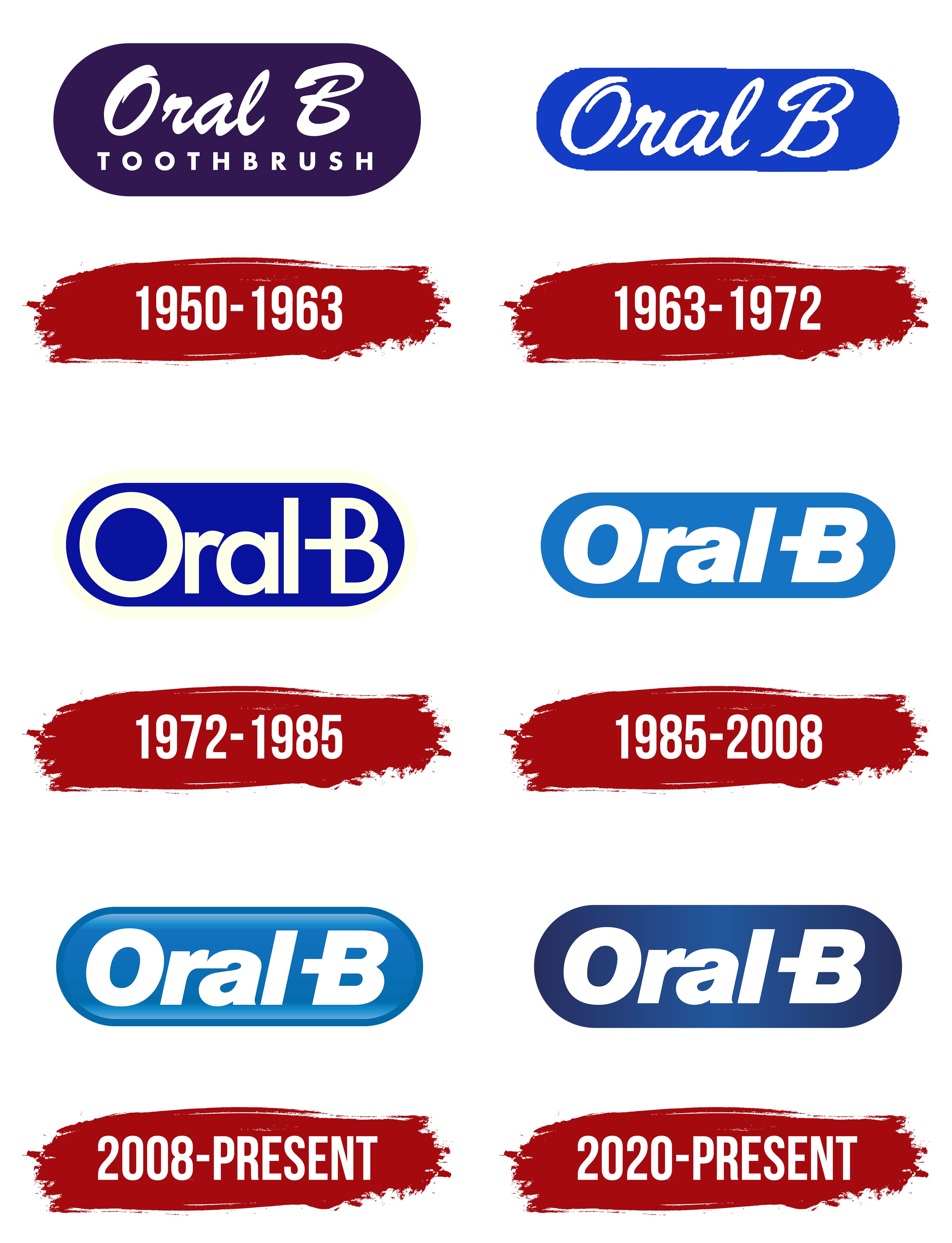
Dr. Robert W. Hutson, the inventor of a unique toothbrush, founded the company. He patented the unique product and created a brand named “Oral-B 60.” The number indicates the number of bristle tufts. The letter “B” stands for “brush.” Later, Dr. Hutson decided to continue his periodontal practice in San Jose, so he sold the business in 1960. Gillette acquired the company in 1984, and Procter & Gamble in 2006. Each new owner has left their mark on the logo’s evolution.
What is Oral-B?
Oral-B is an American brand that specializes in oral care products, including toothbrushes, dental floss, toothpaste, and mouthwash. Founded in 1950, it has since become a leading player in dental hygiene. In 2006, Procter & Gamble, one of the largest international consumer goods companies, acquired Oral-B. Oral-B is known for its innovations, product quality, and wide range of products, including both traditional and electric toothbrushes.
1950 – 1963
The Oral-B name preserves a connection to the brand’s first product, a toothbrush. It comes from “Oral Brush,” with “Oral” identifying the product’s purpose and “B” standing for “Brush.” The brand began with Robert Hutson’s dental practice in California. In 1949, he developed a brush with soft nylon bristles to reduce gum injury during brushing. The product range later expanded, but the Oral-B name remained.
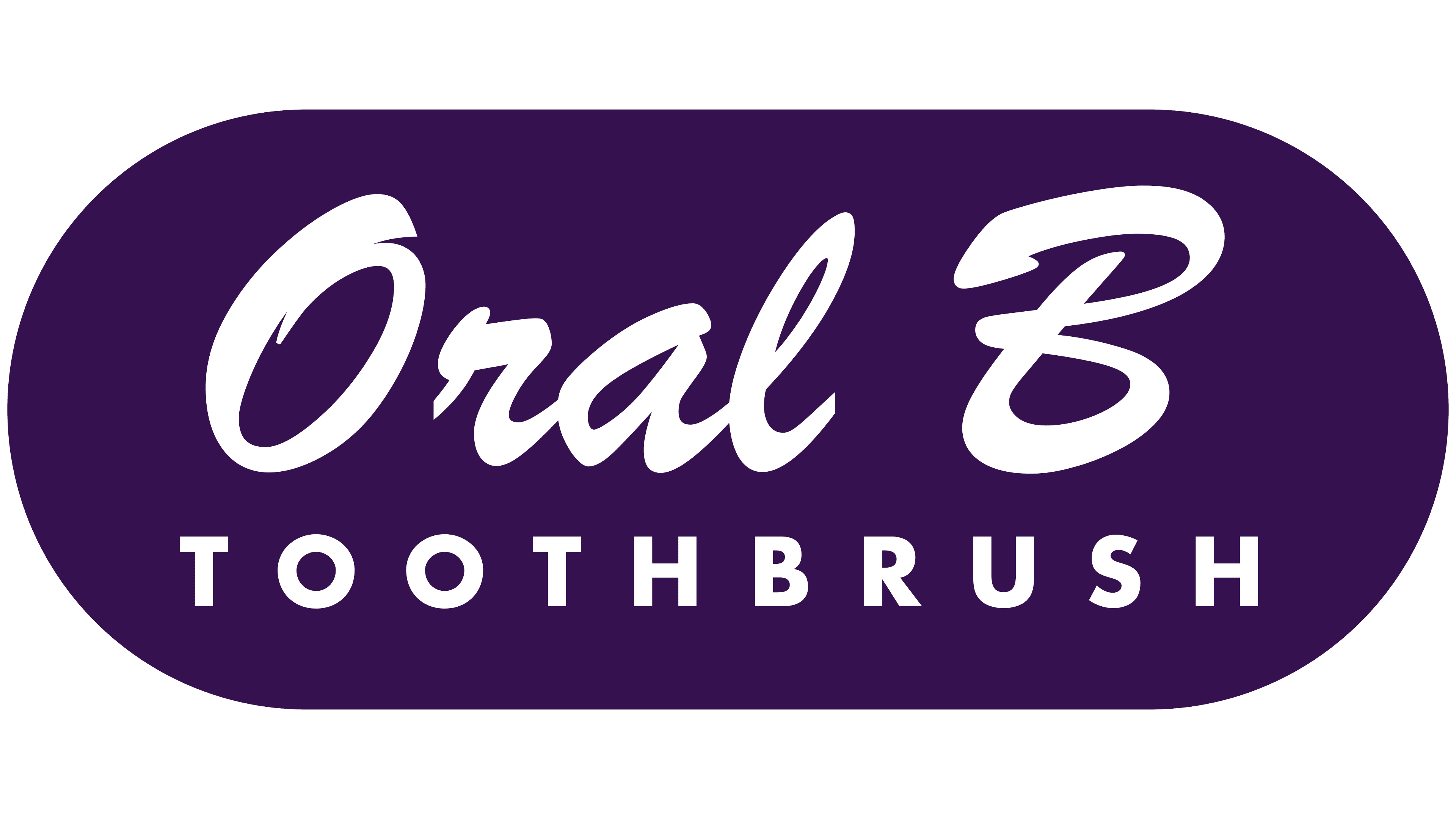
The first Oral-B logo appeared in 1950. It featured an elongated oval in dark blue-violet. White “Oral B” lettering used Brush Script MT, a handwriting-style typeface. Slanted letters, transitions between thin and thick strokes, rounded loops, and extended endings made the name look like a handwritten signature.
“TOOTHBRUSH” appeared beneath the brand name. The lower line used small, generously spaced Futura Bold capitals. These upright letters contrasted with the script above them. The two lines brought the brand name and product description together within a single oval.
1963 – 1972
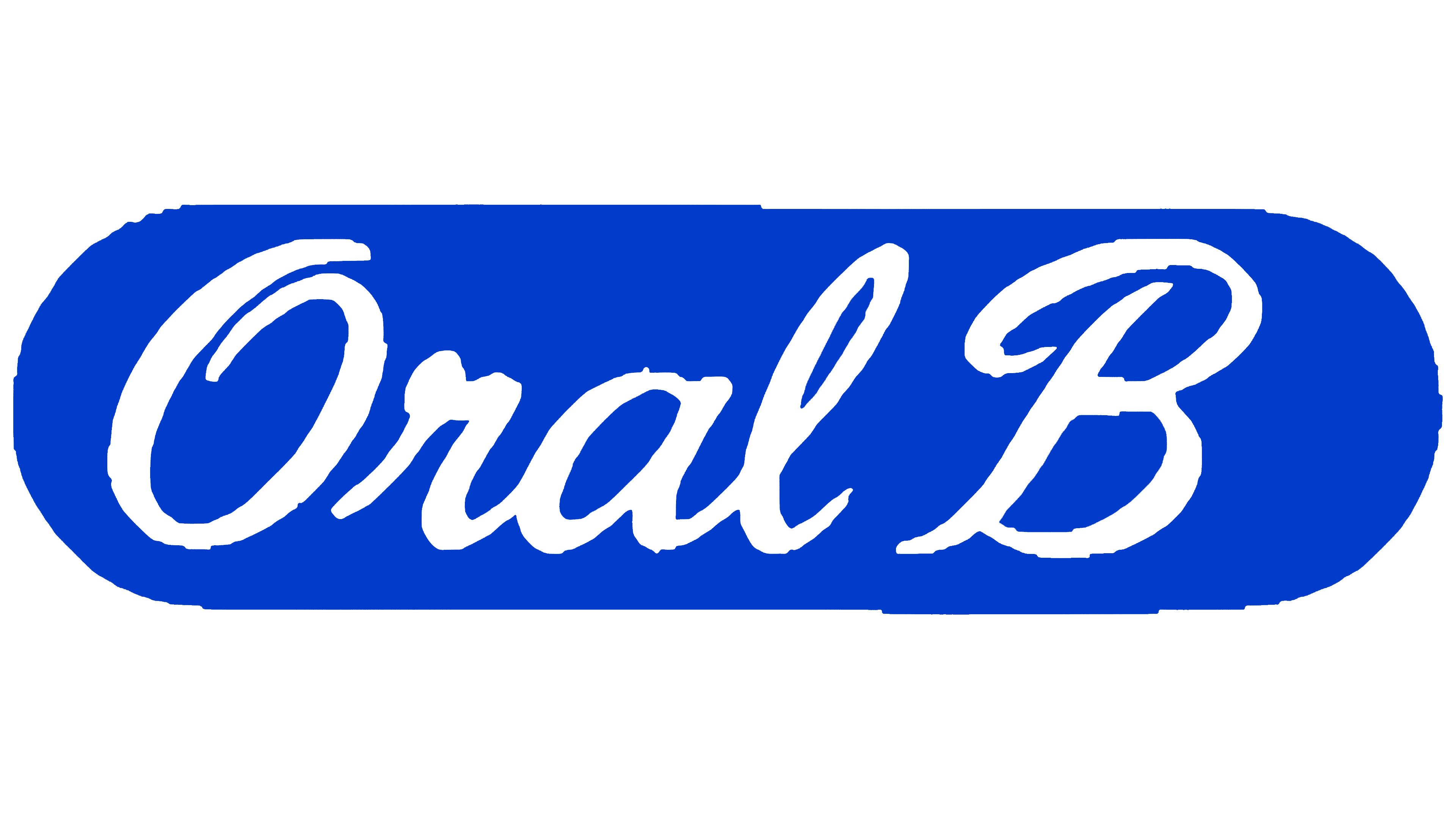
In the next Oral-B logo, the brand name became the only text. With “TOOTHBRUSH” removed, the white script filled nearly the entire height of the emblem. The background turned blue, and the shape became more horizontally elongated.
The name retained the rounded lines and handwritten style of the earlier version. The “O” outline and the upper loop of the “B” featured sweeping curves, with an open gap between “Oral” and “B.”
1972 – 1985
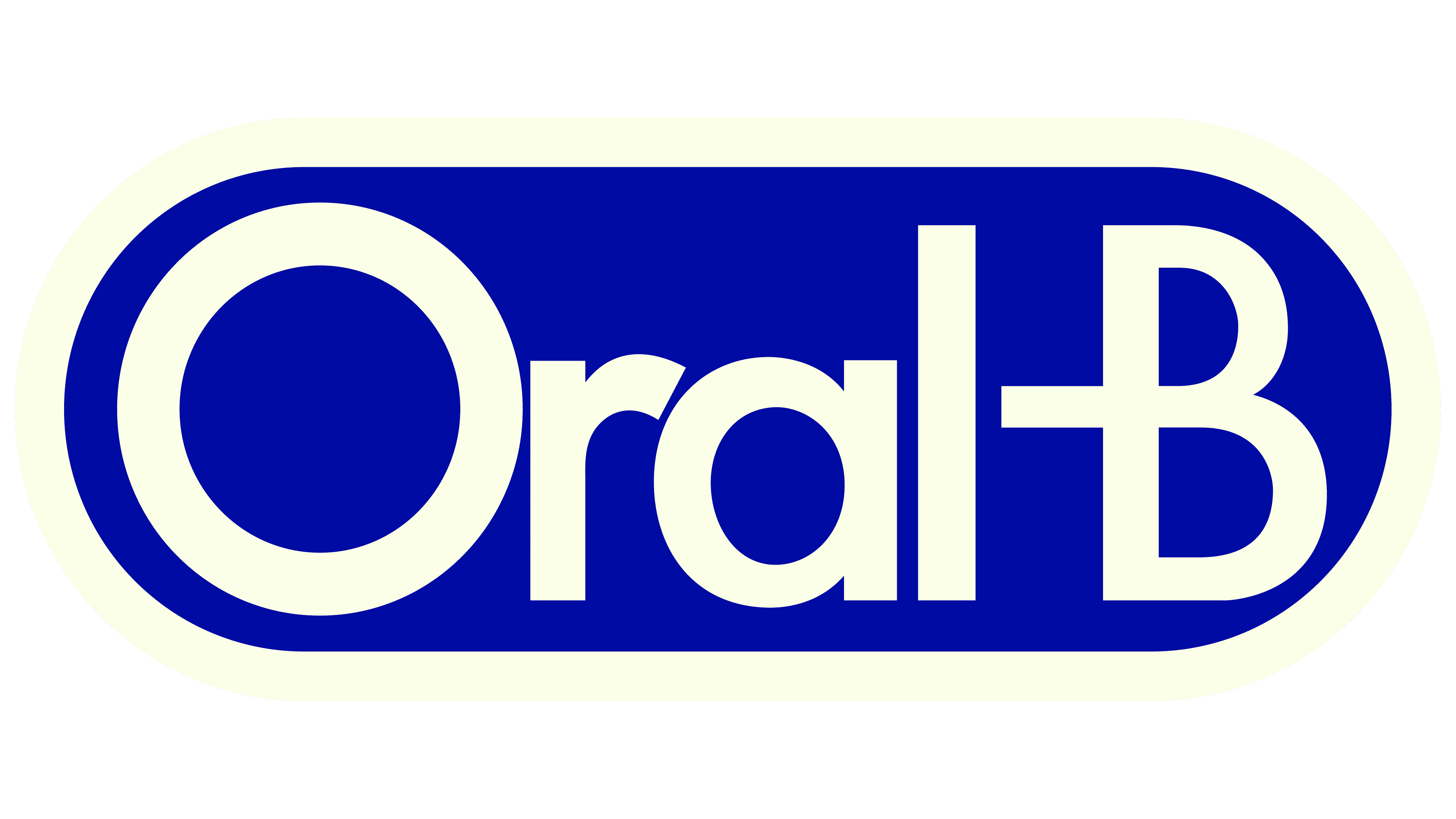
In 1972, a modified version of Futura replaced the script in the Oral-B logo. Circles and vertical lines replaced flourishes, and the strokes became uniformly thick. The sans-serif letters stood upright, with the name remaining on a single line.
A large circular “O” opened the wordmark, followed closely by the lowercase “r,” “a,” and “l.” A capital “B” completed the name, joined to “Oral” by a hyphen. A light border surrounded the dark blue field, following the emblem’s elongated outline.
1985 – 2008
In 1985, Oral-B adopted a bold, slanted lettering style based on a modified Helvetica Black Italic. The letters became heavier, while the “O” and “B” retained large interior spaces. The hyphen joined the middle of the “B” and projected leftward.
The white name appeared on a blue panel with straight horizontal edges and semicircular ends. The light outer border was removed. Landor Associates helped develop Oral-B Laboratories’ identity standards.
2008 – today
Oral-B’s move toward a premium look brought a dimensional version of the emblem. By 2010, it was part of the brand’s core identity system. The white lettering retained its bold, slanted style based on a modified Helvetica Black Italic. At the same time, the blue field took on a glossy, raised appearance.
Shifts in color and highlights along the upper and lower edges created depth. A dark outline separated the logo from the surrounding background. A flat, single-color version was provided for small-scale reproduction and printing with a limited number of inks.
2020 – today

The next Oral-B logo update changed the panel’s color and surface treatment while preserving the lettering. The raised rim, dark border, and bright highlights were removed in favor of a flat design with a smooth outer outline. The blue field became darker. A soft gradient remained inside, shifting from a light blue center to dark blue edges and creating a subtle glow in the middle. The modified Helvetica Black Italic lettering retained its proportions, slant, and the connection between the hyphen and the “B.”
The logo’s rounded forms carried over to packaging for Oral-B PRO electric toothbrushes. Poarangan Brand Design built the line’s packaging around a large circle that connected the round brush head to the “O” in the brand name. The circle guided the placement of images and text across packaging for different models. Diana Preyer and Siri Poarangan completed the project for Braun Design Studio and Procter & Gamble. Their task was to give the line a consistent appearance and help shoppers find the products on store shelves.
Font and Colors
The brand name has always been associated with the words “Oral B,” and it has been written in various styles. A blue horizontal oval serves as its background.
In the logo’s early version, the inscription was handwritten from 1965 to 1980, then set in a print font, and now appears as text with a slight right tilt. The central protrusion of the “B” is elongated and extends beyond the letter. The emblem uses several shades of white and blue.
The latest changes did not affect the font; the brand name is set in Neue Haas Grotesk Black Italic. The blue color transitioned from a light palette to a darker one with a gradient.