


 Pampers Logo PNG
The Pampers logo expresses itself. With it, the American company shows its commitment to caring for children through a bright heart, bubble lettering, and softened corners. The symbol of love is a yellow ribbon from which four rays emanate, as if the heart is glowing from within.
Pampers began inside Procter & Gamble in the mid-1950s. In 1956, chemical engineer Victor Mills visited his daughter’s family and faced the routine of changing and washing cloth diapers for his newborn grandson. He asked P&G’s research team in Ohio to develop a disposable diaper that could be made well and sold at a mass-market price.
At the time, disposable diapers accounted for less than 1% of diaper changes in the United States. Mills saw potential in clean absorbent paper from a cellulose plant, and that idea led to Pampers. Early tests took place in Dallas, and in 1959, 37,000 diapers were sewn by hand for a test market in Rochester, New York. The first machine-made version was tested in Peoria, Illinois, in 1961. The name “Pampers” came from Alfred Goldman of Benton & Bowles.
The first reaction was mixed because the diapers cost about 10 cents each, too high for daily use. P&G reduced costs by speeding up production. By the mid-1970s, Pampers held 75% of the U.S. market and was sold in about 75 countries. The brand added adhesive tapes, newborn and toddler sizes, and versions for premature babies.
In 1976, P&G launched a shaped diaper with elastic features under a separate brand, Luvs. In 1978, Kimberly-Clark answered with Huggies, which quickly took 30% of the U.S. market. In 1982, Pampers added elastic side gathers and refastenable tapes; in 1986, it introduced a thinner, gel-based diaper. By 1979, Pampers had become P&G’s first brand with $1 billion in annual sales. Victor Mills died on November 1, 1997, after also working on Ivory, Duncan Hines, and Pringles.
Meaning and History
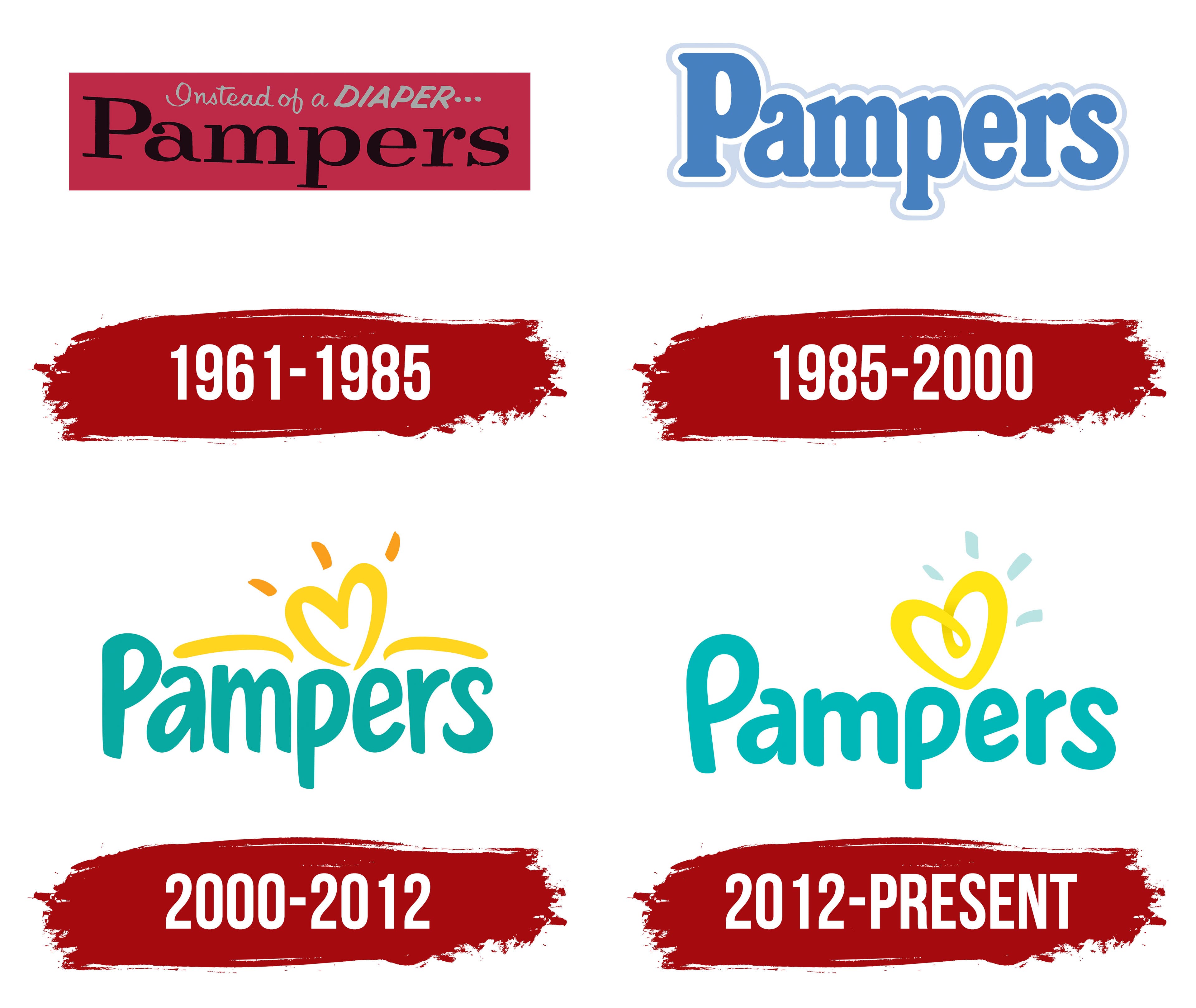
Alfred Goldman of the advertising agency Benton & Bowles created the original name. The logo has changed several times, but every version has always included the word “Pampers.” Designers used different colors and fonts until they settled on iconic turquoise letters with rounded corners.
What is Pampers?
Pampers is the manufacturer of the world’s first disposable diaper. It began mass-producing children’s underwear in 1961. In the same year, a brand was created that is still owned by the American corporation Procter & Gamble. Over time, wet wipes and other children’s hygiene products were added to their assortment.
1961 – 1985
The first logo conveyed the new product’s benefit by featuring the marketing phrase “Instead of a DIAPER” with three dots at the end. The slogan made it clear how profitable disposable diapers are. It was light gray and was in the top row. The first three words were written in cursive, while “DIAPER” was written in bold italics. The lower part of the logo was occupied by the brand name, set in black serif letters. The background could have been anything, but a version with a dark red rectangle has been preserved.
1985 – 2000
1985 marked a turning point in Pampers’ history, as the company began using a single-word logo. It was light blue and had a white background. The inscription was outlined with a gray stripe, set slightly apart. Narrow letter spacing, combined with vertically stretched bold type, made the brand name stand out. The large, rounded serifs added a distinctive character.
2000 – 2012
After the early-2000s redesign, the word lost its outline and serifs. A heart appeared above it, drawn as a single bright yellow line and flanked by two uneven horizontal stripes. Three short orange dashes sat on top, conveying light and movement. The Pampers name was set in custom turquoise bubble glyphs.
2012 – today
In 2012, the designers slightly lightened the inscription and smoothed the corners. At the same time, they made the letters seem to jump by changing their bottom lengths. In this version, the wordmark looks non-standard and inspires confidence because of its “childishness.” The heart is now lemon yellow and three-dimensional because the ribbon that forms it folds into a 3D loop. The transition of different shades creates the 3D effect. The two long stripes to the heart’s right and left have disappeared. Four short dashes sit on top; they are not orange but transparent blue.
Font and Colors
The Pampers symbol expresses tenderness and love towards children. This is suggested by the non-aggressive color scheme, the rounded edges of the letters, and the logo’s main graphic element, the heart. Moreover, the strips emanating from it simultaneously suggest light and energetic movement. In other words, the emblem has dynamics. Together, these elements also hint at the exceptional softness of diapers.
The creators of the Pampers logo developed a unique, custom inscription. It consists of bold letters of roughly equal thickness. The letters are asymmetrical and have rounded corners in the style of bubble fonts. All glyphs except for the first “P” are lowercase.

The colors are chosen so nothing feels dark or aggressive. The emblem uses gentle but bright shades of yellow and turquoise that, according to the authors’ idea, should inspire confidence, coziness, and psychological comfort.