


 Pantene Logo PNG
The shampoo logo is plain and unremarkable. It suggests a simple purpose, and it fits that purpose perfectly. The Pantene logo promises an additional effect- strengthening and conditioning- in addition to cleansing the hair.
In 1945, Swiss pharmaceutical company Hoffmann-La Roche introduced a new hair care line in Europe. The formula was based on panthenol, a provitamin B5 discovered during World War II research into ointment treatments. The ingredient strengthened hair structure and restored damaged areas. The brand name Pantene was derived from panthenol, and the product was sold in glass bottles as a premium, scientifically backed solution.
For the next two decades, Pantene remained largely a European product, distributed through pharmacies and specialty stores. In the 1960s, American travelers began bringing it to the United States, creating early demand. By 1973, the range expanded with the introduction of Pantene conditioner. In 1983, the brand moved into mass retail, shifting from salons and department stores to wider distribution.
In 1985, Richardson-Vicks acquired Pantene from Hoffmann-La Roche. That same year, amid Unilever’s takeover attempt, Procter & Gamble purchased Richardson-Vicks for $1.2 billion. Pantene joined a portfolio that included Oil of Olay, Vidal Sassoon, and Clearasil, marking P&G’s entry into the cosmetics market.
In 1988–1989, an advertising campaign featuring Kelly LeBrock and Iman gained wide attention with the line “Don’t hate me because I’m beautiful.” Around 1990, P&G introduced Pantene Pro-V in Taiwan, combining provitamin B5 with a 2-in-1 shampoo-and-conditioner formula. The product expanded globally soon after.
By 1994, Pantene was in 55 countries and had exceeded $1 billion in annual sales, becoming the leading hair care brand. By 1998, it held leading positions in 90 markets and competed with L’Oréal and Unilever. In 2010, collaboration with NASA contributed to further development of the formula.
Meaning and History

This brand has at least seven emblems. All of them are associated with the name “Pantene Pro-V,” which, in full, is written as “Pantene Pro-V,” where the last symbol denotes a shortened form of the word “Vitamin.” The brand debuted in 1947.
What is Pantene?
This Procter & Gamble brand applies scientific knowledge to hair care and holds a leading global position. The product range includes traditional shampoos, conditioners, intensive repair masks, and specialized treatments based on the renowned Pro-V complex, designed to meet various hair needs. The brand’s strength lies in its ability to offer targeted solutions for specific concerns such as frizz, dryness, damage, and color maintenance while remaining accessible to a broad audience.
1947 – 1986
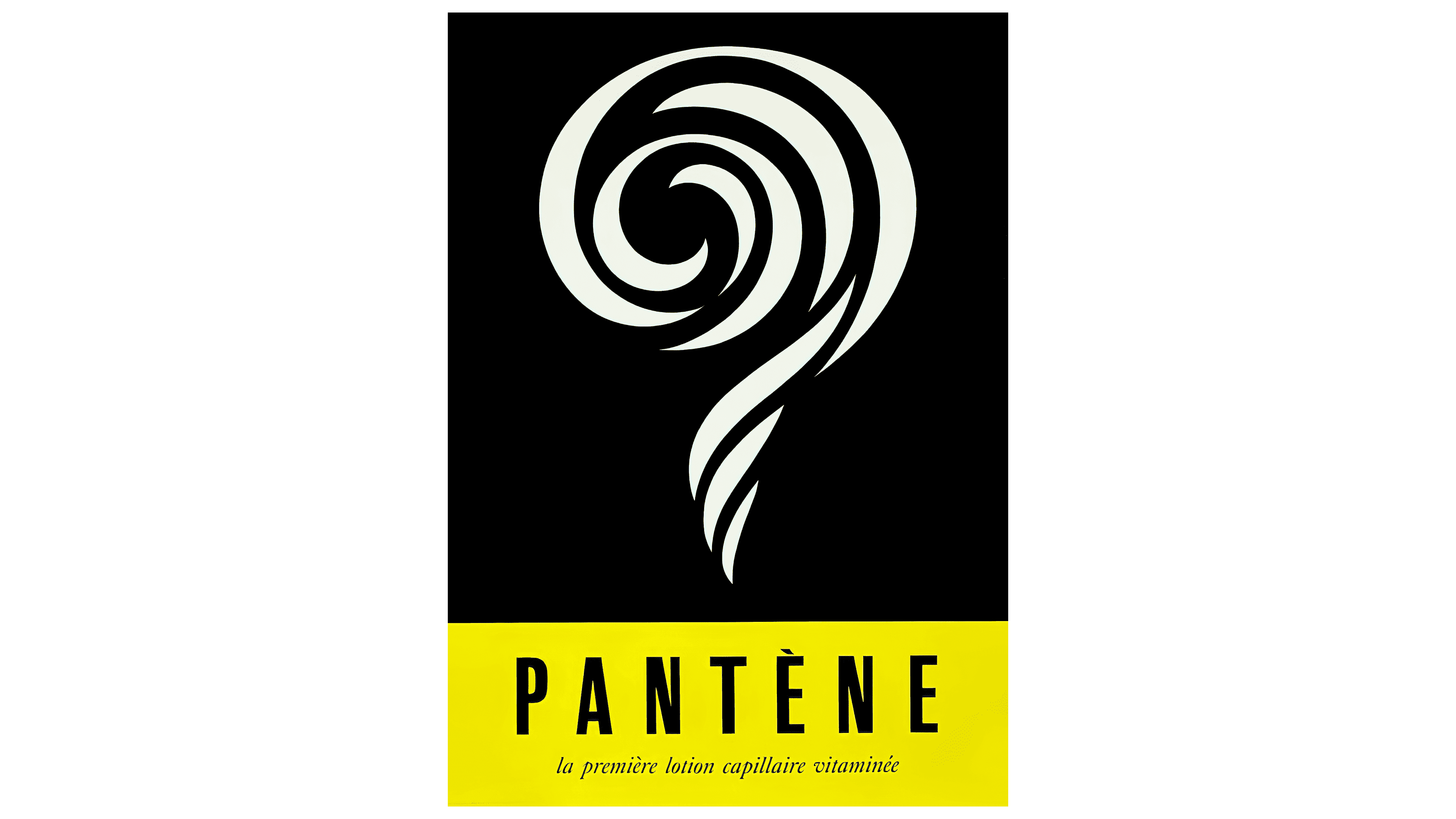
The large black rectangle shows a curl shaped like a question mark. At the bottom is a neon-yellow rectangle displaying the product name and slogan in French.
1986 – 1997

This is a simplified version of the logo with only text. The first part of the name is in large letters, the second in small letters, and both are located at the bottom right.
1997 – 2001

The designers brought back the lock of hair, styling it differently. To the right of the mark is the full name of the cosmetic line.
2001 – 2006

During this period, the company used an intricate emblem of intertwining letters. The letters are separated and placed in a black square, overlaid with a horizontal rectangle bearing the word “Pantene.”
2006 – 2010

The company’s management returned to the 1986 version, slightly changed the font, and added a curl consisting of three elongated stripes.
2010 – 2012

The name’s writing style and the curl color changed.
2012 – 2016

The letters became longer and more serifed.
2016 – today

The developers kept the old font for the name and removed the middle curl.
Font and Colors

All logo variants share a similar wordmark style and curl-based stylization.
The emblem uses several font types. One is Lillianesque Regular, a glyphic serif font designed by Keith Morris. The emblem also uses LP Lazise Semi Serif and LP Lazise Lapidary. The color palette includes gold, black, white, and chestnut.