


 Philips Logo PNG
With the redesign of the brand’s visual identity, the Philips logo has become more expressive and appealing. The logo’s text block emphasizes minimalism, and the name, which symbolizes confidence and stability, conveys quality and style.
Philips began on May 15, 1891, in Eindhoven, when Gerard Philips and his father, Frederik, started producing carbon-filament lamps. By 1893, early competition from German manufacturers had pushed the company to the brink of bankruptcy.
In 1895, Anton Philips joined and focused on sales, building export networks across Europe. By the early 1900s, Philips had become one of the largest employers in the Netherlands, expanding production and its workforce infrastructure.
In 1914, Gilles Holst created the NatLab research center, marking a shift toward scientific development. During World War I, the company expanded output and began producing argon. In 1918, it introduced an X-ray tube, thereby entering the field of medical technology.
In 1927, Philips released its first radio, marking a shift from components to finished products. In 1939, the Philishave electric shaver appeared. By then, the workforce reached 45,000. In 1940, North American Philips was established before wartime factory destruction.
After 1945, recovery was rapid. In 1963, Philips introduced the compact cassette, later setting a global standard. In 1972, PolyGram was founded, and in 1974, it acquired Magnavox.
In 1982, Philips and Sony launched the compact disc. Competition from Sony and Panasonic weakened its position, leading to losses by 1990 and restructuring under Jan Timmer.
In 2006, NXP was spun off. In 2013, the company became Royal Philips. In 2016, the lighting division became Signify, and the company shifted its focus to healthcare technologies.
Meaning and History
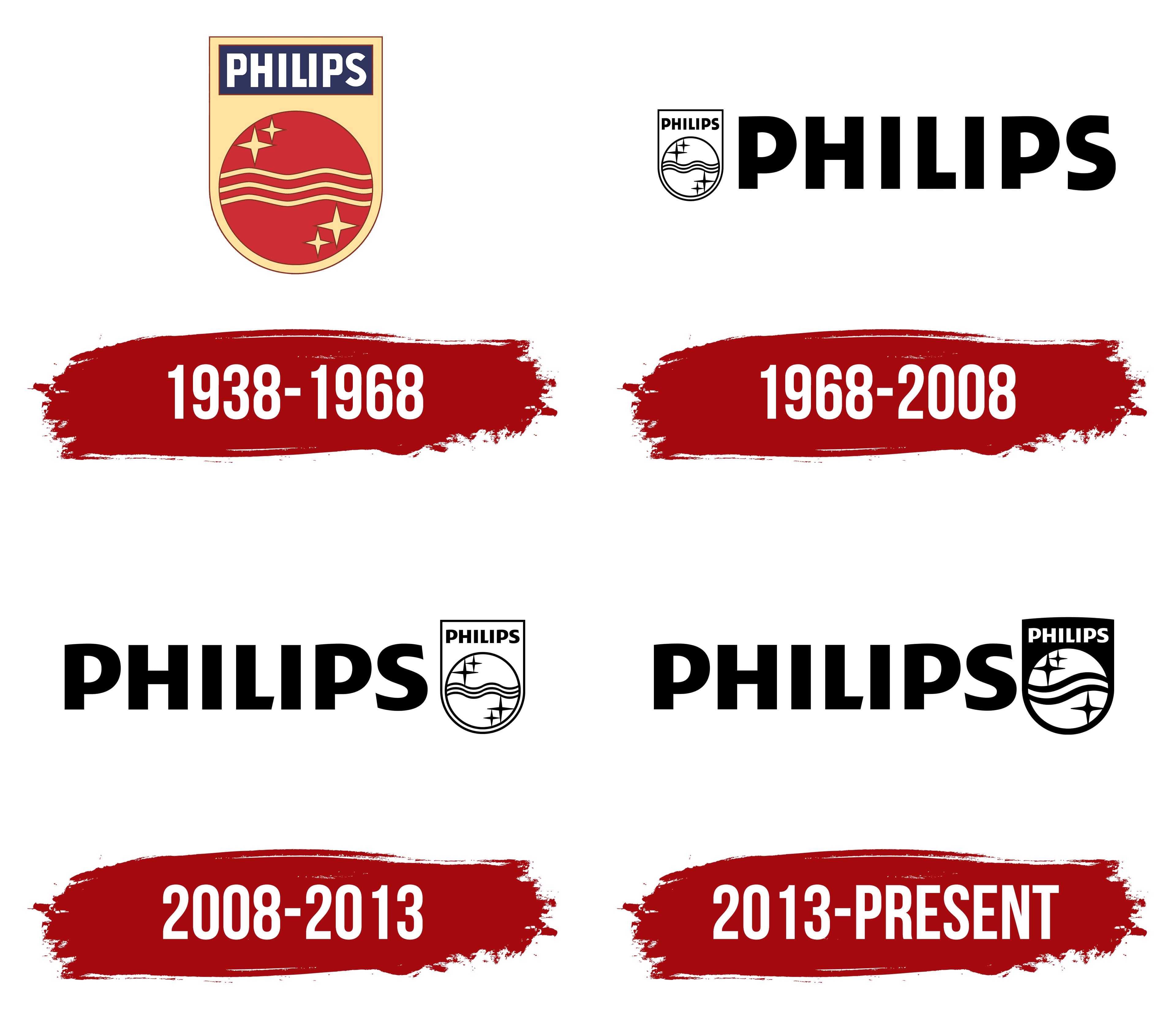
Philips was founded in 1891, but its first known logo dates back to 1938. It is based on an earlier version introduced around 1925. Johan and Kalf van der Ley designed it. Johan decorated the emblem with shiny four-pointed stars, which he associated with electric light, and Kalf added wavy lines – sound waves moving through the air.
What is Philips?
Philips is the shortened name of the Dutch company Koninklijke Philips N.V., founded in 1891 by Gerard and Frederik Philips to produce electric light bulbs. Today, it is a major international conglomerate manufacturing electrical equipment. The company prioritizes producing modern medical devices and related goods. The company’s headquarters are in Amsterdam, the Netherlands.
1938 – 1968
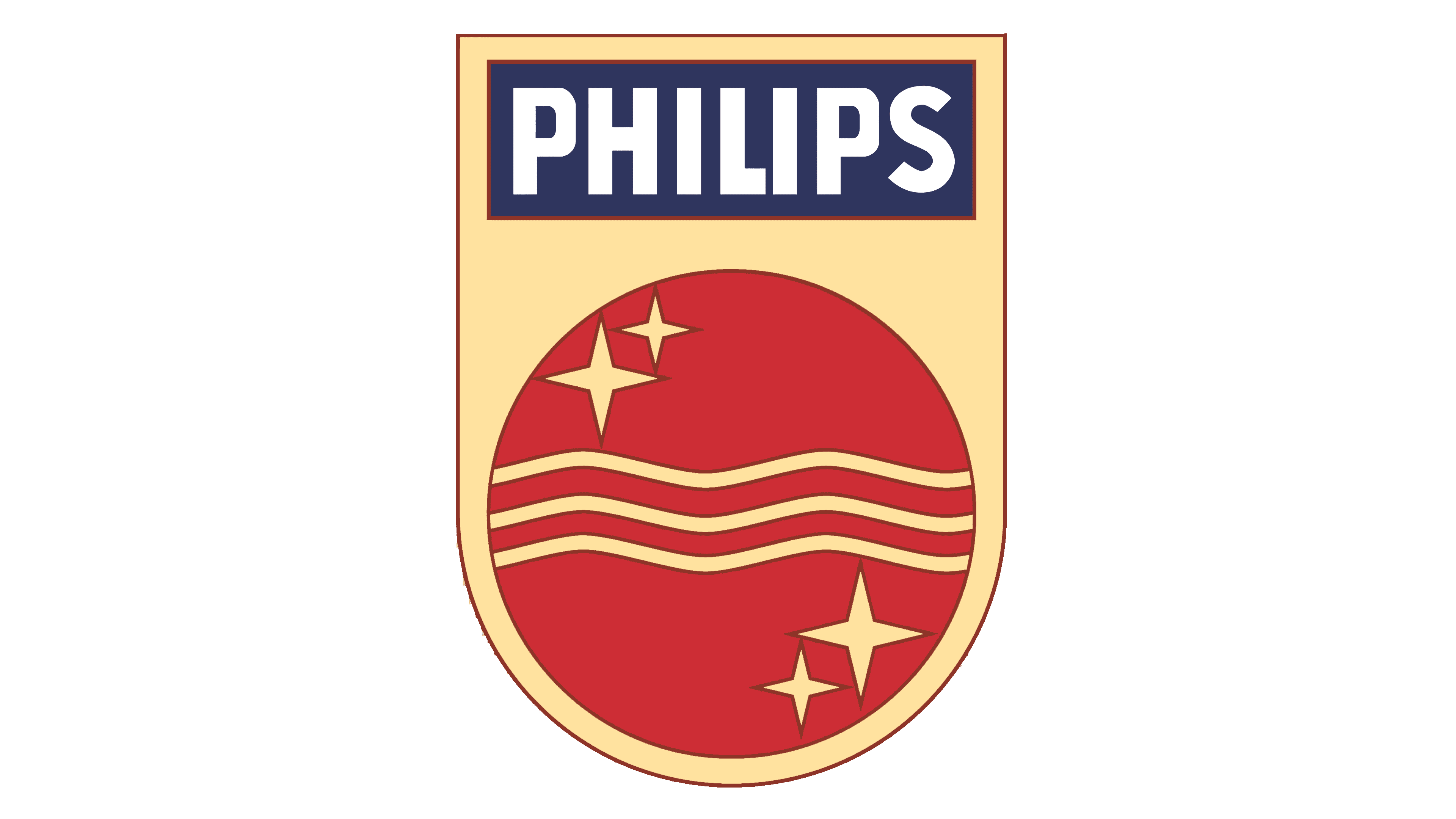
One of the old Philips logos has an unusual shape: a vertical rectangle (at the top) smoothly transitions into a circle (at the bottom), forming a golden rectangle. Against this background, other elements are depicted: a blue horizontal rectangle inscribed with “PHILIPS” and a red circle with three wavy lines and four stars.
1968 – 2013


Without hesitation, the emblem creators removed all details, leaving only the blue word “PHILIPS.” In 2008, the graphic part of the logo moved to the right.
2013 – today
The 2008 redesign turned out to be less global. The developers slightly adjusted the font, making the vertical ends of the “L” and “S” more pronounced. The graphic symbol was inverted. Black areas became white and white areas became black. As a result, the emblem became more expressive and attractive.
Font and Colors

Against the backdrop of Philips’ many old, colorful logos, the modern version looks strict and democratic. There is nothing superfluous in it – only the company name, designed in the spirit of minimalism.

To write “PHILIPS,” designers used a sans-serif font. The latest version differs from the previous one in the trimmed edges of “S” and “L.” Since 1968, the color palette has not changed: the blue-and-white combination has long been integral to the corporate style.