


 Radiohead Logo PNG
The Radiohead logo is open and confident. The emblem represents a band that isn’t afraid to experiment and has explored many genres and sounds throughout its career, excelling in every direction.
Radiohead began in 1985 at Abingdon School in Oxfordshire, where five students rehearsed on Fridays under the name On a Friday. The lineup included Thom Yorke, Colin Greenwood, Ed O’Brien, Phil Selway, and Jonny Greenwood. After returning to Oxford following university studies, the group reformed and continued working with the same members. This configuration remained unchanged over the decades.
In 1991, they signed a six-album deal with EMI Records after being introduced to manager Chris Hufford. The band adopted the name Radiohead, taken from a Talking Heads song. The debut EP “Drill” (1992) was followed by the album “Pablo Honey”, recorded with producers Sean Slade and Paul Q. Kolderie. The single “Creep” became an unexpected international hit after initial rejection from UK radio and criticism from the music press.
The second album, “The Bends” (1995), expanded the band’s musical direction beyond early grunge comparisons. In 1997, “OK Computer” was recorded in locations including a 16th-century manor in Bath and addressed themes of technological and social change. The album reached number one in the UK and top positions in the US, receiving a Grammy Award for Best Alternative Album.
In 2000, “Kid A” marked a shift toward electronic and experimental production, dividing critical reception but topping charts in multiple countries. After leaving EMI, Radiohead released “In Rainbows” (2007) independently via a pay-what-you-want model on the Internet, followed by a physical release through traditional retail channels. The album reached number one in the UK and won Grammy Awards for Best Alternative Album and Best Packaging Design.
Meaning and History
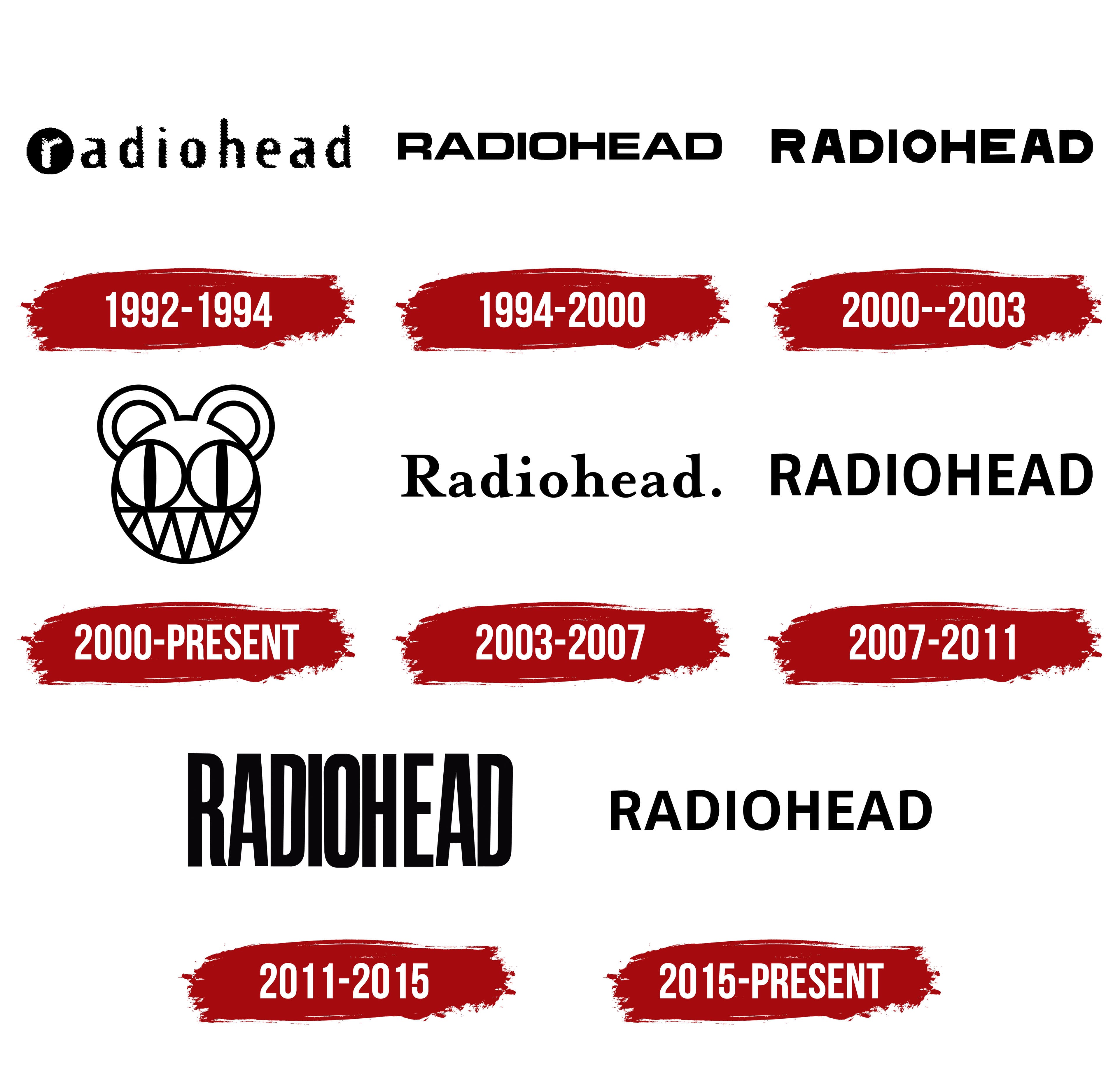
In choosing a brand identity designer, the band showcases unprecedented consistency. Every emblem for the band since 1994 was crafted by the British designer and artist Stanley Donwood (Dan Rickwood). Stanley managed to rightly capture the band’s creative spirit and convey it on paper. This is likely due to the friendship between the maestro and the frontman, Thom Yorke, that began at university. The designer typically plays with the band’s name, but that doesn’t rule out a drastic shift from the original concept, as in 2000, when the band decided to change their musical style.
What is Radiohead?
A musical ensemble that began performing in 1985 as a private school band in Abingdon-on-Thames and gradually became a band whose albums rank 20th on the 500 Greatest Albums of All Time list and top the Billboard 200 and UK Albums Chart. It shifted from rock music to electronic throughout its career, achieving remarkable success in both.
1992 – 1994

The first emblem was born alongside the album Pablo Honey. It depicts the band’s name in lowercase, with the first letter encased in a black circle, and its color changed to white. The symbol signifies a desire for leadership and hints at discs and records constantly playing on the radio.
The band’s name was taken from a song by the musician’s favorite band, Talking Heads. It refers to a form of autism where an individual continually makes monotonous noises resembling staccato singing. Fans perceived the band’s work in this light, noting that most songs are melancholic and sung with the vocalist’s elongated voice modulations.
The band’s name also resonates with Thom Yorke’s Asperger’s syndrome.
Interestingly, the band conceived and performed all the songs on the album when they were named On a Friday. The musicians changed the name of their studio album.
1994 – 2000

The logo for the EP My Iron Lung was so successful that it remained with the band for four years. The emblem appeared on two studio albums (The Bends and OK Computer) and their associated performances.
Square letters with streamlined corners were designed by Dan Rickwood, who accepted the job because of his acquaintance with the vocalist and initially didn’t appreciate the band’s artistry. The broad symbols convey the band’s experimentation with musical genres, begun with The Bends and continued with OK Computer.
Uniform, slender letters emphasized the musicians’ equal contributions to songwriting and arrangement, especially since OK Computer didn’t have a producer.
The harmonious logo seemed to foreshadow the birth of the music that the frontman considered the best in the group’s history. The song “Exit Music (For a Film)” wasn’t included on the albums, but influenced the direction of subsequent creativity.
2000 – 2003

A strict emblem featuring straight, elongated, massive letters was used for the band’s 4th and 5th albums and for their 2021 reissue. Kid A (2000) and Amnesiac (2001) resulted from the lead singer’s deep fascination with electronic sound.
In albums recorded almost simultaneously, there’s a reevaluation of essential laws of existence: birth, death, reincarnation. Strict “correct” symbols point to the immutable laws of the universe. They emphasize the precise machine processing of the instruments’ sound and the vocalist’s voice. Even the album’s title, Kid A, is named after a device the band worked with.
2000 – today
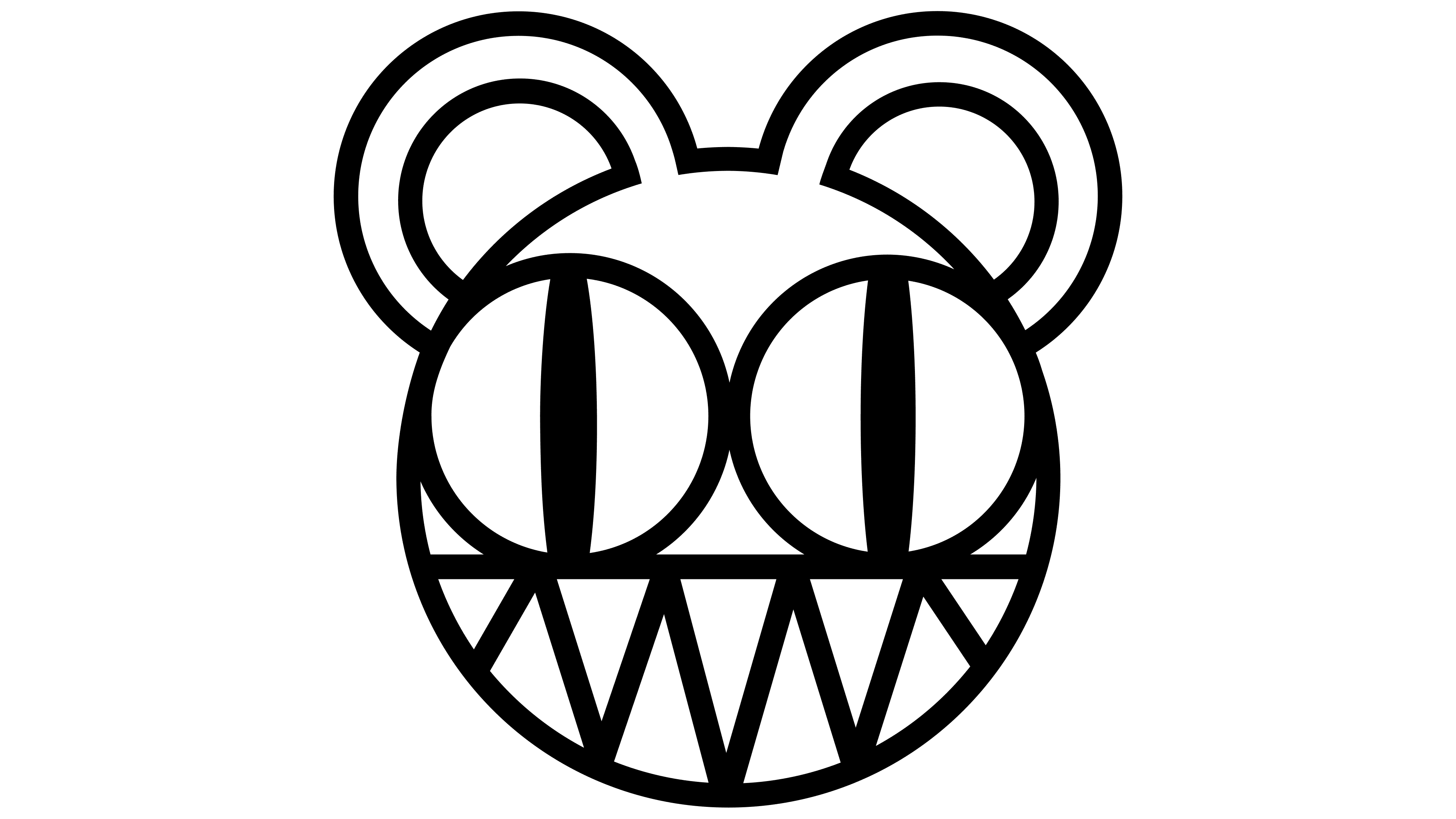
The transformed face of a bear, stylized in an anime- and Tokyo-esque style, became the face of the advertising campaign for the fourth album, Kid A. The vocalist, Thom Yorke, collaborated with the regular designer on the image.
The robot bear conveys electronic processing for the songs on the album. The animal’s slightly ferocious look intertwines with the main ideas that inspired the album cover’s designers: catastrophes, the war in Kosovo, and pools of blood from victims of terrorism.
2003 – 2007
The printed computer font in the Hail to the Thief album logo conveys the atmosphere of a live recording. Quick and confident performance without re-recordings reduced the album’s production time to 2 weeks.
The font used for internet printing emphasized a prevalent media theme, the fight against terrorism. The disc, like a message from the band, contributes to the broader discussion. And the period after the inscription underlines the finality of the position.
2007 – 2011

The album In Rainbows featured a very simple logo that conveyed its accessibility. The collection was released digitally without a label and was made available for download at a price set by the buyer. This was the first release after the contract with EMI ended.
The sign indicates that the album was recorded sporadically, so the work stretched over two years. The simplicity of the inscriptions also speaks to the artists’ daily lives, since the collection contains many personal songs.
2011 – 2015
The King of Limbs received a majestic, slender, and “tall” logo, befitting a king. The design and title are associated with ancient oaks, tall and strong. Hence the massive letters. The album emphasizes an unusual rhythm, which, according to the musicians, is the “king” of the work.
2015 – today
The emblem of the album A Moon Shaped Pool, in its font, resonates with In Rainbows and speaks of simplicity in its own way. The symbol emphasizes the predominance of live instruments and orchestral arrangements. Songs were recorded on a simple, outdated magnetic tape, which limited options for working on them (for instance, you couldn’t re-record individual parts; you had to erase the recording and start anew). The themes of the tracks were also simple and as old as time: love, forgiveness, and regret over the past.
Font and Colors
The black color of the logos aptly matched the cover designs’ diverse color schemes, which predominantly featured red, white, and yellow. The shade features strong guitar parts and slightly melancholic lyrics, evoking emo themes.
The font resembles Molde Semibold, in which bold uppercase letters are paired with the lightness provided by increased spacing between them.