


 Reliance Logo PNG
The Reliance logo indicates signal strength. A telecommunications operator broadcasts over short and long distances. It is ready to enter into contracts with individuals and companies. The emblem signals reliability and a serious business approach.
Reliance traces back to Dhirubhai Ambani, born in 1932 in Gujarat. He worked in Aden as a clerk, learned trade flows, and returned to India in 1958. In 1960, he set up Reliance Commercial Corporation in Mumbai, dealing in spices and polymers. A textile plant followed in 1966, targeting synthetic fabrics.
In 1977, Reliance Industries went public on the Bombay Stock Exchange, attracting many retail investors. By the 1980s, it led India’s synthetic textile market. It expanded into petrochemicals in 1985, undertook refining projects in the 1990s, and launched the Jamnagar refinery in 1999 with a capacity of 27 million tonnes per year.
After Ambani died in 2002, his sons Mukesh Ambani and Anil Ambani split the group in 2005. Mukesh kept core oil and petrochemicals, along with a new telecom venture. Anil took power, finance, entertainment, and Reliance Communications.
Reliance Communications later struggled as Bharti Airtel and Vodafone India cut prices. The launch of Jio in 2016 with free tariffs intensified the pressure. By 2019, Reliance Communications had entered bankruptcy due to heavy debt.
Mukesh’s Reliance Industries expanded gas production after the KG-D6 discovery in 2002, with output starting in 2009. Reliance Retail, launched in 2006, grew into the country’s largest retailer, competing with Tata Group formats like Tata Croma.
In 2020, Reliance sold stakes in Jio Platforms to Facebook and Google, raising over $ 20 billion to reduce debt. By 2023, Reliance Industries had the highest market capitalization in Asia, ahead of Samsung Electronics.
Meaning and History
In 2006, the company was renamed Reliance Communications Limited; in 2008, it switched to the GSM standard. A little later (in 2010), it was licensed to use 3G communications in three cities nationwide. And a year later, to improve these services, the organization introduced MIMO technology. The operator continually strove to improve and did everything possible to do so, improving its image.
In spring 2012, to attract more subscribers, it reduced the tariff rate by 61 percent. In 2016, the operator stopped using CDMA and, by September of that year, transferred clients to GSM and LTE. He also has smartphones in his arsenal, produced by Reliance in conjunction with Lenovo.
Despite filing for bankruptcy, this company has not closed its telecommunications business; instead, it continues to provide services on 4G networks. In 2020, it revised its working strategy and undertook a major rebranding.
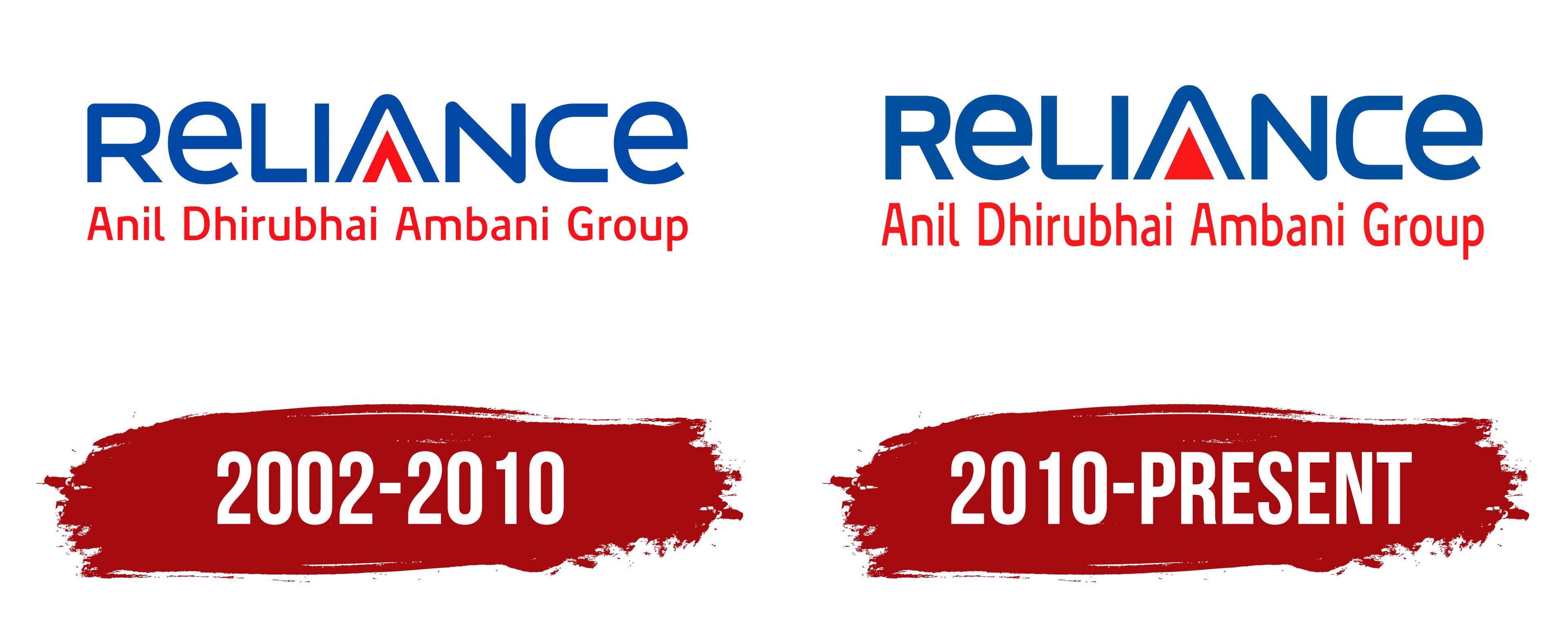
The service is now called the Global Cloud Xchange. It continues to provide data transmission and fixed-line services. It also specializes in submarine cable networks. After a difficult journey, the operator managed to preserve its identity and stay true to the chosen symbolism. Throughout his career at Reliance, he has had two emblems.
What is Reliance?
Reliance (full name: Reliance Industries Limited) is an Indian conglomerate and the country’s most profitable organization. It owns enterprises in various sectors, including electricity, gas, telecommunications, petrochemicals, textiles, and trade. The headquarters is located in Mumbai. Thecompanyr wasfounded by Dhirubhai Ambani. It was established in 1958.
2002 – 2010
The logo consisted of the company name. It occupied the entire area, shaped as a horizontal rectangle. The letters are smooth, squat, and slightly wide. The emphasis was on “A,” which looked like an open triangle within a triangle. The first is large and blue; the second is miniature and deep red. It was an alternative to the standard “A” crossbar, so it paired well with the word “Reliance,” turning it into a personalized emblem.
The final “CE” also stood out: the letters were written in different styles and cases. “C” rough, with straight elements without classic bends; “E” lowercase, soft, with rounding.
2010 – today
The main change was in the font: in this version of the logo, the signs are elongated and narrower than before. The central “A” remains the key element. Instead of the line, it uses a solid red triangle, and the letter itself is slightly taller than before.
Font and colors
All Reliance brand logos are text-dominated: it is the basic element of the company’s identity. Moreover, “A” is presented as a relay tower, clearly seen in the first logo.
How many emblems, so many fonts. That is, the telecommunications operator had two types of typefaces. Both are smooth sans serifs from the Sans Serif category. Here is where they differ: in the first case, the signs are wide and angular; in the second, they’re tall and sloping, except for the triangle. The color scheme consists of a saturated blue-and-red spectrum. The background is white.