


 S. C. Johnson Logo PNG
The household chemicals manufacturer has reflected the idea of creating a clean and healthy environment in its identity. Although the S.C. Johnson logo does not feature overt imagery, it symbolizes the power and energy required to combat pollution. The logo is also associated with reliability, support, and mutual aid.
S. C. Johnson began in 1886 in Racine, Wisconsin, when Samuel Curtis Johnson bought the parquet flooring division of Racine Hardware Manufacturing for $2,100. He had worked there as a flooring salesman since 1882 and knew customers needed care products for wood floors. The new firm had four employees and earned less than $300 in its first year.
In 1888, Johnson created Johnson’s Prepared Wax and advertised it in the Saturday Evening Post. The wax soon outsold flooring, and by 1898, floor-care products had overtaken the original parquet business. In 1892, Herbert Fisk Johnson Sr. joined his father, and in 1906, when he became a partner, the company was renamed S. C. Johnson & Son.
The company opened its first foreign unit in the United Kingdom in 1914. In 1917, Herbert paid employees a $35,000 bonus after a strong year. In 1939, Herbert Fisk Johnson Jr. commissioned Frank Lloyd Wright to design the Administration Building in Racine; the Research Tower followed in 1950. During the Great Depression, the company avoided layoffs.
In 1956, Samuel Curtis Johnson Jr. launched Raid House & Garden Bug Killer after testing more than 70 formulas. That year also brought Glade air fresheners. OFF! followed in 1957, and the Pledge in 1958. In 1993, SC Johnson bought Drackett from Bristol-Myers Squibb for $1.15 billion, adding Windex, Drano, and Vanish. DowBrands followed in 1998 with Ziploc, Saran, Scrubbing Bubbles, and Fantastik. Later deals added Bayer’s Baygon and Autan in 2003 and Sara Lee’s Kiwi in 2011.
Meaning and History
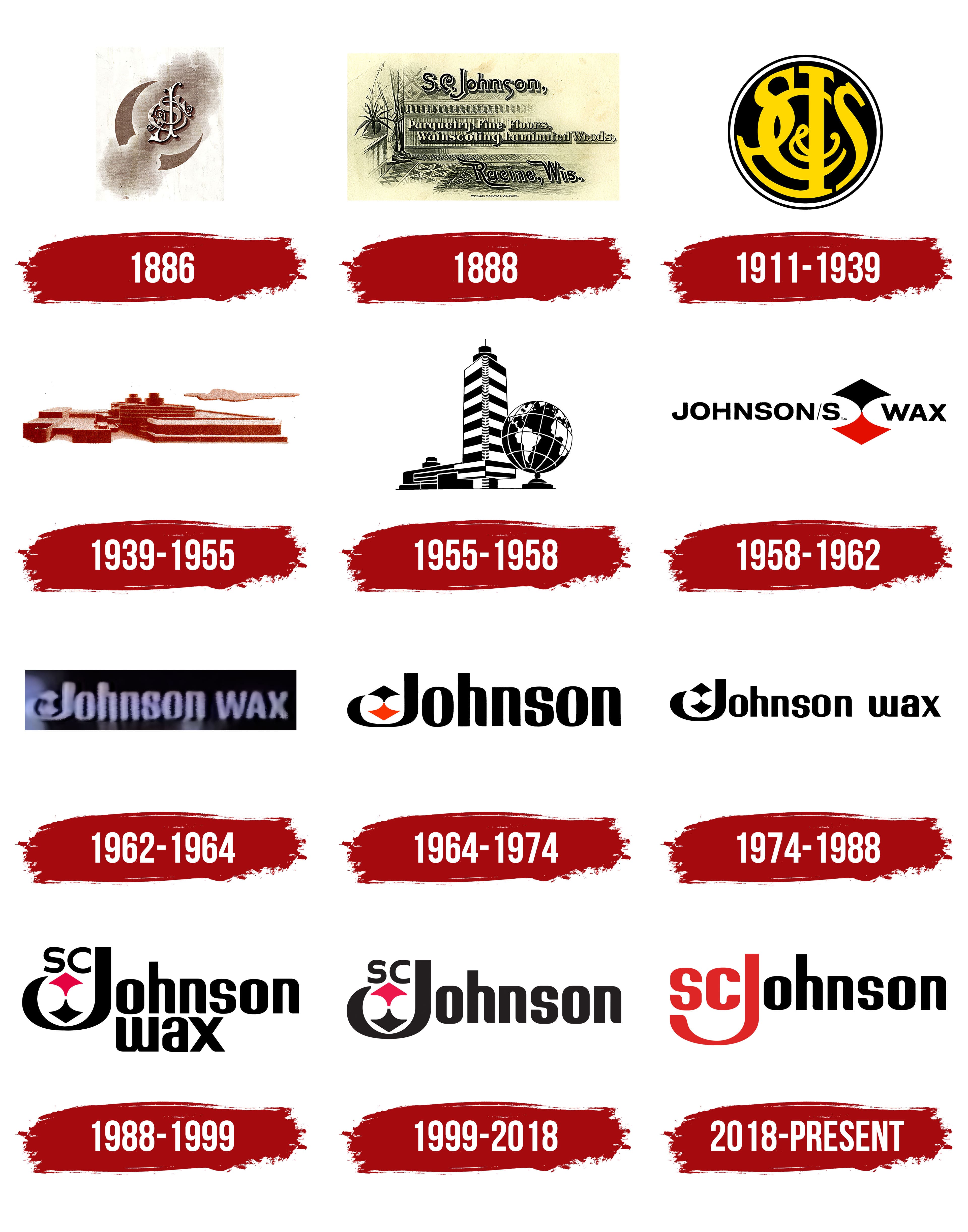
S.C. Johnson’s logos embody the history of one of the oldest American companies. The company took its name from Samuel Curtis Johnson, a businessman who first sold floor coverings and then products for cleaning parquet. His initials were intertwined in a bizarre monogram and long used as an emblem. It happened in the 1880s.
Five generations of the same family ran the company. They were in control of everything, right down to the visual identity, so for a century and a half, the S.C. Johnson logo evolved with the brand. It reflected the household chemicals manufacturer’s famous headquarters, its desire for international expansion, and a creative approach to design. In 1964, Lippincott & Margulies created a black wordmark that gave rise to a whole group of similar inscribed emblems.
What is S. C. Johnson?
A large American corporation is offering chemicals for home and personal care products. Since its founding in 1886, it has been owned by the Johnson family.
1886 – 1888

An interesting idea was chosen for the first logo: the owner’s initials floating in the sky. They seem to float in the embrace of the month on a cloud above any hardship and adversity.
The ornate monogram letters are stacked on top of each other. Have curly tendrils intertwined. Such intertwining shows a person perfectly harmonious with himself, his family, relatives, and loved ones. Johnson relies on the strength, knowledge, and upbringing his family gave him to build his company. He does not seek help from the outside. And it paid off: in four years, he bought the parquet company he worked for. And then, after 1886, he invented a way to care for it.
His thorough approach and strength of character are expressed in the logo, as the monogram of the name appears forged from iron. It is sturdy and strong.
The initials move upward, higher and higher, as seen in the flow of the air masses. The choice of the Monthly as the basis of the image shows not the way to the Sun to burn, but the way to the stars to dream, to take one’s place among the prosperous and wealthy.
1888 – 1911
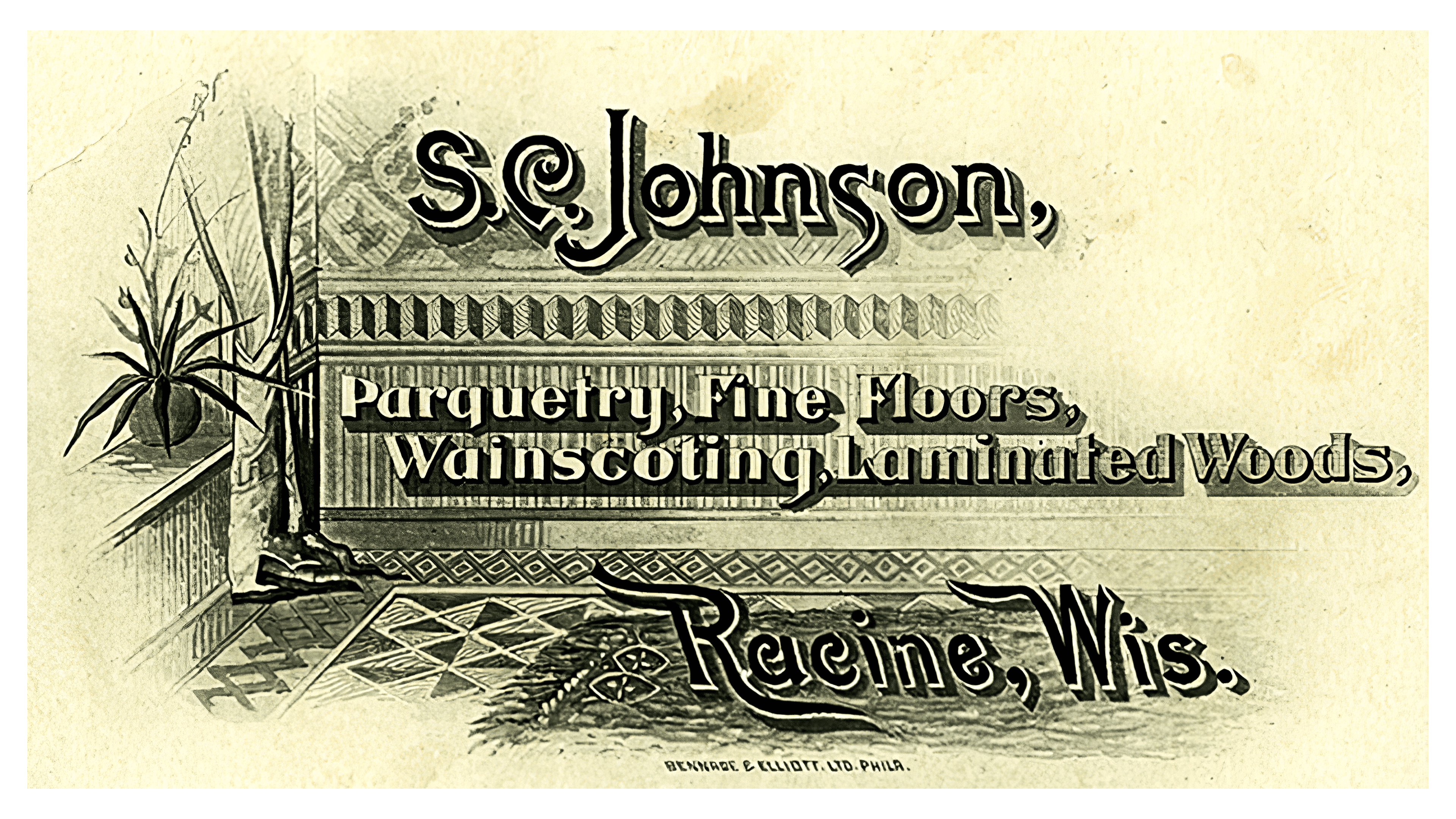
Samuel introduced Johnson’s Prepared Wax, expanding the range of home wood products. Johnson designed a new logo to boost profits, which barely exceeded $300 in the first year.
It is in the style of a business card or modern banner. The updated sign favors visibility. It’s an image of a part of an apartment that uses Johnson products in its interior. The designer tried to convey the coziness of a paneled, parquet-floored room to give customers a sense of what it might look like. At the top of the image is a list of all the firm’s offerings. A thick, shadowy backing highlights the inscription. It lifts the text above the picture, making the logo look three-dimensional.
The added details, including the interior and the list of products, helped us understand what the firm does, as the name S. C. Johnson didn’t tell us much.
At the top and bottom of the logo, the company name and location (Racine, Wisconsin) were added in black, larger lettering.
1911 – 1939

In 1892, the founder’s eldest son, Herbert Fisk, joined the business. Their joint effort significantly expanded the product range, and the company was renamed S.C. Johnson & Son (1906). The logo was also updated to match the new name.
The too-long name returned the owners to the idea of a monogram. The basis was chosen for a round coin with a black background and white edging. It symbolizes the company’s profitability. Inside are intertwined yellow capital letters from S.C. Johnson & Son: S, C, J, & S. The yellow evokes gold, further reinforcing the impression of the company’s wealth and importance.
The logo demonstrates family values. It has no emphasis on products. It doesn’t matter what exactly Johnson and his sons do. It will always be a team effort and a great result. The logo reeks of reliability and consistency.
1939 – 1955

In 1928, the founder’s grandson, another Herbert Fisk, was already at the helm of the family business. He was in no hurry to change the visual identity. Before that, he had time to register the company as a corporation because it had more than 4 subsidiaries and to develop the hit floor-care product Glo-Coat. The new logo was introduced in time for the completion of the modern headquarters.
It is the new office that is depicted on the emblem. Added to the image is a cloud floating by, which makes it clear how tall the complex is – it’s higher than the clouds. Over the years, the Johnsons have built a veritable empire. It is this greatness and prosperity that the emblem reflects.
1955 – 1958

From this period, the company switched to insect repellents and air fresheners, leading to the popular Raid, Off!, and Glade. The visual sign emphasizes the research laboratory where new products are created. This 14-story tower was built in the early ’60s and later even became a historical landmark. The logo conveyed the firm’s serious approach to product development, with a focus on safety and effectiveness, thereby increasing customer confidence.
The logo also demonstrated the corporation’s scale. The image of the globe emphasized world expansion.
1958 – 1962

By 1958, the company was planning a global expansion. Over the next ten years, representative offices were opened in 18 countries on all continents except Australia. The great-grandson of the founder, also named Samuel Curtis Johnson, became chairman. The company name was again fully in line with the owner’s initials: S.C. Johnson Wax.
The brand’s visual identity is also renewed. It includes a wordmark and an emblem separating the words “Johnson” and “Wax”. The image looks like a red-and-black rhombus with notches on the right and left, which is where the name fits. Therefore, only the arrows pointing up and down, connected by a thin bridge, are visible in the figure. They show that the company produces household chemicals for both floors and the air. Hint at the firm’s spread to the south and north by depicting compass arrows. They show the corporation’s deep roots and upward aspirations.
1962 – 1964

This was the first year the enlarged letter J appeared, cradling the company’s emblem. The Johnson family nurtured the corporation, carrying it in their arms and nurturing the plan for its development in their hearts. The heart and soul are invested in every product the company produces. The new letter J conveys the idea of caring, family, and love for their business.
The white lettering signifies the purity of the company’s products.
1964 – 1974

In 1964, the company name was changed again to S.C. Johnson & Son to reflect the birth of an heir. However, the first son, Samuel Curtis Johnson, did not take over the family business. Herbert Fisk Johnson III, the third offspring, took over, but the male line continued, and his sons had a chance to inherit the business.
The logo changed a little after the renaming. They removed the word “Wax” from the name and changed the letters’ color from white to black. This made the logo more contrasting, crisp, and attractive.
1974 – 1988

Johnson adds personal care products to its lineup. It reintroduces the word Wax back into the name.
1988 – 1999

The fifth member of the dynasty, Herbert Fisk Johnson III, joins the family business. The logo becomes more intense at this time. The name is placed in large font on two levels. Inside the letter J, the emblem and the founder’s initials are placed. This demonstrates the idea of family identity. The company’s products are put on the same level as children. Every product is literally born by the corporation and is under the wing of the Johnson family.
1999 – 2018

In 1998, there was a major acquisition of DowBrands, a manufacturer of plastic packaging, while most of the personal care brands were sold. After becoming the largest consumer products manufacturer, the firm again emphasizes its family focus. The word “Wax” is removed from the logo again, as it is only one of many products. The slogan “Family Company” is often used alongside the logo.
2018 – today

In its latest visual sign, the corporation attempted to remind itself that it takes the quality of its products and services very seriously. To this end, they added “at work for a better world” to the usual slogan about the family-owned company. S. C. Johnson strives to make the world a better place.
Font and Colors

The modern version of S.C. Johnson comes in two colors: red and black.
- Red is the color of passion and energy that evokes attention and increases adrenaline, so it is often used to attract attention. It is associated with strength, energy, action, and success. In the context of the S.C. Johnson brand, red can symbolize its energy and drive to succeed.
- Black is the color of elegance, luxury, and power. It is associated with seriousness and professionalism. In the context of the S.C. Johnson brand, black can symbolize quality, reliability, and durability.
These two colors create a two-tone logo combining energy and elegance. This may reflect a company’s philosophy that strives for high standards of quality and efficiency while placing great value on elegance and design.
For the company’s customers, this two-tone palette can symbolize quality, reliability, and consistency, which are especially important to consumers seeking durable, effective cleaning and home care solutions.

The latest version of the S.C. Johnson logo, introduced in 2019, also uses the Futura Bold font used in previous versions. Futura Bold is a sans-serif typeface designed by Paul Renner in 1927. It is characterized by clean lines and geometric shapes, making it easy to read. The soft, flowing letterforms are also reminiscent of the Bahnschrift Light font family.