


 Savage Logo PNG
The Savage logo features crisp, clean lines, contrasting colors, solid shapes, and a decorative component. These elements are excellent tools for designers to create a confident image of the renowned arms manufacturer. The Savage emblem demonstrates strength, dynamism, professionalism, and high-quality value, fundamental aspects of the Savage philosophy.
Arthur William Savage was born in Norwich, England, in 1857. Before founding his company, he worked as a graphic artist in London, managed a cattle farm in Australia, ran a coffee plantation in Jamaica, and later settled in New York. In Utica, he managed a streetcar line and worked on a new rifle design in his home workshop.
In 1889, Savage received his first patent for a hammerless lever-action rifle with a rotary magazine. Unlike Winchester’s tubular magazine, it held cartridges in a rotating spool, allowing the use of stronger pointed bullets without the risk of primer impact. In April 1894, Savage Repeating Arms Company was registered in Utica, New York. Its first model appeared in 1895 and was built under contract at Marlin.
In 1899, the improved Model 1899 was introduced. Later known as the Model 99, it remained in production until 1997 and became a major hunting rifle, competing with Winchester. In 1907, Savage released the Model 1907 semi-automatic pistol in .32 caliber, later praised by Buffalo Bill Cody and detective William Pinkerton. A .45 version entered the 1911 U.S. Army trials but lost to the Colt M1911.
During World War I, Savage merged with Driggs-Seabury Ordnance and produced Lewis guns for Britain. In 1920, it bought J. Stevens Arms, and in 1929 added A.H. Fox Gun Company. World War II brought Thompson submachine guns and Lee-Enfield rifles under Lend-Lease. After its 1988 bankruptcy, Savage reduced its range to the Model 110. Ronald Coburn bought the firm in 1995; AccuTrigger followed in 2002; Vista Outdoor acquired Savage in 2013; and the company became independent again in 2019.
Meaning and History
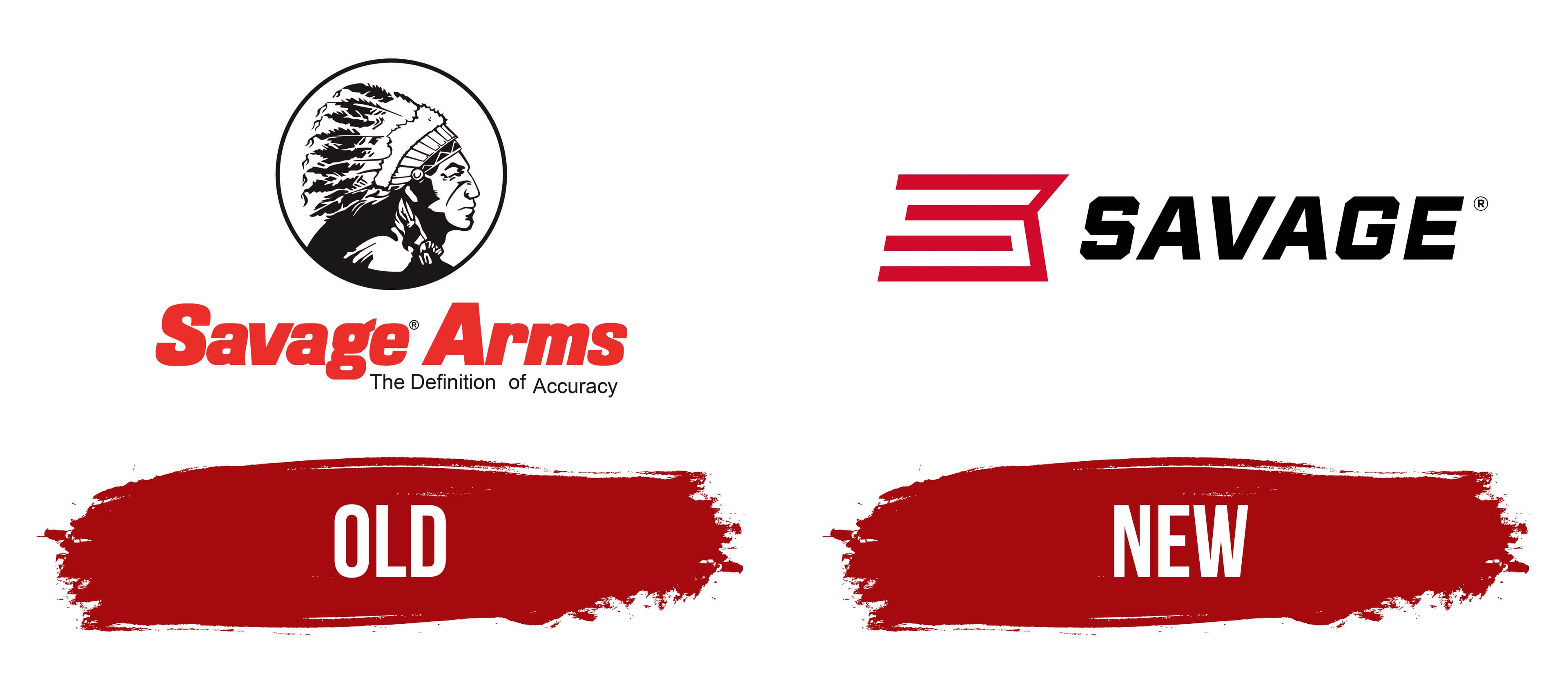
The visual identity of the Savage company was originally based on a non-standard emblem for this field. It included two-level lettering and a detailed image of a Native American in a traditional headdress. But it was short-lived because it could not fully reveal the company’s main message. After a while, it was replaced by a bolder, more modern logo that highlighted Savage’s key features and advantages.
What is Savage?
Savage is a well-known American company specializing in the manufacture of various types of firearms. The most famous developments of the brand are the 300 Savage rifle cartridges and the Model 99 lever-action rifle, which has been withdrawn from production. Currently, the manufacturer produces high-tech rifles (Model 64, Model 93, Rascal, sporting varieties) and combination rifles.
Old
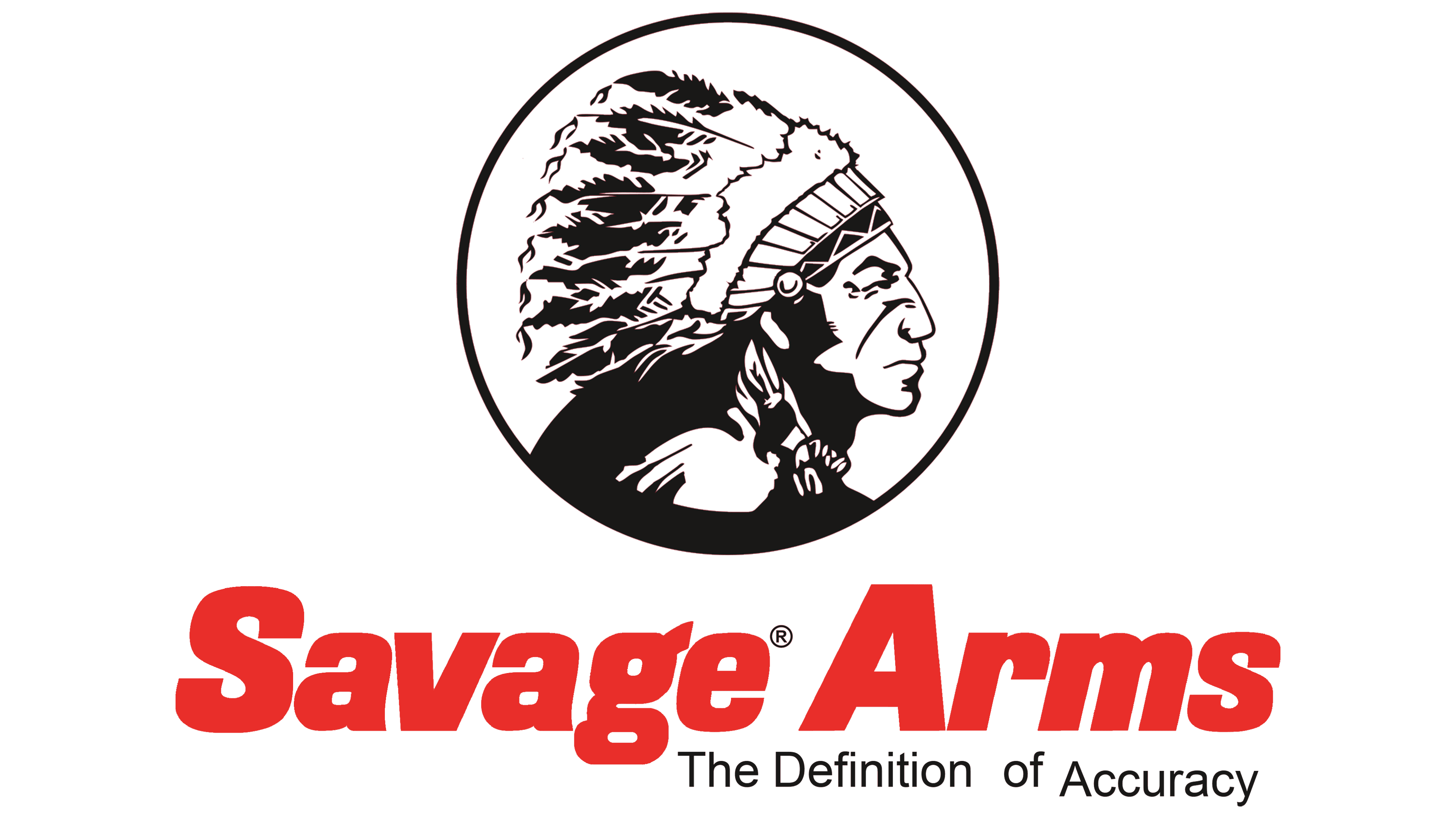
The first sample logo appeared in 1919, 25 years after the company’s foundation. The brand’s founder, Arthur Savage, was approached by a Native American tribal leader with a request to buy rifles for his warriors. He also offered his image as a badge for the corporate logo. Arthur Savage accepted his offer and provided him with rifles at a discount. Thus, an early version of the emblem emerged, with a detailed picture of Chief Limp Deer as its centerpiece.
The picture showed a Native American face in profile. He also wore the tribe’s traditional headdress, a hat made of many feathers. The picture was placed inside a thin black frame and outlined in black, which made it quite realistic. At the bottom of the emblem was a large inscription: Savage Arms. It featured a massive, thick sans-serif typeface with straight cuts and smooth curves.
There was also a neat little inscription below the name: The Definition of Accuracy. This sign displayed the manufacturer’s motto, which defined accuracy. Savage was constantly improving and periodically introducing new technologies to perfect the products. The efforts yielded results, and the company gained a firm position in its segment.
The aspiration for this status was embodied in the black used in the decorative sign’s design and in a miniature motto. The rest of the logo, in the form of a massive red inscription, demonstrated energy, progress, and openness to new solutions. The large size of the letters also indicated confidence and reliability.
New
After a while, the brand had to update its logo because the previous version was outdated and no longer accurately reflected its essence. The designers employed a complex solution to convey all aspects of their main message. The essence of the logo was the combination of a verbal sign and a unique graphic element. Both elements were designed in a minimalist style and appeared very modern.
The straight stripes were reminiscent of the stylized feathers featured on the previous emblem. However, unlike the earlier version, the figure here is more abstract, making it difficult to determine the exact degree of similarity. According to the designers’ concept, the decorative lines symbolize development, innovation, and improvement, which are areas in which the company excels.
Additionally, the stripes create the illusion of movement, emphasizing the dynamism. The main part of the logo, the brand name, was designed in the same format. It consisted of solid, confident letters in italics. Combined with an abstract figure, the inscription demonstrated the company’s high level of professionalism and its commitment to improvement.
Font and Colors
The Savage logo combines elements of modern design, demonstrating active development, with traditional style features that reflect reverence and a tribute to the past. Classic motifs are noticeable in the font. A thick geometric typeface is chosen for the lettering, with well-balanced spacing and clean lines. Beveled cuts across the entire surface are noticeable in the letters S and G.

The chosen style evokes associations of prestige and authority that directly describe Savage. In addition, confidence, reliability, and an excellent reputation are built on solid foundations. The austere black color is perfect for such a solid inscription, continuing the semantic line mentioned above. An abstract figure painted in red makes a profitable contrast with the dark color scheme. It is a symbol of energy, courage, and strength, which have characterized the brand’s activity since its creation.