


 SDA Logo PNG
Visually, the current SDA logo perfectly represents the company. It shows the company’s professionalism and its affiliation with the large Poste Italiane group. The overall style can be characterized by several features: large scale, thick lines, geometric shapes, and expressive coloration. All this makes the emblem particularly memorable, which is important for a transport brand with a leading position in its segment.
SDA Express Courier was founded in Rome in 1984 by Alberto Astolfi and the Cecchetti brothers. The company entered Italy’s express delivery market when the sector was still developing, focusing on urgent shipments nationwide. In 1986, Walter Catoni joined as general manager and shareholder, helping SDA expand its regional network, vehicle fleet, and logistics infrastructure.
By 1997, SDA had become one of Italy’s main private courier operators, with an annual turnover of about 308 billion lire. That same year, it bought a 20% stake in Bartolini, one of its major competitors in freight transport. In 1998, Poste Italiane acquired a 100% stake in SDA Express Courier. The deal, together with related purchases, was valued at around 200-220 billion lire.
After joining Poste Italiane, SDA gained access to a national infrastructure of thousands of post offices and logistics points. In 2000, Poste Italiane used SDA to acquire a 20% stake in Bartolini’s share capital. Poste Italiane, SDA, and Bartolini then formed a parcel sorting and distribution consortium covering Italy, with a combined market share of about 40%. Competitors challenged the deal in court, but the arbitration panel ruled in favor of the consortium.
The Bartolini partnership ended in 2005, when Poste Italiane declined to renew the agreement and sold its stake. During the 2000s and 2010s, SDA expanded its business-to-consumer delivery operations, while its international services relied on partnerships with FedEx and UPS. On November 1, 2019, a group reorganization made SDA an operating company focused on logistics inside Poste Italiane, including nationwide parcel distribution.
Meaning and history
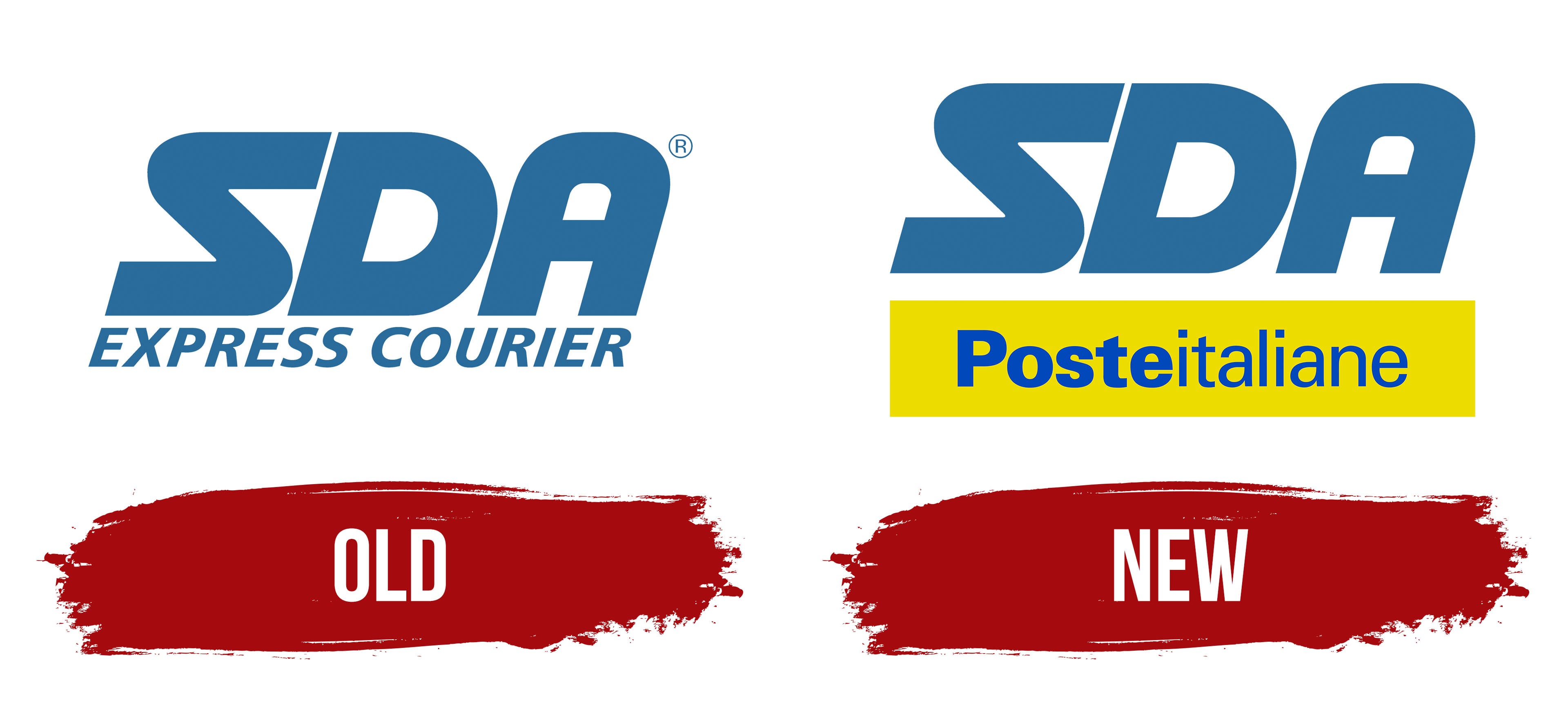
Quality service, customer care, and high-speed delivery have always been SDA priorities. The company’s visual concept also confirms this. The characteristics were reflected in both the early version of the logo and the current company badge. For this reason, they have very similar designs and layouts. The main difference is the change of one part of the lettering due to the transition to the new company.
What is SDA?
SDA is the name of the national express delivery service that operates in Italy. The headquarters are in Rome, and Massimo Rosini is the president. Currently, the company provides domestic transportation and collaborates with international courier services to handle international parcel shipments. The brand’s turnover is quite large. Annually, SDA generates about 45 million euros in revenue.
Old

SDA began its operations in 1984. Every year, the small postal service expanded its operations, and over time, it became a large enterprise with a turnover of 300 billion lire. In its early stages, the brand had a powerful, bold logo that demonstrated several major advantages of the company. Among them are reliability, confidence, and high-quality service.
In addition, the emblem demonstrated dynamism and comfort. This is what every customer who turns to the express delivery service wants. The designers embodied all of these values in a fairly simple text logo that included no decorative symbols. Most of the meaning was contained in the special font format.
For the two-level brand name, a modern sans-serif format was used, which falls within the new grotesques group. Characteristic features of this font are evenly spaced lines, straight cuts, and equal-sized spaces. Italics were an additional feature. The chosen design symbolized speed (as a service advantage), confidence, reliability, and excellent reputation. The light blue color scheme was also associated with trust.
New
Some time later, SDA was fully acquired by Poste Italiane. This event marked a change in corporate identity. In the new logo, only the main element remained unchanged: the service name. It was still in large, bold, capital letters. The color did not change either.
This meant that the company’s founding principles were still being followed even after the changeover to another firm. These included customer care, fast delivery, and employee attentiveness. All of this was reflected in the flowing, confident letters, which instilled a sense of reliability and peace of mind. The lower part of the inscription acquired a new look.
Here is the name of the company that bought the SDA assets. The “Posteitaliane” inscription was placed in a bright rectangle, making it stand out against the larger SDA sign. The design of the lower text included two different fonts, symbolizing Poste Italiane’s participation in the new company and control over its activities.
Font and Colors

SDA has a fairly recognizable, bright logo presented as a two-tiered inscription. The upper part is a massive inscription in the form of a brand name. It demonstrates solid status, boldness, dynamism, and leadership. The confident, thick lines, the absence of serifs and italics, and the large letter size convey this. Spacing is minimal here, visually making the lettering more solid and whole.
For the lower part, another typeface is used. It is distinguished by thinner, straight lines, in contrast to the first part. In the letter T, the characteristic beveled cut is also noticeable. The logo’s color scheme consists of blue and yellow. They are associated with reliability, care, and responsibility. The SDA provides all this to each of its customers.