Seesaw Logo PNG
The Seesaw logo represents interactive learning, where children express their ideas creatively, and teachers and parents can observe their progress. The resource makes learning fun and lets users show their achievements through drawings, notes, videos, and audio.
James Lim, Adrian Graham, and Carl Slett founded Seesaw in San Francisco in 2013. The company’s original goal was to create a digital learning platform that effectively connected parents, teachers, and students in a shared educational environment.
During its first year, the team focused on developing the platform’s core features. The founders held numerous discussions with educators and school administrators to better understand their needs and create useful learning tools.
2014 was a key year for the company’s growth, as it launched the app’s first version. The software allowed teachers to create digital portfolios for students and share their work with parents. That year, initial pilot programs were introduced in schools across California.
In 2015, a major investment enabled the company to accelerate product development and expand its engineering team. New features were added throughout the year, including drawing and annotation tools, as well as voice and video recording options.
Between 2016 and 2017, the user base expanded rapidly. The platform began reaching educators and schools outside the U.S., leading to international adoption. During this period, multilingual support and tools designed for collaborative learning were introduced.
In 2018, the company launched Seesaw Plus, an advanced version with additional teacher features. The company also introduced a complete solution for all educational institutions, featuring enhanced administrative tools.
In 2019, the company redesigned the user interface and added new educational resources. The company also focused on building a community of educators by creating a dedicated space to share insights and teaching materials.
Between 2020 and 2021, the platform expanded its capabilities significantly by introducing new tools for assessments and remote learning. More student activity options were added, and the feedback features were improved.
In 2022, technical upgrades were implemented, enhancing integration with other educational services and introducing new tools for personalized learning.
In 2023, new features were introduced to support teaching methodologies and learning styles. Monitoring and assessment tools were also improved.
As of early 2024, the company continues to grow, regularly introducing new features and updates to meet the evolving needs of modern education. It remains committed to developing effective tools that enhance learning and communication between educators, students, and parents.
Meaning and History
What is Seesaw?
Seesaw is an educational online platform that simplifies learning for preschoolers and school-aged children. It helps students and teachers interact during the learning process by completing assignments, creating digital portfolios, and easily sharing work. The application includes creative tools that allow students to record what they have learned through drawings, photos, notes, or videos. Children can showcase their achievements, while parents can track their progress. The platform supports in-person and distance learning, letting teachers assign tasks, leave comments, and monitor each student’s progress.
First

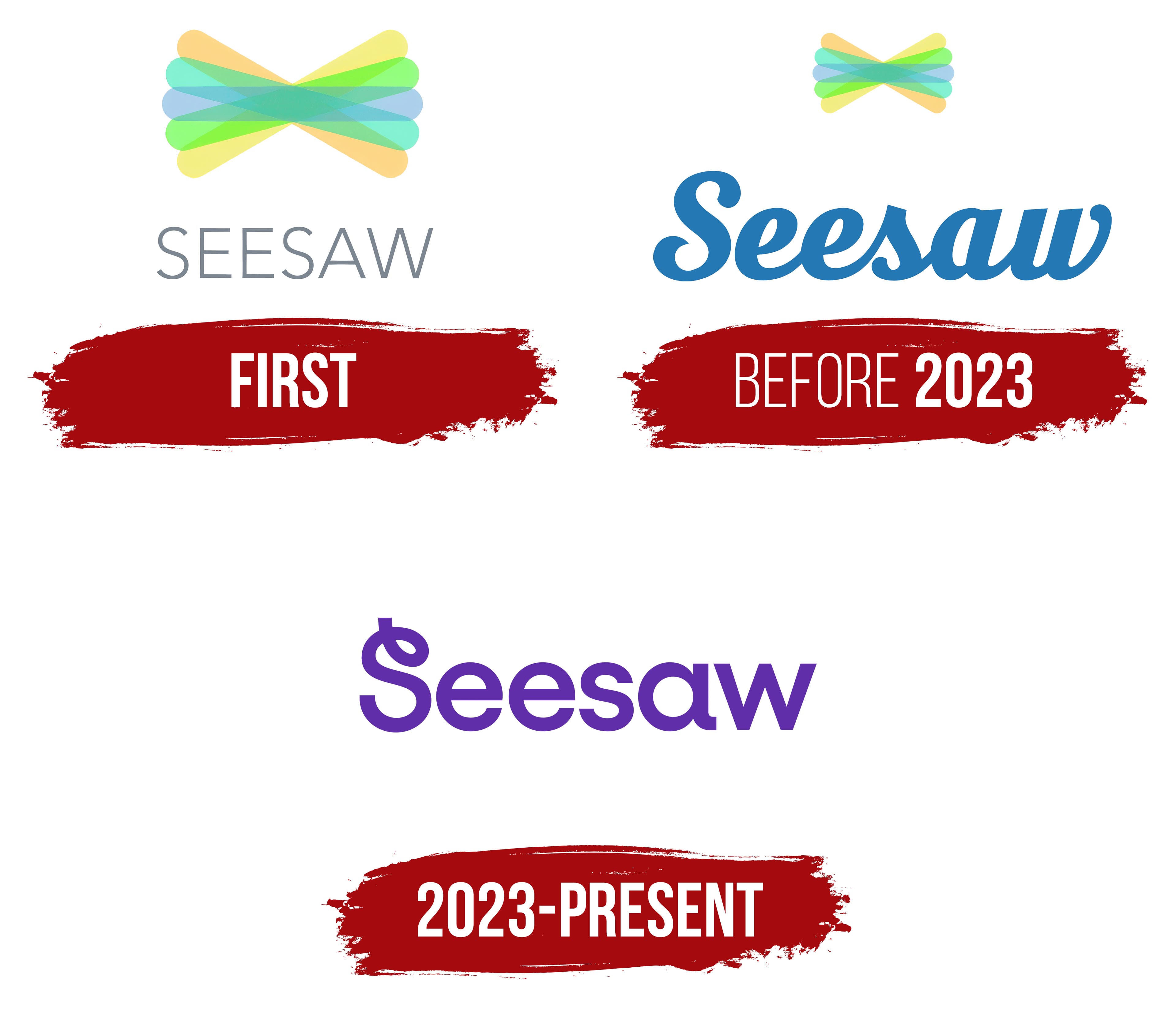
The first known Seesaw logo reflects balance, movement, and interaction, aligning with the brand’s name. The design is based on intersecting stripes that create a visual effect of a rocking seesaw.
The graphic part of the logo consists of five wide, rounded-edged lines resembling popsicle sticks. The two back stripes, pale yellow and a darker yellow, form a cross-shaped base. Three semi-transparent stripes, green, blue, and turquoise, are layered on top. Because the colors overlap, new shades appear at the intersections, creating a rich, multi-layered composition.
The name Seesaw further enhances the sense of balance. Beyond the text, the designers incorporated this concept into the symbol; the central figure resembles a schematic seesaw. Semi-transparent lines were used to illustrate different beam positions in motion. These create a rocking effect that emphasizes the logo’s dynamic nature.
The color palette consists of five vibrant shades. The primary colors blue, green, and turquoise connect to themes of education, digital technology, and creativity. Yellow and orange accents add energy and positivity. Transparency creates an overlay effect that reinforces interaction and collaboration.
The logo’s typography is thin and precise. The letters are clean and unembellished. The gray text color balances the strict typography with the lively, bright graphic elements.
Seesaw is an educational platform, and the logo fully conveys its essence. The design embeds dynamics, balance, and interaction.
before 2023

The logo has been updated but retains the familiar symbol at the top. The graphic element, resembling a seesaw, remains unchanged. Colorful intersecting stripes create an effect of movement, balance, and interaction.
The main change is in the typography. The name is now written in blue, styled as handwritten text. The letter “S” is separated from the rest, while the other letters connect, making the inscription fluid and easy to read. The font has no serifs, but some letters have curved ends that add character. The text is slightly slanted to the right.
The font resembles Fenotype Lager Black but has been adapted to Seesaw’s brand identity and is likely a custom character set. The letters appear dense yet not heavy; soft, rounded lines harmonize with the logo’s upper symbol.
The logo redesign makes it more modern while maintaining continuity. The seesaw symbol remains recognizable, while the new handwritten style adds a sense of personalization and friendliness.
2023 – today

The updated Seesaw logo transforms the brand’s visual style while keeping its connection to education and interaction. The new symbol has become more minimalist, moving away from the previous Seesaw icon. Yet it still reflects movement and the smooth transfer of knowledge between participants in the learning process.
The primary change is the new font. The letters have become more even, precise, and geometric while retaining soft forms. All characters are lowercase except the first “S,” which stands out in size and has a distinctive loop at the top. This element visually resembles a loop, symbolizing continuous learning and the connection between teachers, students, and parents.
Purple has become the primary color in the new identity. It replaces the familiar blue and green shades while maintaining trust and creativity. This shade modernizes the logo, meets WCAG accessibility standards, and emphasizes the company’s commitment to inclusivity.
The brand’s overall visual style changes with the logo update. It now feels simpler, more readable, and more open. The letterforms highlight the platform’s technological features and ease of use, while the new color adds brightness and strengthens brand recognition in digital spaces.
Although the previous symbol with intersecting stripes has disappeared, the new logo design continues the theme of connection, interaction, and continuous learning. The brand identity now looks more modern and aligns with digital standards while remaining the same educational tool that brings teachers, students, and parents together in one space.