


 Snapple Logo PNG
The Snapple logo resembles an air bubble rising through water, evoking themes of beverages, carbonation, and tea. The emblem evokes freshness and creates a desire to quench one’s thirst. It hints at the naturalness and purity of the company’s products.
Three New Yorkers, Leonard Marsh, Hyman Golden, and Arnold Greenberg, founded Snapple in 1972. The company was first called Unadulterated Food Products and supplied natural juices to health food stores across New York. Golden and Marsh had worked together in window cleaning, while Greenberg owned a small health food shop, where the business began.
The Snapple name came from an early failed product, a carbonated apple drink whose cans exploded during storage. The drink was removed, but the name, formed from “snappy” and “apple,” stayed. In 1987, Snapple launched bottled iced teas with natural flavors, and those drinks became the brand’s main product. Distribution relied on delis and small New York stores rather than large retail chains.
By 1992, revenue had reached $100 million, and by 1993, it was about $700 million. The campaign with Wendy Kaufman, the “Snapple Lady,” helped define the brand’s public voice through TV spots based on customer letters. Snapple also bought radio ads on Howard Stern and Rush Limbaugh shows. At the same time, Arizona Iced Tea entered the market in 1992, while Lipton, backed by PepsiCo, used its access to major supermarket shelves.
In 1994, Quaker Oats bought Snapple for $1.7 billion, hoping to repeat its Gatorade success. The company changed distribution, dropped Wendy Kaufman, and shifted the advertising tone. Sales fell, and in 1997 Quaker sold Snapple to Triarc for $300 million. Triarc brought back Kaufman and rebuilt distributor ties. In 2000, Triarc sold Snapple to Cadbury Schweppes for about $1.45 billion. In 2008, Dr. Pepper Snapple Group was formed, and in 2018, it merged with Keurig Green Mountain to create Keurig Dr. Pepper.
Meaning and History

Despite changes in color and font, the brand’s logo remains stable, reflecting its product consistency. Minor adjustments occur due to ownership changes or an expanded product range. The logo’s transformations revolve around water and beverages, with a focus on carbonation. The emblem underlines that the products perfectly quench thirst and are sugar-free.
Snapple’s main advantages are its innovative flavor combinations and its use of only high-quality ingredients. This fact is reflected in the logo, which emphasizes the uniqueness and individuality of the company’s beverages.
What is Snapple?
Snapple is a beverage brand owned by Keurig Dr. Pepper. The product range includes chilled teas and carbonated drinks. The company’s production facilities are located in various states across the US, with each plant specializing in specific flavors. Snapple’s headquarters is in Plano.
1972 – 1987

Snapple debuted in 1972, introducing beverages that combined original flavors with a unique presentation. The young brand began with carbonated apple juice, which gave the company its distinctive name and later made it famous across the United States. The name “Snapple” plays on two simple words: “snap,” meaning a click and freshness, and “apple,” associated with naturalness and apple flavor.
Snapple’s first logo conveyed the brand’s core concept: lightness, naturalness, and a homey style. The lettering was done in the Kalligraphia font in a warm green-brown color reminiscent of real apple juice. The color logically supported the positioning of beverages made exclusively from natural ingredients.
The original logo’s main distinguishing feature was its natural, handwritten look. The font resembled handwritten text, thanks to its diagonal slant and smooth lines. This effect emphasized the image of a homemade beverage, created with care and attention to detail.
The brand’s identity was originally designed to evoke a tactile and visual sense of freshness and naturalness. Beyond the beverages, the company’s popularity was driven by an unusual marketing tactic: the famous “Real Facts” printed on bottle caps, which became a distinctive brand hallmark.
1987 – 2008

The updated Snapple logo kept its recognizable handwritten style but adopted more precise contours. In the new version, the letters acquired smooth lines, neat curves, and uniform stroke thickness. The text retained its diagonal layout, making the inscription look lively and easy on the eye.
The main innovation is a red line forming a capsule-like frame around the word. The outline is thin and intermittently broken, creating a light, subtle effect. The space inside the frame is filled with white, and the blue text is separated from the red border, making it appear brighter and clearer.
The text has shifted from its previous brownish hue to a dark, rich blue. The new color reinforces the brand’s associations with the beverages’ freshness and coolness. Despite the structural changes, the logo has not lost its connection to the original concept of handcrafted quality and naturalness, remaining authentic and relatable to the consumer.
2008 – 2015

When the CBX agency took on the project, the Snapple logo changed style. Unlike previous versions with smooth lines and slanted letters, the focus is now entirely on the typography. The slant and decorative frame disappear, and the lettering becomes straight.
The new spelling of “Snapple” is based on ITC Barcelona Bold, with some modifications. The capital S sits alongside lowercase letters, each with soft curves and wedge-shaped serifs. A subtle, barely perceptible variation in stroke weight appears in the letters and their transitions, giving the composition a friendly, open feel. The color is black.
In this emblem design, CBX abandoned the concept underlying the previous diagonal version of the logo. The reason is simple and pragmatic. The 20-degree tilt, which previously held the entire composition together, proved uninteresting to consumers. Yet in Snapple’s advertising campaigns, that tilt played a crucial role, whether on large billboards behind the Snapple Lady in the ’90s, on bottle caps opening in commercials from the 2000s, or in close-ups in recent humorous videos featuring wigs. Now, the angle and its associations have been abandoned.
The transition from the slanted logo to a strictly typographic design based on ITC Barcelona Bold underscores a shift toward neutrality. Instead of the uniqueness and specific meanings that could have been embedded in previous versions, the brand has chosen the path of proven versatility. Yes, the eccentricity and playfulness have disappeared, but simplicity and clarity remain qualities the brand deemed more important than an unusual presentation.
2015 – 2020
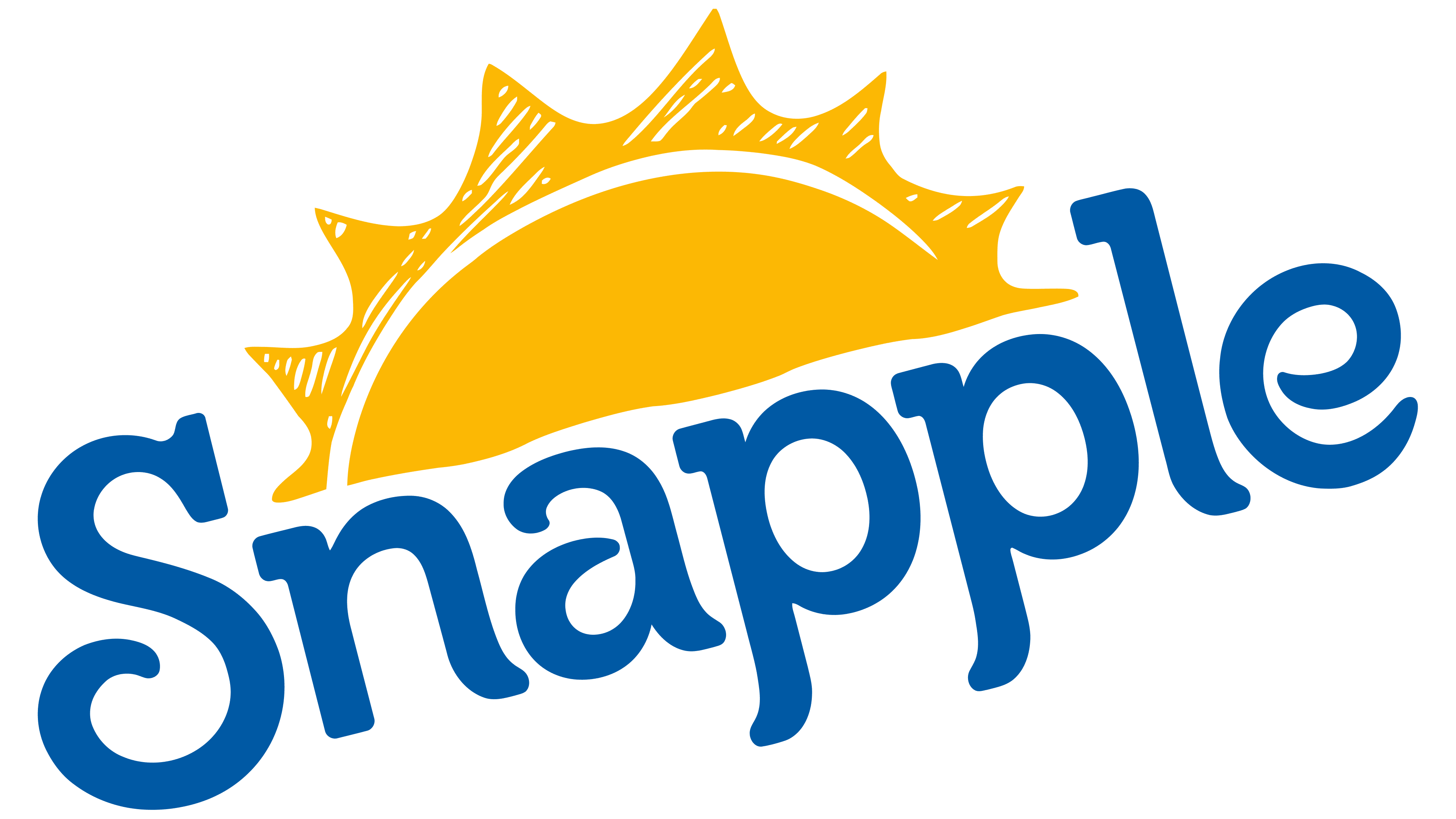
The Snapple logo from 2015–2020, designed by CBX, brings the brand back to a figurative style. The understated version is replaced by a brighter design built from type and symbol. The composition once again features slanted lettering, now styled differently and complemented by a new visual accent.
The logo is based on the name “Snapple,” set in a serif typeface derived from ITC Barcelona Bold with some modifications. The letters appear soft and cohesive, without sharp edges. The text is set on a diagonal, continuing the brand’s theme of lightness and openness since its inception.
Above the text is a yellow sun symbol. The semicircle rises above the letters, creating a sunrise effect. The sun’s rays are uneven, as if hand-drawn; they have a light texture and naturally imperfect lines. The strokes inside the yellow shape emphasize the handcrafted feel.
The logo’s color scheme is based on a contrasting blue-and-yellow palette. Blue continues the tradition established in previous versions, while yellow introduces a new mood of warmth, freshness, and a summery vibe that reflects the character of the beverages.
2020 – 2026

The 2020 version of the Snapple logo strips away details and illustrations, emphasizing simple form and clear geometry. Instead of a sun or hand-drawn strokes, it now features a simple blue shape resembling a capsule, tilted at about 20 degrees.
The white lowercase letters of the word “snapple” are positioned inside this oval, contrasting with the rich blue background. For the first time, the brand has chosen a sans-serif font based on Hurme Geometric Sans No. 4 SemiBold Oblique. The letters are rounded with a subtle slant, giving the logo a high-tech, minimalist feel.
An important detail of the new version is the play on the letter outlines in the word “apple,” hidden next to the main symbols. They are written in thin blue lines that blend into the background. This technique makes the word “apple” stand out within the logo, reminding viewers of the name’s origin in the company’s first apple juice.
The typeface’s distinctive elements are further emphasized by individual letters extending beyond the oval’s boundaries. The two “p”s with long stems and the tall, straight “l” extend beyond the oval’s bottom edge, creating the impression that the characters are cut into the surface. The other letters do not protrude and remain flat within the outline. This creates a dual effect: some letters appear as cutouts, while others appear superimposed.
The blue oval itself, which encloses the word, represents water, while the white letters evoke air bubbles rising to the surface. The diagonal slant reinforces the sensation of the word rising upward, reminiscent of bubbling, and emphasizes the lightness and refreshing nature of Snapple beverages.
2026 – today

In January 2026, Snapple reminded fans of its heyday by unveiling a revamped logo designed by Deutsch Design. Released alongside the return of the iconic glass bottles in select markets, the new style had already taken center stage in the brand’s design by spring.
The Snapple logo is based on a racetrack-like element, a silhouette familiar to fans of the drinks from the late 1980s to the early 2000s. In the updated version, the capsule shape is outlined in a bright red diagonal contour. The line is not continuous; it is interrupted in several places, which adds a sense of lightness.
Inside the red outline is the blue Snapple lettering. The typeface is based on a modified ITC Barcelona Bold, with its characteristic rounded letterforms and expressive wedge-shaped serifs. The letter S is larger than the others and serves as a visual focal point. The entire text follows the frame’s slant. The background beneath the lettering remains white, enhancing the contrast and making the elements easier to perceive.
The brand’s overall visual identity also received a revamped color palette tailored for digital platforms: contrasts became more pronounced, shades brighter, and the fruit illustrations on the bottles were given individual designs that highlight the variety of flavors.
For Keurig Dr. Pepper, the brand’s owner, the new look signaled a return to Snapple’s 1990s style and energy. It then captured attention with its original advertising, unique presentation, and unconventional packaging. After a long period of decline and unsuccessful changes, the brand needed to restore the image that had long remained in consumers’ memories.
With the new logo, the brand offers its audience a refreshed, clean, and vibrant version of a familiar, successful concept, reminding them of its heyday.
Font and Colors
The white letters symbolize eco-friendliness. The company has reduced its use of polyethylene terephthalate in bottles and switched to 100% recycled plastic. This shade also speaks to natural ingredients, sugar-free beverages, and health benefits.
The blue background reflects water, the primary ingredient in all the brand’s products, associated with quenching thirst and restoring water balance.
The logo font “Hurme Geometric Sans No 4 Bold Oblique” features rounded, smooth letters reminiscent of bubbles.