


 Softsoap Logo PNG
The fluidity and streamlining of the Softsoap logo make it attractive and make you want to touch it. The emblem promises softness, excellent glide, and plenty of foam, all achievable with the brand’s gels and soaps.
Softsoap emerged in 1980 under Minnetonka Corporation, led by Robert Taylor. The company, founded in 1964, saw demand for liquid soap in Europe but found no equivalent household market in the United States, where bar soap dominated.
Taylor anticipated rapid entry by Procter & Gamble and Colgate-Palmolive. Before launch, he secured contracts for 100 million plastic pump dispensers from the only two US suppliers, spending about $ 12 million and locking up production capacity for nearly 2 years.
In 1980, Softsoap entered retail and quickly gained traction. Consumers adopted the liquid format, while competitors struggled to source dispensers. By the time they entered the segment, Softsoap had already established distribution and brand awareness.
By 1982, the product generated over 25 million dollars in annual revenue for Minnetonka, which also managed Calvin Klein Cosmetics under a 1978 license. Liquid soap became a mass category, though Softsoap retained a strong share.
In 1987, Colgate-Palmolive acquired Minnetonka, adding Softsoap to compete with Lever Brothers and Procter & Gamble. The brand expanded into body wash, antibacterial variants, and children’s lines, using mass retail channels.
In the 1990s, antibacterial soaps grew in popularity, and Softsoap introduced triclosan-based formulas. In the 2000s, competition intensified from Henkel with Dial and Unilever with Dove, spurring updates to scents and packaging while maintaining mid-range pricing.
In 2017, after regulatory bans on triclosan, Softsoap reformulated its products to use alternatives like benzalkonium chloride and alcohol, in line with new safety standards.
Meaning and History
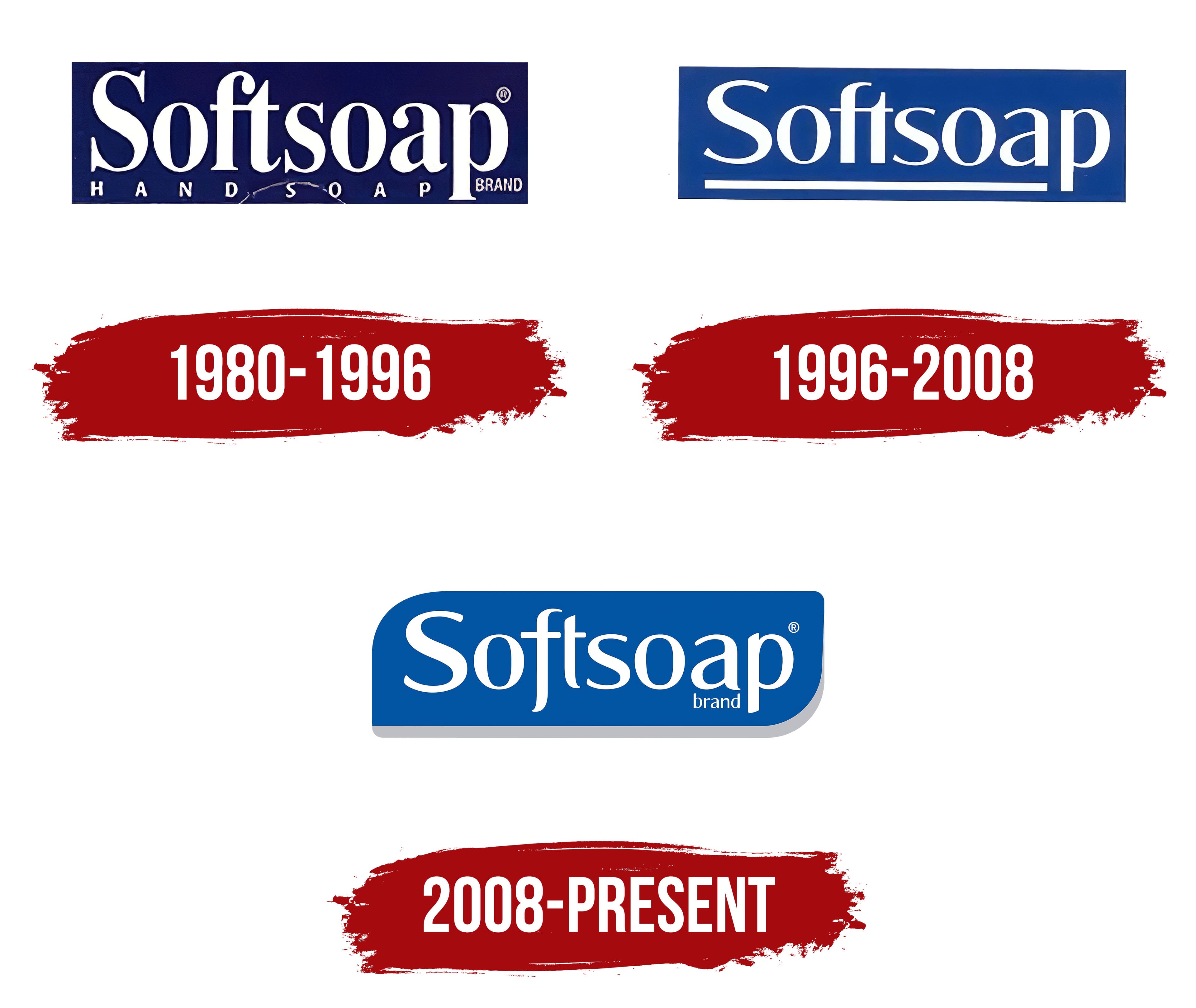
From its inception to the present, the brand has had three emblems that have transformed heavy, wide letters into light, narrow symbols. The first version is dated to the year the liquid soap debuted.
What is Softsoap?
This Colgate-Palmolive brand has transformed routine care into a pleasant sensory experience with a wide range of liquid soaps and body washes. The product line includes moisturizing body washes enriched with ingredients such as milk proteins, shea butter, and coconut oil, as well as an antibacterial hand soap specially designed for the kitchen. The brand’s distinctive feature is the combination of fragrances, skin-nourishing ingredients, and effective cleansing, making the products accessible and suitable for daily use.
1980 – 1996
At first, the logo featured a compound inscription with several words. The biggest and top brand name was “Softsoap.” Below was the phrase “Hand soap.” It occupied almost all the space under the main element, consisted of narrow symbols, and reached the “p” leg. It was followed by the even more subtle word “Brand.”
1996 – 2008
The designers replaced the dark blue rectangle with a light one, removed all the bottom labels, and replaced them with a long white stripe. She underlined the name, highlighting it against a solid background.
2008 – today
The updated logo is now used without a line under “Softsoap.” Instead, the inscription “Brand” appears. The background has turned blue with a gray outline. The rectangle is rounded, with pointed top-right and bottom-left corners.
Font and Colors
From the very beginning, the brand’s trademark consisted of its name. Any brand owner who didn’t break this structure made only minor adjustments.
Each emblem uses a different type of typeface: the first is a classic serif, the second is a chopped, grotesque typeface, and the third is a thin, rounded typeface. Moreover, at first, the letters “ft” were connected by a common crossbar, and later they were disconnected. The color scheme consists of white, gray, and several shades of blue.
FAQ
What company makes Softsoap?
Colgate-Palmolive, an international company, makes Softsoap shower gels and liquid soaps. The company is known for its wide range of household and personal care products. Acquiring Softsoap helped the brand grow its product lineup and strengthen its position in the personal care market.
Colgate-Palmolive has maintained high quality and popularity, making it a household favorite. The brand’s focus on innovation and customer satisfaction has helped it become a trusted name in personal hygiene. Colgate-Palmolive’s global reach and expertise have made its products available and successful in many countries.
What is wrong with Softsoap?
Before the ban on triclosan in the United States, Softsoap contained this harmful ingredient, which is known for its adverse health and environmental impacts.
Concerns remain about the composition of Softsoap products. They include BHT, CAPB, SLS, and unknown chemical fragrances. BHT (Butylated Hydroxytoluene) is a preservative that can cause skin irritation and has potential links to cancer. CAPB (Cocamidopropyl Betaine) is a surfactant that can cause skin irritation and allergic reactions. SLS (Sodium Lauryl Sulfate) is another surfactant known to cause skin and eye irritation. Using unknown chemical fragrances is problematic because they may contain undisclosed chemicals that can cause allergic reactions or other health issues. These ingredients pose serious health risks, especially for sensitive skin or allergies.
Is Softsoap made in China?
Several types of Softsoap products are made in Morristown, New Jersey. While Colgate-Palmolive, the parent company, has factories in China, it is not publicly known if Softsoap is produced there, as this information is not advertised.
Colgate-Palmolive’s main production location is in the United States, specifically New Jersey. Although the company has a global manufacturing network, it does not always disclose the locations where each product is made.
Are Softsoap and Palmolive the same?
Softsoap and Palmolive are different brands, both owned by Colgate-Palmolive.
Softsoap focuses on liquid hand soaps and body washes. It is known for various scents and moisturizing formulas, making it a popular choice for personal hygiene.
Palmolive offers a broader range of products, including dishwashing liquids, hand soaps, and body washes. It is especially well-known for its dishwashing liquids, which have been a household staple for many years.
Although both brands are part of Colgate-Palmolive, they target different market segments with distinct product lines.