


 StartMail Logo PNG
The StartMail logo is a key advertising tool for the mail service, conveying the brand’s essence. It is a nonverbal signal to users, encouraging them to send letters without fear that intruders may access confidential information.
StartMail launched in 2014, built by the team behind the privacy-focused search engine StartPage. StartPage founder Robert Beens led the service, created in response to growing concern that email providers were collecting and analyzing user data for targeted advertising. Its core idea was an encrypted email based on OpenPGP, a standard linked to Pretty Good Privacy, developed by American scientist Philip R. Zimmermann.
Before the public release, a selected group tested the beta version in early 2014. The official launch followed later that year. Based in the Netherlands, StartMail focused on strict privacy rules, end-to-end encryption, and disposable email addresses, giving users more control over personal communication and online identity.
Over the next several years, the service added more security and usability features. In 2015, it supported PGP-compatible encrypted messages with other providers. In 2016, it introduced aliases, allowing users to create additional addresses tied to a single main account. In 2017, the interface and mobile experience were improved, followed by two-factor authentication in 2018.
StartMail continued updating its infrastructure and tools afterward. In 2019, it improved spam filtering and server capacity. In 2020, it added email scheduling and better mailbox organization through tags and filters. In 2021, iOS and Android updates improved mobile security and usability. In 2022, the platform expanded API support and compatibility with third-party email clients, while in 2023 it focused on stronger encryption and private email protection.
Meaning and History
StartMail lets you generate unlimited disposable email addresses. It’s also intended for everyday communication and for companies that offer special business accounts on the platform. The email service has much in common with Startpage because it was launched by the same person, David Bodnick, co-founder of Surfboard Holding BV. Both services aim to protect privacy and do not collect user data.
StartMail launched in 2013, much later than Startpage. However, Gravita Creative Ltd. worked on its modern visual identity. In this regard, both brands share a similar concept. They even share the same color scheme: white, light blue, and dark purple.
What is StartMail?
StartMail is an email platform that protects its users’ privacy. It was created in 2013 and, along with Startpage.com, is owned by the Dutch company Surfboard Holding BV. The web service was founded by software developer David Bodnick.
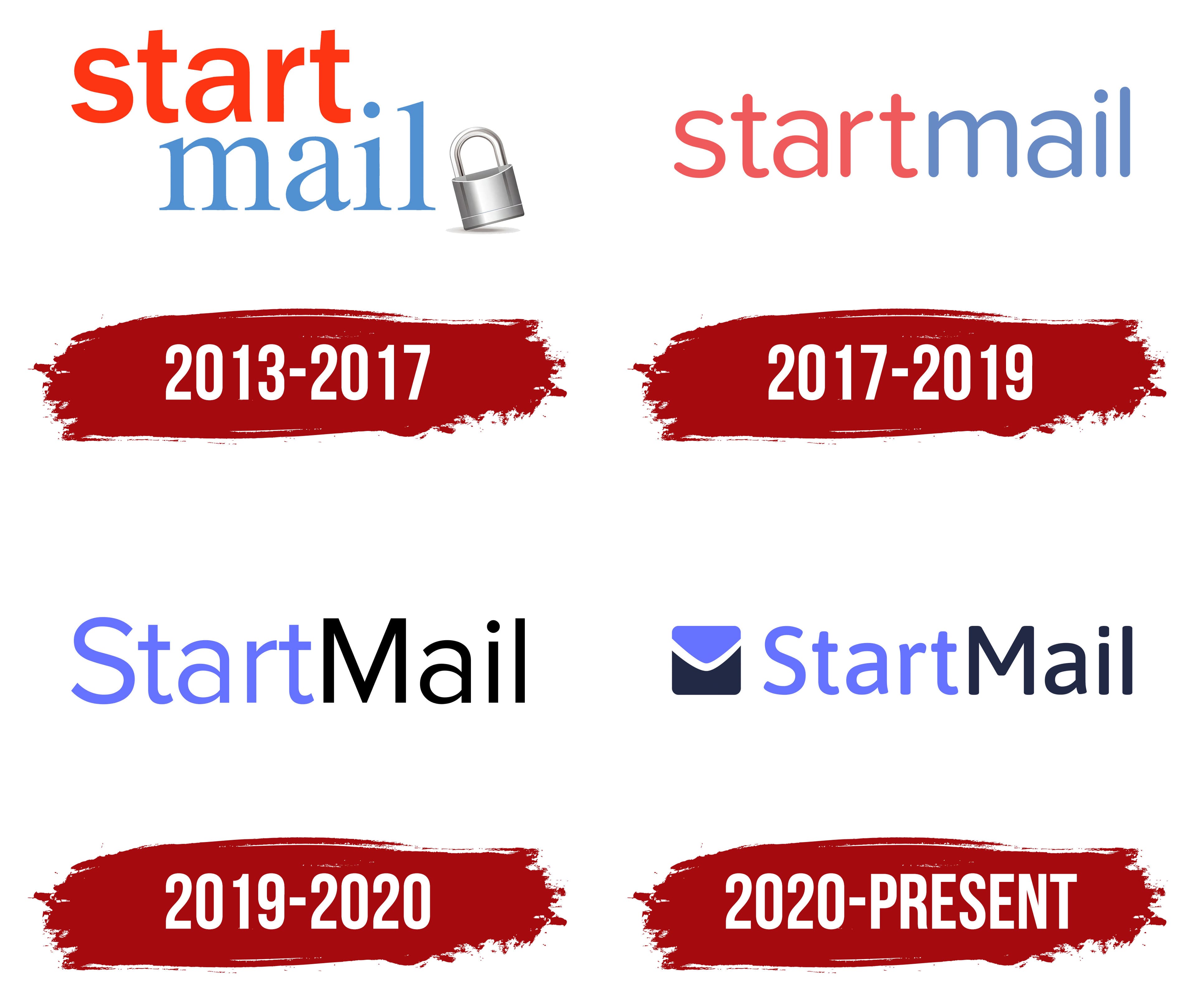
2013 – 2017

The StartMail logo, used since 2013, represents the company’s entry into the secure email service market. The main goal was to highlight the service’s security, ease of use, and reliability, the key focuses behind the visual identity.
The design centers on two main elements: the text and a lock. “start” appears in bright red, symbolizing energy, dynamism, and innovation. The red emphasizes the company’s fresh, modern approach to protecting users’ data. The word “mail” is blue, reflecting the service’s reliability, calm, and security.
The logo’s font stands out with its contrast. For the word “start,” a simple yet dynamic sans-serif font was chosen to symbolize the service’s openness and accessibility. In contrast, the word “mail” uses a more traditional serif font, adding stability and underscoring the company’s serious approach to security. This font pairing successfully merges innovation with time-tested technology.
A key element of the logo is the lock icon, positioned to the right of the text. The lock symbolizes protection and privacy, reflecting the service’s primary mission of protecting users’ correspondence from prying eyes. In 2013, as public concern about data privacy and security grew, this logo became a distinctive mark highlighting the importance of data protection in the digital age.
2017 – 2019

This updated logo reflects changes to the company’s image. It still focuses on security and ease of use, but with a new, more minimalist approach. Unlike the first visual identity, it removes the lock, the security symbol that once served as a clear focal point. Now, the emphasis is on the brand name itself, with security serving as an underlying message rather than an explicit visual element.
The color palette has become softer and more muted than the previous bright logo. The red of the word “start” still symbolizes dynamism and readiness for action, but the shade is now more subdued, making it less aggressive and more approachable. The blue color of the word “mail” has also become lighter and more pastel, reflecting calmness and reliability without sharp contrast. These changes highlight the company’s shift toward greater elegance and subtlety.
The font has been completely redesigned. Previously, it featured more traditional, sharp serif lines, but the company has now chosen a soft, rounded sans-serif font. This new font conveys technological advancement while remaining friendly and easy to read. The rounded letterforms signal that the company is staying current and adopting more modern design solutions.
The absence of the lock suggests that the company no longer needs to emphasize its security as overtly as it did in earlier years. By 2017, as cybersecurity concerns became widely discussed, users began to expect high data protection from such services. The logo became simpler and more refined, likely to build greater user trust.
2019 – 2020

Another updated version of the StartMail logo, introduced in 2019, marked a new phase in the brand’s development, highlighting its commitment to minimalism and modern trends. This was the company’s third visual identity, and its creation reflected a shift in approach to visual branding: the style became simpler, and the colors more subdued. The main goal of this update was to emphasize the company’s focus on technology and user-friendliness, with a strong emphasis on the service’s transparency and reliability.
The most noticeable change was the font. It became even more modern and softer, without sharp edges or serifs. The rounded shapes symbolize the company’s openness and friendliness towards its users. The letter lines became slightly thicker, giving the logo more confidence, while the words “start” and “mail” remained in the same font. This underscores the brand’s unity and cohesiveness.
Previously, red symbolized dynamism and passion, but it has now been replaced with a cooler, calmer shade of lavender, symbolizing reliability and security. The lavender color of the word “start” was carefully chosen because data protection and online security had become particularly relevant at the time.
2020 – today
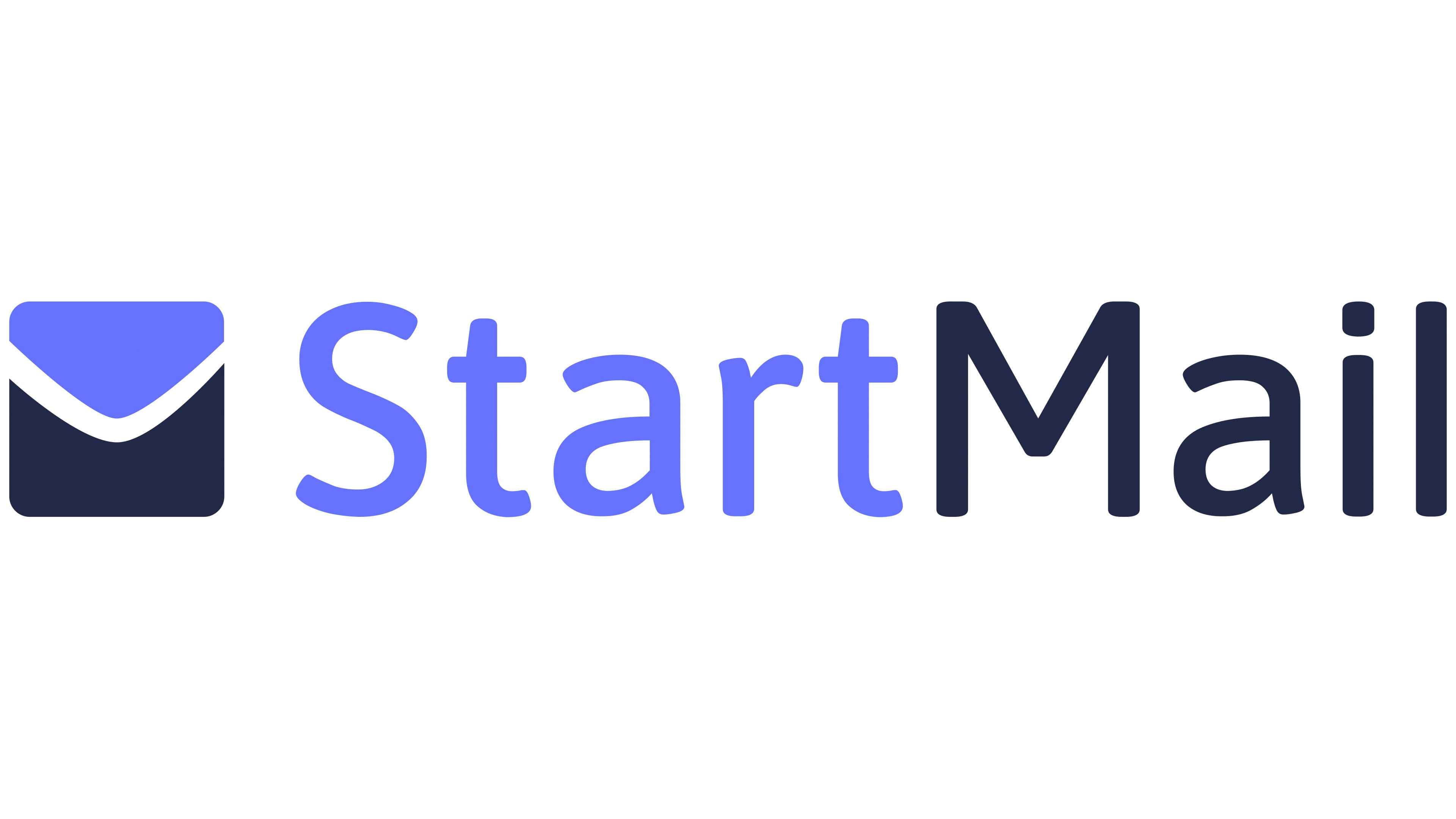
The current StartMail logo has two parts. On the left is a stylized square letter envelope with rounded corners. A white line divides it into two halves, curving downward like a boomerang. This strip resembles the middle of a capital “M,” and the imagination completes the side strokes: they run parallel to the quadrangle’s edges. This brings to mind the Gmail logo.
The bottom of the envelope looks like a dark purple rectangle with a notch in the middle. The top is a light blue triangle pointing at a 90-degree angle into the recess directly below it. The Gravita designers reviewed many StartMail logo concepts, with various shapes and combinations, before settling on this one. Their designs included paper airplanes, origami, and the blue “M.” However, the agency staff abandoned all versions in favor of the current emblem.
To the right of the graphic sign is the service name. It is also two-tone: the first half (“Start”) is light blue, and the second (“Mail”) is dark purple. Each part starts with a capital letter. The designers chose a sans-serif font to design the inscription. It could be called simple if they hadn’t rounded all the corners. This decision makes the logo visually soft.
Font and Colors

Logically, the email service uses a logo featuring a mail envelope. Here, it symbolizes information protection, an opaque shell that hides the letter’s contents from strangers. Dividing the drawing into two parts lets you play with negative space: if you look closely, you can see the capital “M” hidden in the negative space, the first letter of the word “Mail.”
Initially, Gravita designers planned to combine three elements in the lower half of the sign: an envelope, a fortress tower, and a heart. So, the protruding edges of the dark purple fragment can be seen as stylized fortress teeth or halves of a heart. Fortification provides reliable protection, and the heart symbolizes love for users.
Both parts of the service name are set in the same font: grotesque with rounded corners. It resembles Adobe’s Myriad Arabic Regular in shape; only the “M” has a slightly lower middle diagonal. Similar typefaces are Webnar Medium by The Northern Block, Drive Regular by Fontyou, and Noto Sans Display Medium by Google. However, Gravita’s designers rounded the letters to make the lettering feel smooth and streamlined.

The British agency’s staff paid equal attention to the color scheme. They chose a purple theme for StartMail (and its sister service, Startpage), complemented by white and light blue.