


 Swat Logo PNG
“Special Weapons And Tactics” does not have a single officially approved emblem because each division uses a unique set of symbols that characterize its history, mission, and values. The SWAT logo may vary by region, yet these versions share many commonalities. They often include elements associated with bravery, strength, and determination, emphasizing teamwork, law enforcement, and the ability to act in extreme situations.
SWAT, or Special Weapons and Tactics, emerged during the unrest of the 1960s, when ordinary police units lacked training for riots, political violence, hostage crises, and heavily armed offenders. In August 1966, Charles Whitman opened fire from the tower at the University of Texas in Austin, killing 16 people and wounding over 30. Officers had no dedicated tactical unit, suitable equipment, or established response plan, and the attack continued for about ninety minutes.
In 1967, LAPD inspector Daryl Gates proposed a specialized team combining military methods with civilian law enforcement. Early members trained in assault tactics, sniper operations, close-quarters combat, and hostage rescue. The first major public test came in December 1969 during a prolonged confrontation at the Black Panther headquarters in Los Angeles. Media coverage exposed the new police model to departments across the country.
During the 1970s and 1980s, SWAT units became common in major American cities. Their duties expanded from armed standoffs and hostage incidents to high-risk warrants, drug raids, and counterterrorism. At the federal level, the FBI created the Hostage Rescue Team in 1983 to handle crises beyond the capacity of local agencies.
After September 11, 2001, federal programs supplied local departments with armored vehicles, heavy weapons, and military communications equipment. During the 2000s and 2010s, civilian deaths during several operations intensified debate over police militarization. Many departments responded with de-escalation protocols, body cameras, stricter deployment criteria, and tighter approval procedures for high-risk raids.
Meaning and History
There are no uniform rules that all SWAT groups in different U.S. cities follow. Each formation decides what weapons to use and what logo to adorn its uniform. Nonetheless, their systems of visual identification share many similarities. Since these police divisions have special training and perform complex tasks, their emblems typically symbolize the following values:
- team spirit;
- patriotism;
- safety;
- power and strength.
SWAT logos often feature an eagle, embodying the ideal qualities of a special forces soldier, such as honor and bravery. Moreover, this bird is a national symbol of the U.S. and appears on many coats of arms and flags.
A broad light stripe outlines a verbal sign with the white inscription “S.W.A.T” on a black rectangle background. The distance between the letters is uneven. The bold, vertically elongated font is roughly similar to the Royal Rumble Regular from The Sports Fonts, but differs in that it lacks thin dividing lines. The inscription style is reminiscent of a military aesthetic, characterized by uppercase glyphs, conciseness, and minimal details.
What is SWAT?
SWAT is an elite police special unit that performs the most complex tasks, including the arrest of dangerous criminals, the neutralization of explosive devices, the prevention of terrorist acts, and the rescue of hostages. These are well-trained teams with the best equipment and modern weapons. The first such assault group appeared in Philadelphia and other U.S. cities. Different divisions do not have a common concept; they are united only by the special nature of their duties.
1964 – today
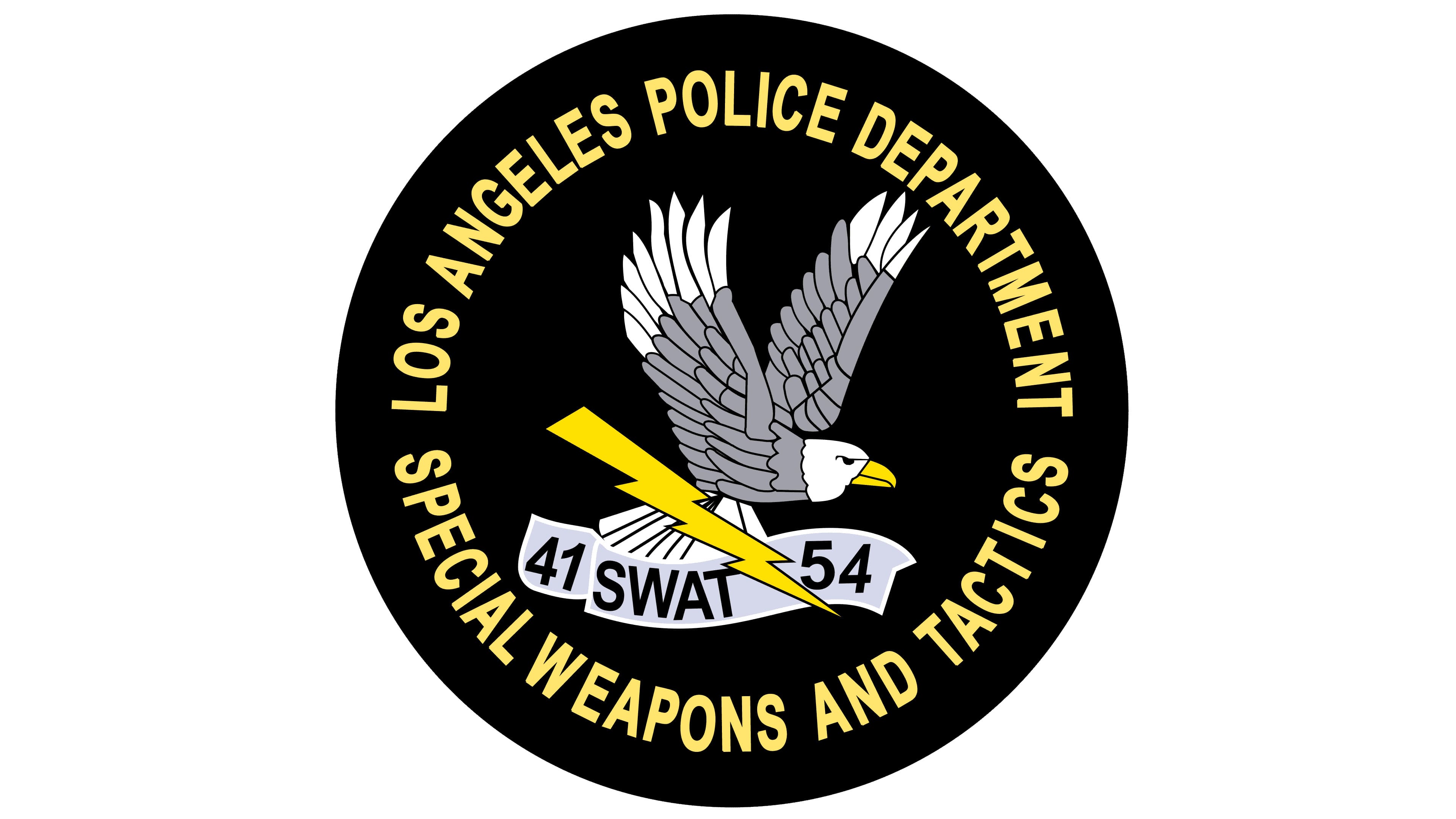
The logo is presented by D Platoon (SWAT), a special operations unit from Los Angeles. Its central figure is the bald eagle, the principal symbol of the United States. The soaring bird of prey carries a yellow lightning bolt in its talons, which signifies strength and speed. Below is a gray ribbon inscribed “41 SWAT 54”. This is enclosed in a ring of text, “LOS ANGELES POLICE DEPARTMENT SPECIAL WEAPONS AND TACTICS,” and is placed within a large black circle.
The number “4154” has its backstory. According to the LAPPL, this is the badge number of Special Forces Officer Steve Gomez, who retired in 2010. He was the only one allowed to receive a replica of his badge as a token of gratitude for his service, as Gomez participated in the most high-profile cases. The “4154” on the SWAT emblem reminds us of two significant incidents that showcased the unit’s courage and selflessness.
Font and Colors

Each Special Weapons and Tactics (SWAT) group has its own system of symbols, so it is impossible to single out a specific font that all units would use. But there are general trends. Preference is given to uppercase letters and a stern sans-serif typeface because the design of the inscription should match the serious nature of the SWAT’s activities.
The same applies to the color scheme: a universal black-and-white combination is prioritized. Nevertheless, D Platoon from Los Angeles also incorporated gray and yellow elements into its logo.