


 The Prodigy Logo PNG
The group’s logo shows electronic sound vibrations. Within the genre, musical variations are possible that aren’t possible in other styles. The Prodigy logo represents the band as a constantly growing professional outfit.
In 1990, in Braintree, Essex, Liam Howlett produced tracks on a home sampler, shaped by hip-hop and early rave culture. A DJ set led to meeting Keith Flint and Maxim Reality, who joined as performers, while Leeroy Thornhill handled stage presence. In 1991, The Prodigy signed with XL Recordings and released Charly, built on a BBC children’s sample. The track reached No.4 on the UK chart and triggered a wave of similar releases.
In 1992, Experience arrived as a breakbeat-driven album designed for dancefloors yet sold as a full record. In 1994, Music for the Jilted Generation responded to the Criminal Justice Act and hit No. 1, adopting a harsher tone.
By 1995, Flint moved from dancer to vocalist. Howlett shifted away from pure rave toward a heavier hybrid later labeled big beat. In 1996, Firestarter gave the group its first UK No.1, followed by Breathe. Both preceded The Fat of the Land in June 1997.
The 1997 album topped charts in over 20 countries, including the US and UK. It featured a collaboration with Zack de la Rocha. The band was often compared with The Chemical Brothers. After a long break, Always Outnumbered, Never Outgunned was released in 2004, featuring guest vocalists and a limited presence by Flint. In 2009, Invaders Must Die reunited the core lineup and reached No. 1 in the UK. In March 2019, Flint died at 49 in Essex. In 2023, the group resumed concerts, with Howlett continuing as the main composer.
Meaning and History
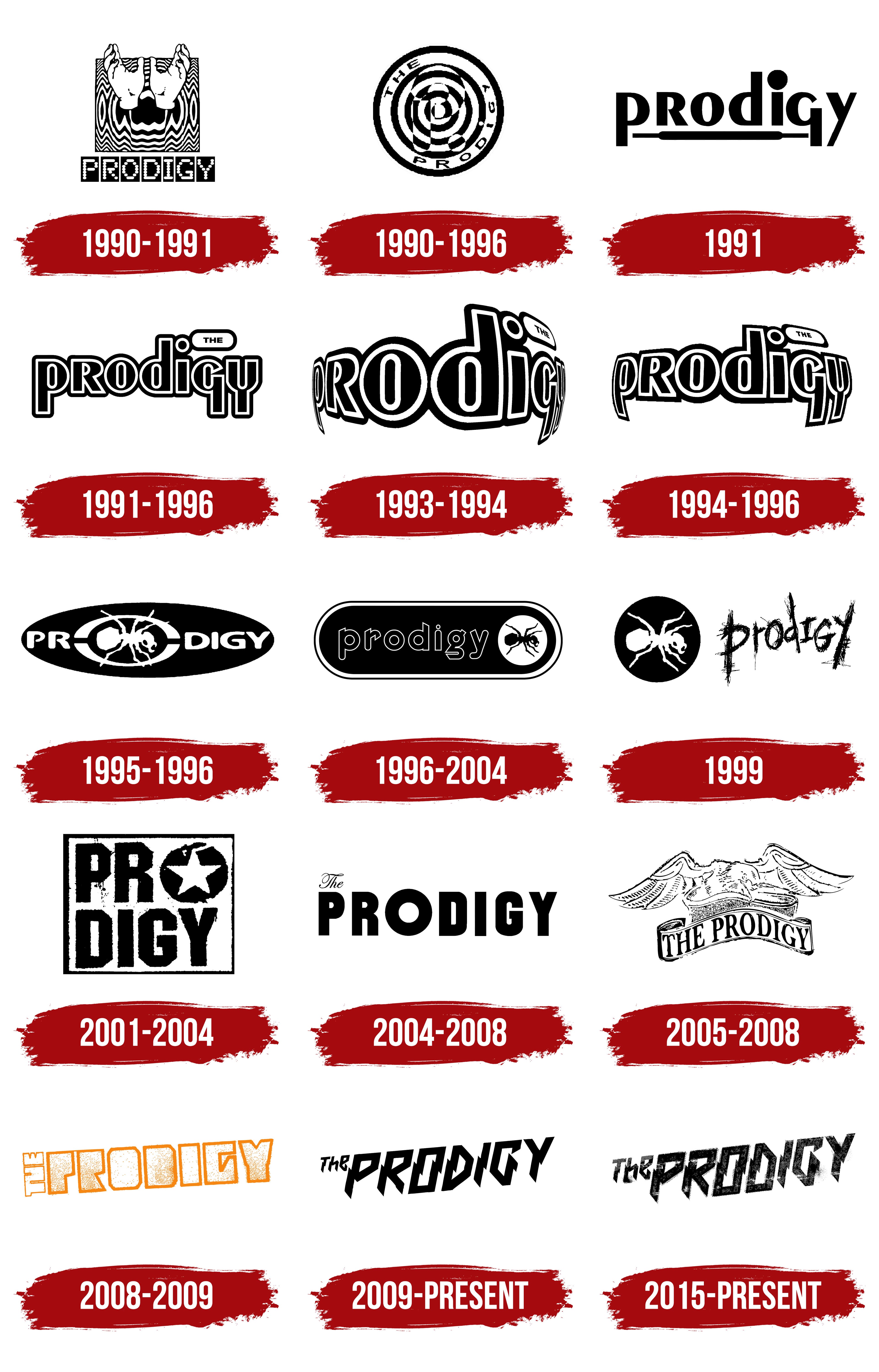
Over the past three decades, the music team has changed many logos. The first was in use for the shortest time, from 1990 to 1991. Moreover, each version of the branding is directly related to the band’s name: The Prodigy means “gifted,” “gifted,” or “wonderful.” Its history is quite simple. Liam Howlett borrowed the name from his first keyboard synthesizer, the Moog Prodigy.
What is The Prodigy?
The Prodigy is a British band performing electronic, club, and alternative music. Its work also includes punk, techno, breakbeat, and rock. Keyboardist, producer, and songwriter Liam Howlett formed the band in 1990. The group’s singles ranked in the UK top 5.
1990 – 1991
Two versions of the logo that appeared on studio albums of that period belong to this period. The first depicts two palms against a square background, with wavy black-and-white lines resembling circles on water or sound vibrations. Drawn below are black squares, each containing one white letter from the word “Prodigy.”
1990 – 1996

The second emblem also imitates waves diverging from the center as monochrome stripes. It is a circle with a translucent (or rather, ghostly) “R” in the middle. The group’s name appears on the brightest line.
1991

The phrase “Prodigy” fills the entire logo, so no other elements appear. The letters are set in printed type and combined: “R” and “Y” are uppercase, “p”, “o”, “d”, “i”, and “g” are lowercase. They are also the same size. Has double black and white piping.
1991 – 1996
This logo appeared in 1991 and appeared on five singles, the debut album Experience, and several music cassettes. In its standard form, it is black; in the individual form (on the covers), it is colored. The emblem contains only lowercase letters, except for the capital “R.” All characters are wide, with a double border around the edges. The legs of “p,” “g,” and “y” are balanced and extend the same distance. Moreover, “g” looks like “q.” To the right of the “i” in the white oval is the article “THE.”
1993 – 1994

Alongside the previous version, another logo was in use. This is the same emblem, but three-dimensional, convex, and designed with a curved perspective. The central signs are larger than usual (o, d, i), while the side ones are smaller (p, r, g, y).
1994 – 1996
The emblem, chosen by the musicians in 1994, features a legible inscription because the previous version had uneven letter sizes. In this case, the name is visible despite the stereoscopic effect.
1995 – 1996
During this period, the iconic ant image appeared, which the musicians used on other covers. The logo is depicted within an ellipse with a large “O” that contains the insect.
1996 – 2004

The designers moved the ant to the right, put it at the end of the name, and changed the uppercase letters to lowercase.
1999
The logo is based on an ant. He first appeared on the album’s cover in 1995. Now the group is back to him again. A white insect sits in a solid black circle. To its right is the “Prodigy” inscription from the original design. The band’s name appears scratched into a hard surface. It consists of small, irregular stripes applied randomly. The letters are located in different registers: “p”, “r”, “o”, “d”, and “y” are in the lower register, and “I” and “G” are in the upper register.
2001 – 2004
This year’s version featured affirmative accents: a very large font written in Caps Lock. In addition to the black uppercase characters, the white square contains a light star set against a black, torn background.
2004 – 2008
The musical group’s emblem adopted a softer style, as evidenced by the article “The,” written in flowery modern italics. The rest of the letters are simple, sans-serif.
2005 – 2008
In this version, the classic black-and-white combination has disappeared. A pleasant heavenly blue replaced it. The group’s name is on a wide, curly ribbon, like on a banner. Above the ribbon is an eagle with wings spread to the side.
2008 – 2009
The article “THE” has returned to the emblem again. The musicians turned it sideways and placed it to the left of the name, so it reads as another letter. The remaining characters in the word “Prodigy” are outlined along the contour with a thin, sand-colored line. The sand effect is added to the surface, making it appear sprinkled with fine grains of sand. Excessive white makes the letters look hollow inside. At the same time, they are outlined with a fuzzy, schematic drawing and lack specific details.
2009 – today
The repertoire of those years once again took on an overtly aggressive, challenging tone, as reflected in the logo. Torn, angular, sharp letters are painted black.
2015 – today
The modern emblem reworks the previous one. The designers set the word in a straight line, added yellow, increased the size of the word “The,” and moved it up.
Font and Colors

The logo’s current versions consist of two clear inscriptions: “The” and “Prodigy.” At the same time, they have an original design: a beveled center adds texture. Such futurism echoes the music’s content and reveals the performers’ character. In the 2015 version, the letters are not only zigzag but also aged. Numerous abrasions, damage, and scratches are visible on the surface.

In the musicians’ emblems, you cannot find two identical inscriptions – they are so different. Each one is individual, created specifically for a specific album. Among them, there are point, strict, extended, gothic, contour, hollow, and zigzag. Therefore, in this case, one cannot speak of fonts, since each letter is, in fact, a graphic sign.
The Prodigy logo color scheme has always been consistent. It is monochrome, a fatal combination of black and white.