


 TIM Logo PNG
We will connect you via mobile network and wires, the logo promises. The TIM logo demonstrates reliability and customer focus. The sign symbolizes the ongoing communication the company engages in with subscribers.
TIM’s history began within Italy’s state-controlled télécom system. From 1964, SIP managed the domestic network alongside Italcable, Iritel, Telespazio, and SIRM, all held by STET under IRI. This fragmented structure reflected a monopoly model that dominated Italian telecommunications for decades.
On July 27, 1994, these entities were merged into Télécom Italia, forming a unified operator designed to compete with European peers such as British Télécom, Deutsche Telekom, and France Télécom. In 1995, the mobile division was split into Télécom Italia Mobile, later rebranded as TIM.
In 1996, TIM introduced prepaid GSM SIM cards, accelerating mass adoption of mobile services. In 1997, it launched SMS, strengthening its market position. That same year, Télécom Italia was privatized in a €13 billion deal, becoming one of Europe’s largest télécom operators.
In 1999, Olivetti executed a leveraged takeover, transferring debt onto Télécom Italia’s balance sheet. By 2001, Marco Tronchetti Provera took control and initiated restructuring, introducing ADSL services, including the Alice broadband offering.
International expansion became a priority. In 1998, TIM entered Brazil, where TIM Brasil developed into a leading operator. The group also acquired assets in Venezuela, Chile, and Peru. In 2003, TIM absorbed the Italian operator Blu, consolidating its domestic position.
Between 2015 and 2016, Télécom Italia unified fixed, mobile, and internet services under the TIM brand and renamed the group accordingly. In 2017, Vivendi became the largest shareholder, triggering tensions with Italian regulators. On July 1, 2024, TIM sold its fixed network to KKR for €18.8 billion, cutting debt by about €22 billion and shifting toward a service-based model.
Meaning and History
After the merger of state industry organizations, the telecommunications operator entered the profile market, the former monopoly of telephone services, Società Italiana per l’Esercizio Telefonico pA. The new firm immediately gained a wealth of experience and personal identity that set it apart from its competitors.
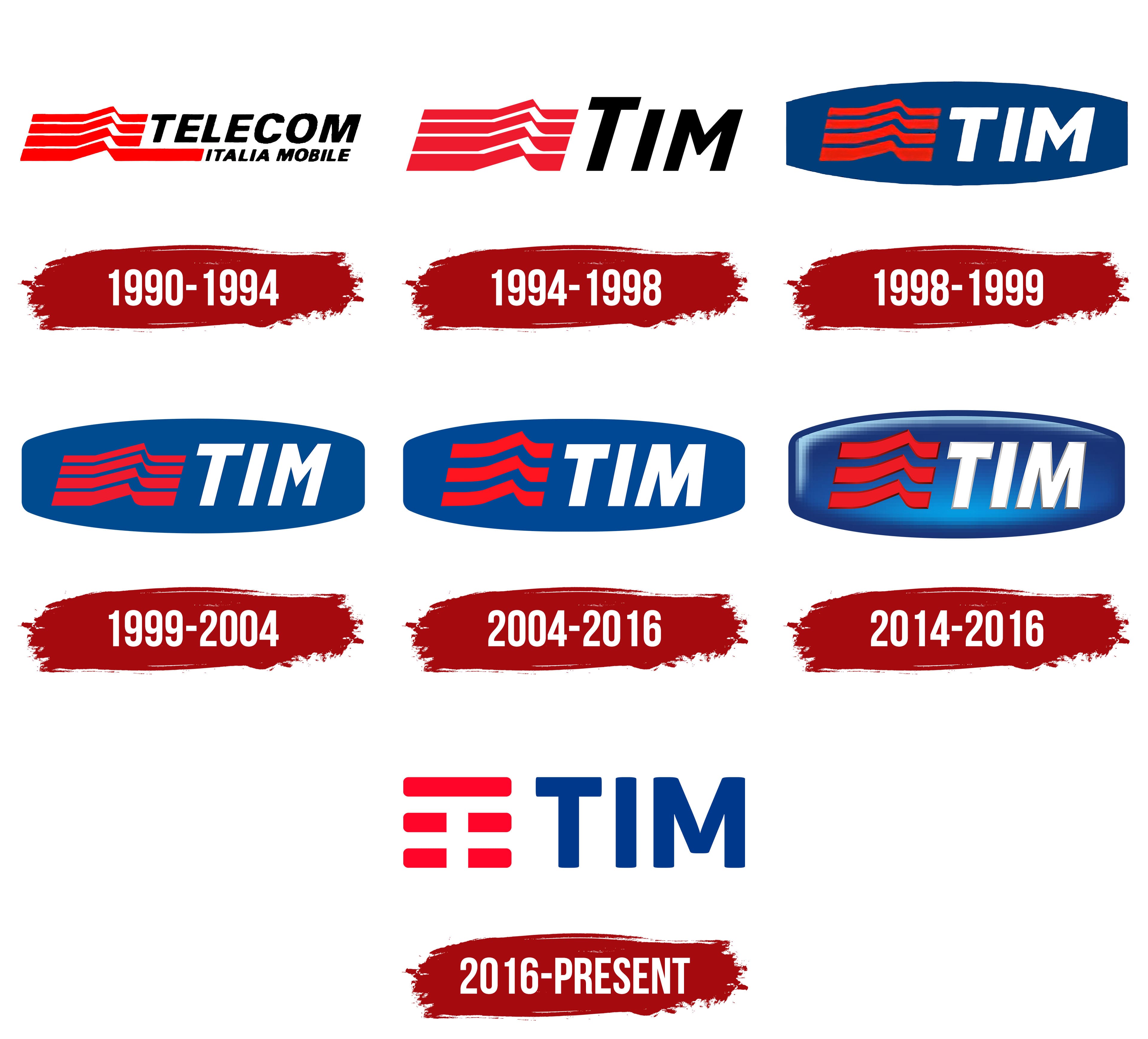
Despite its short lifespan, TIM has changed its logo several times. It continually refined it through six redesign stages. In total, it has seven logos, almost identical to each other because the changes were minor.
What is TIM?
TIM stands for “Telecom Italia Mobile.” It is the legal name of the company Gruppo TIM, the most influential provider of telecommunications services in Italy. It appeared in 1994 as Telecom Italia SpA but was renamed in 2019. TIM is also the brand name created in 1995 and owned by Gruppo TIM.
1990 – 1994
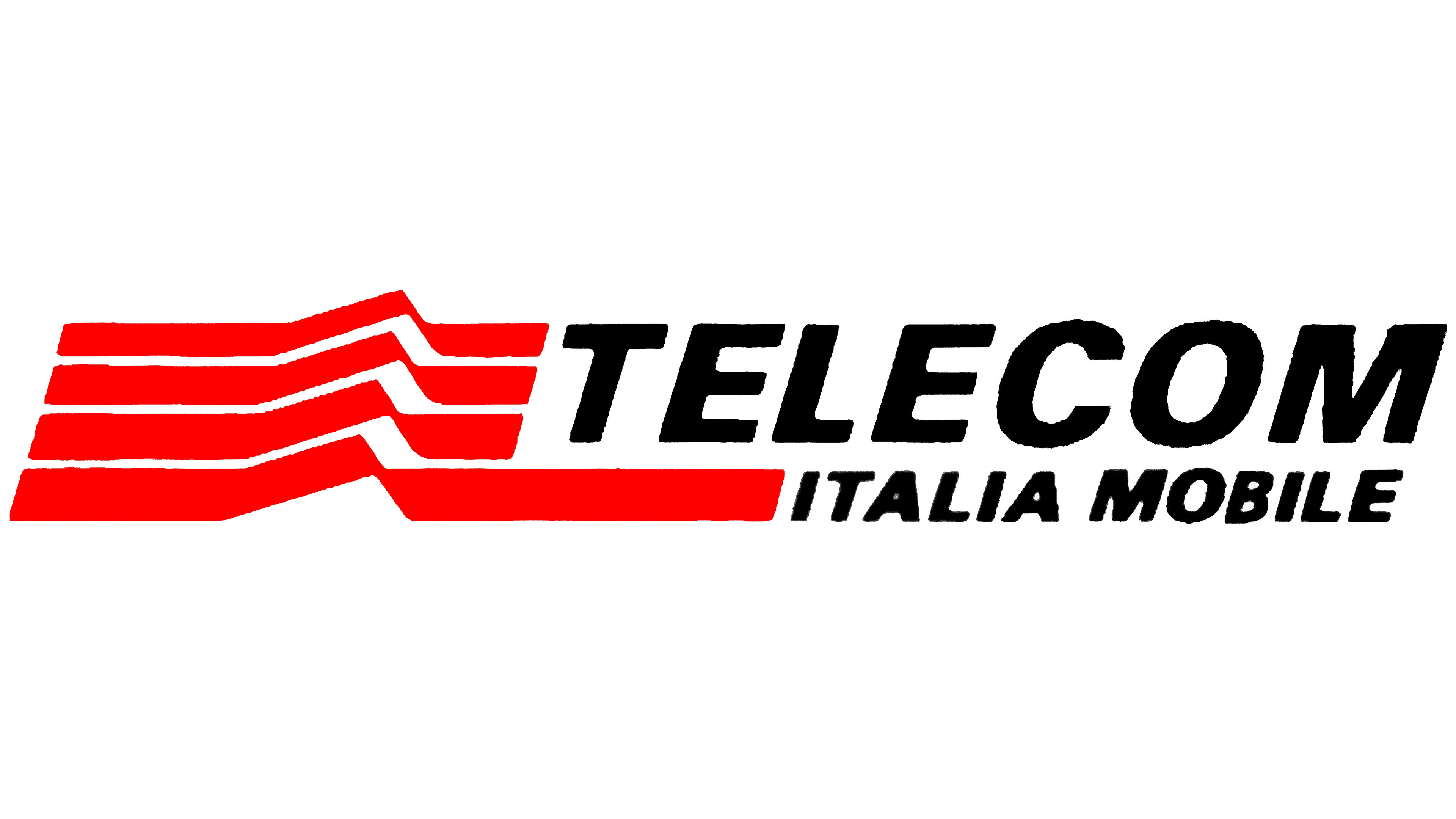
The original logo featured four red stripes: three short and one long. They twisted down to the company name, set in two lines. Above was the large “Telecom,” below the smaller phrase “Italia Mobile.” The lines symbolized steady waves that could overcome any obstacle. The text was printed, chopped, and slightly tilted to the right.
1994 – 1998
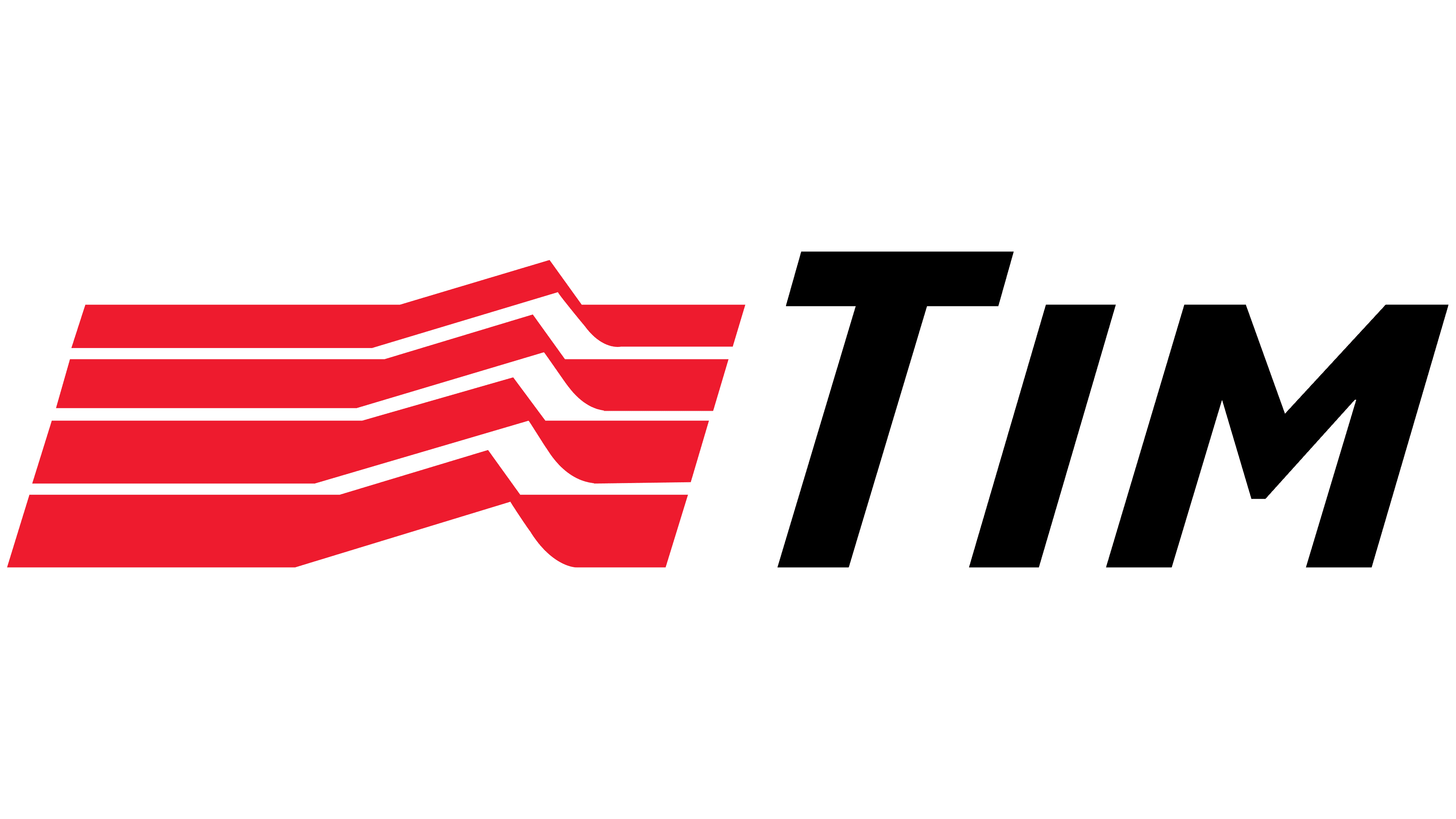
Following the restructuring, the telecommunications operator adopted a new logo. It was based on the old logo with minor changes. The designers made all the strips the same length and shortened the operator’s extended name. The abbreviation consisted of capital letters larger than the others (the first “T”). The developers left the symbols’ colors, fonts, and slants unchanged.
1998 – 1999
A 1998 modification brightened the logo and brought it closer to modern graphics. To do this, the authors took several key steps while preserving the personal sign’s original structure. They made the “TIM” acronym the same size, increased the stripes’ color, and added a blue oval truncated on both sides. It became the backdrop for white letters and red lines.
1999 – 2004
Subsequent changes affected the main inscription. The designers extended the letters while maintaining the same text style. They smoothed the corners of the truncated oval and adjusted the stripe width, positioning them in perspective from wide (in front) to narrow (in the background). At the same time, the ellipse itself became slightly wider.
2004 – 2016

In 2004, the telecommunications company adopted the most revolutionary logo in its history with three stylized waves instead of four. They indicated the number of work areas covered: fixed telephony, mobile network, and the Internet. The stripes were still the same length and contained identical “splashes,” acute-angled protrusions. At the letter “M,” the designers have lengthened the middle section, placing it at the level of the legs.
2014 – 2016

During this period, the logo took on a 3D version. The developers added shadows and highlights to the existing logo to create a sense of volume: the farther from the center, the darker the blue. Thanks to this play of shades, the personal sign became convex and suited modern information carriers. But the typography did not change: the inscription remained printed with a slight slant.
2016 – today
The current version is a completely redesigned logo. First, the designers straightened the stripes and rounded their edges. They depicted overcoming obstacles with waves as discontinuous segments. Moreover, the red lines (one long and four short) form negative space, in which a single white “T” is visible. To the right of the icon is the abbreviation “TIM.” It is now straight, elongated, with the middle “M” cut off.
Font and Colors

Although the evolution of the personal identification mark is insignificant, it accurately reflects the key stages of a telecommunications operator’s activity. As a result, the modifications simplified a visually complex, multi-structured symbol into something minimal and uncluttered. Now each element works for the brand and conveys specific information. And even negative space is used.
At different times, different fonts prevailed in the logo. Urbano Black Italic by FontSite Inc. was chosen as the debut. Today, a typeface resembling Caros Soft Extra Bold with rounded outer corners is used. Other times, modified PCTL9600 Bold Italic, Ridley Grotesk Extra Bold Italic, and Vista Sans Black Italic were used.
The emblem palette consists of navy blue (#013889), crimson red (#e50528), and neutral white. Black also appears in the inscriptions.