 Tuborg Logo PNG
The Tuborg logo preserves a unique recipe the creators used centuries ago. The logo spreads information about the product everywhere.
Tuborg is a 4.5%-5.6% low-fermentation beer brand produced at its eponymous plant in Denmark. It is one of the most famous brewing brands, and its products are distributed in more than 100 countries and produced under license in almost 25 countries in Africa, Asia, and Europe. Four industrialists formed a business alliance to found the company: Philip Heyman, Rudolph Puggaard, Gustav Brock, and C. F. Tietgen. Today, the Carlsberg Group owns it. The head office is in Fredericia, Denmark. The alcohol brand appeared in 1873. The company brewed its first pilsner in 1880.
The company’s roots date to the second half of the 19th century, when a brewery opened in Copenhagen, built by the Danish businessman and financier Carl Frederik Tietgen. He teamed up with three entrepreneurs led by Philip Heyman to launch the beer brand. They introduced a light, low-fermented alcoholic beverage with an unobtrusive hop flavor and called it Tuborg. The name refers to the local Thuesborg, which translates as “Thue’s castle.” It lies near a 17th-century hotel and gave the brewery its name. It also gave Copenhagen a street named Tuborgvej.
The beer became successful and widespread not only because of its taste but also because of the bottles it was poured in. First, Tuborg was the first company in Denmark to offer beer in portioned containers instead of kegs. Second, it was easier to deliver the product to every corner of the country and abroad, expanding its distribution. Three years after the company was founded, it began producing its famous Tuborg Green line, and five years later, it launched Tuborg Gold.
In 1894, a historical event occurred: 11 breweries in Copenhagen were united into a single group called The United Breweries. Its main task was to compete with Carlsberg. However, in 1903, Tuborg agreed with Carlsberg to split the supply and income, dividing the market in half. In 1970, Carlsberg A/S took over both plants. Then BBH (Baltic Beverages Holding) took over the Copenhagen plant. But after a few years, the situation changed, and Carlsberg and the Tuborg brand took it over.
Meaning and History
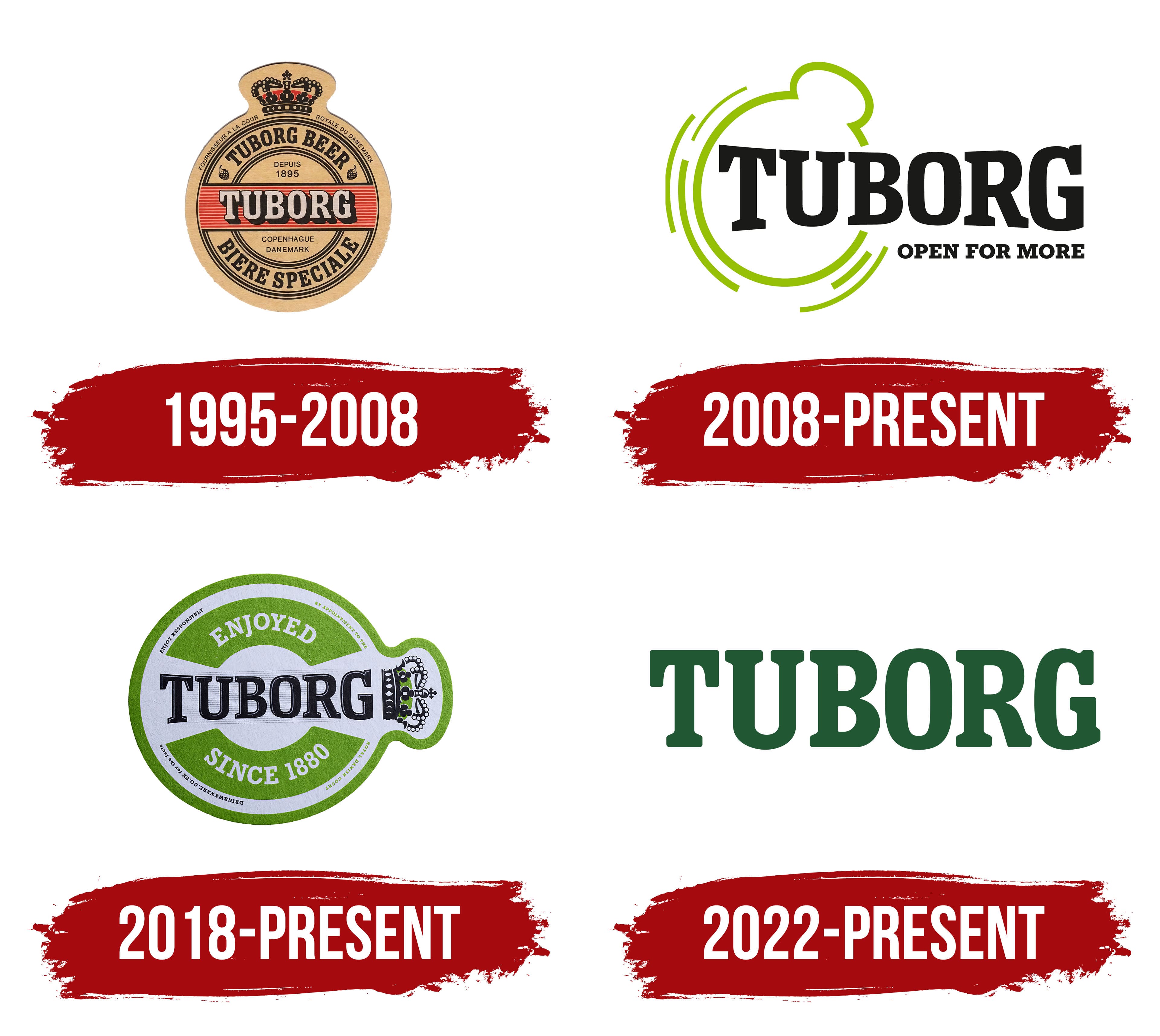
With over 140 years of brewing history, Tuborg strives to maintain a modern, creative, and youthful image, as it doesn’t want to be associated with a product “for old people.” However, it still uses its pocket watch-shaped logo today, albeit in a redesigned form. Philip Wulff Heyman, co-founder of Tuborg Brewery, created the original logo and understood marketing well. The crown on the label appeared in 1915, when the brewer was granted status as a purveyor to the court.
What is Tuborg?
Tuborg is a Danish beer brand and the company that produces it. It was founded by a group of businessmen led by Philip Heyman, whose descendants held the company’s helm for a long time. The brewery was opened in 1873 on the outskirts of Copenhagen, in Hellerup Harbor. It brewed its first pilsner in 1880 and then introduced several variations to the market. Since 1970, the brand has been part of the Carlsberg Group and has exported to more than 100 countries worldwide.
1995 – 2008
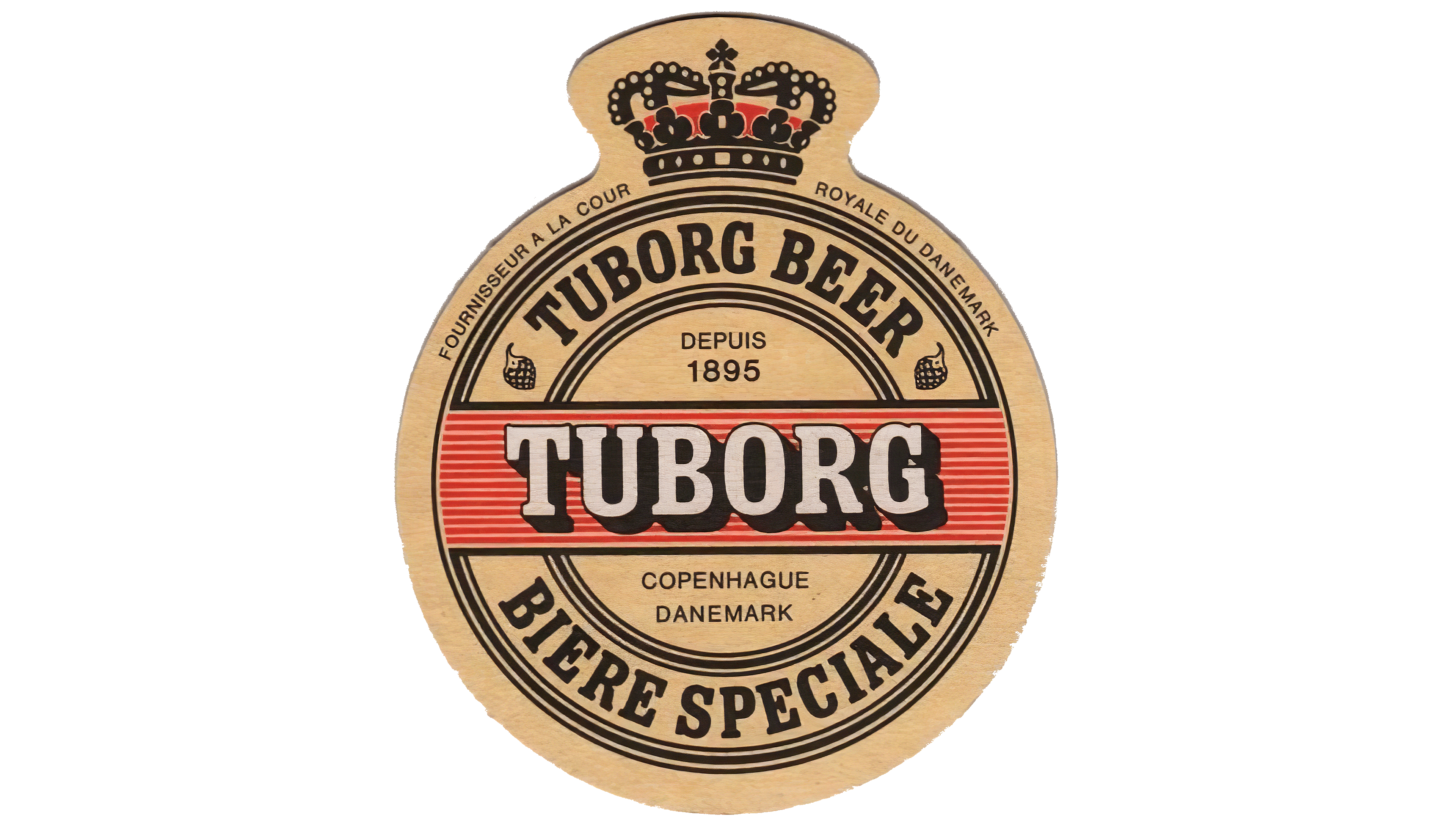
The logo is divided into two zones: graphic and text. The first part is an image of the imperial crown. The attribute of monarchic power is colored gold and studded with precious stones cut in round, rhombic, and rectangular shapes. Large white pearls are drawn on the crossbars. The cloth side is dyed red, and a figure cross crowns the whole with four-fingered, rounded ends. The bottom of the crown and the dividing lines are black.
Below is the brand name Tuborg, rendered in a grotesque style and painted gray. At the same time, a shadow falls from each letter. This inscription is the largest on the label, so it immediately attracts beer lovers’ attention. It is no longer used on all beer brands.
2008 – today

A variation of the emblem appears on bottles, cans, and caps. It is a cap: it fits around the element, with a ring at the top for tapping the beer. One variant has the word “Tuborg” in the center. It is inclined and almost vertical. The letters are black, with white stripes on the left that extend from the center to the edges. Wide arches on the left and right sides of the brand name bear inscriptions with information: the type of beer, the place of production, and the year of the first pilsner.
The basic version of the modern logo is schematic but also resembles a cap with an uncorking ring. Arc-shaped strokes of different lengths surround it. The beer producer’s name is set horizontally and decorated with large serifs. All elements are colored in lettuce green or black and set against a white background.
2018 – today

The logo features a large “TUBORG” inscription against a dark, thin stripe background. The black letters with gray shadows appear two-dimensional. A green arch-shaped quadrilateral appears at the top, and a mirror image, curved in the opposite direction, appears at the bottom. The first fragment contains the white word “ENJOYED,” and the second, the phrase “SINCE 1880.” A font with rectangular serifs is used for these inscriptions. The traditional Tuborg crown is located to the right of the brand name, a reminder of the rich history of alcoholic beverages. All elements are placed in a white circle with a protrusion, surrounded by a wide green stripe.
2022 – today
The beer manufacturer did not abandon the “pocket watches” motif but instead brought an exquisite wordmark to the forefront. The rebranding was planned as early as late 2020. At least that’s when Tuborg signed a contract with the British design studio Robot Food, which had won the tender to update the Danish company’s corporate identity. The team worked on the emblem throughout 2021. Designers had to rejuvenate the brand and show it wasn’t only intended for older generations. Tuborg’s owners were concerned that modern youth make decisions based on the “all or nothing” principle and reject old beer brands as uncool.
The agency sought to attract the target demographic’s attention with a wordmark aligned with the fashionable principles of minimalism. Typographer Rob Clarke designed the new logo’s font. He created a version that fits comfortably on the packaging’s curve. Now all letters have a smooth shape and rounded serifs. The designers kept the traditional green but chose a darker shade associated with confidence, freshness, and reliability.
Font and Colors
Tuborg prefers to use several logo variants for marking the individual beer lines. They share the same name, which appears on all the labels. Some of them are also characterized by a crown placed beneath the text. It has become the main link between the beer, its founders, and its place of origin.

The brand’s key association has passed down through generations and centers on its unchanging Stencyl for uppercase letters and Cheltenham for lowercase letters. The color palette is also stable: green in several shades and neutral white. Red, gold, and black appear from time to time, depending on the beer type and the container it is placed in.