 Udemy Logo PNG
Create a cozy and happy home, find a profession, or build a house? The service offers information on everything. The Udemy logo conveys comfort, completeness, and ideals. Soft lines show care. The emblem represents knowledge that promotes growth.
Udemy began with Eren Bali, a Turkish programmer who grew up far from strong educational resources. In 2007, he built software for virtual classrooms. In 2009, Bali and Oktay Caglar moved to Silicon Valley, met Gagan Biyani, and shaped the idea into a marketplace where anyone with practical knowledge could create and sell a course.
In February 2010, the founders started pitching investors and received over 30 rejections. They launched anyway on May 11, 2010, using personal savings. Within months, Udemy had 1,000 instructors and about 2,000 courses. By August 2010, it had raised its first $1 million. Series A followed in 2011, led by Eric Lefkofsky and Brad Keywell, and a $12 million Series B followed in 2012, led by Insight Venture Partners.
Udemy added an iOS app in 2013 and an Android app in 2014. By January 2014, the app had passed 1 million downloads, with 20% of users studying only on their phones. Dennis Yang became CEO in April 2014, while Bali shifted toward technology. The same year, Norwest Venture Partners led a $32 million Series C round, as Udemy reached 1 million students.
Udemy for Business, launched in 2013, later became the company’s main revenue driver. By 2019, it served more than 5,000 corporate clients, including Adidas, Pinterest, Toyota, and Eventbrite. After a piracy controversy in 2015, Udemy introduced Link-Busters in 2018. Benesse Holdings invested $50 million in 2020, and Udemy went public on Nasdaq in 2021 under UDMY. In December 2025, Coursera announced a deal to acquire Udemy for about $930 million.
Meaning and History
Eren Bali, one of Udemy’s co-founders, studied in a small village school, so self-education was close to him. He teamed up with Oktay Caglar and Gagan Biyani to create a virtual classroom where people can learn new knowledge or share their own experiences. No investor believed in the project’s success, but after attracting 10,000 users, they still secured funding.
The company name consists of two parts: “U” (You) and “demy” (Academy). They chose it in 2010, and it became the basis for all wordmarks, which were updated and redesigned periodically.
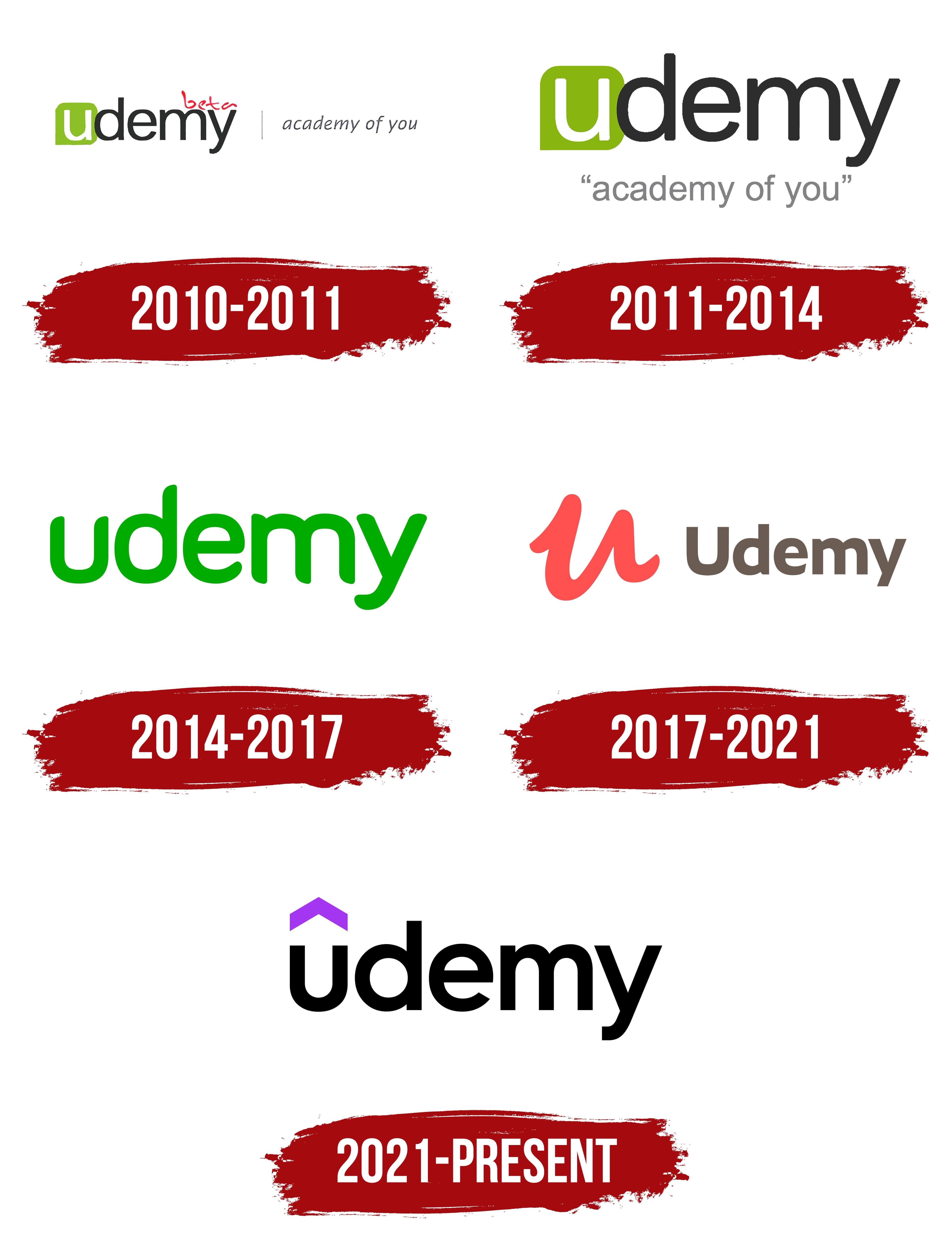
2010 – 2011
The beta version of Udemy used a multi-component logo with captions. The online learning platform’s name appeared on the left in a sans-serif typeface. Above it, in the upper right corner, was the red handwritten word “beta.” A thin vertical line ran along the right. It separated the phrase “academy of you” in gray italics. The first letter in the title was white and depicted inside a green square with three rounded corners. Udemy retained this element in its identity until 2014.
2011 – 2014
In 2011, Udemy launched the main version of its site and introduced a new logo. Due to the change in status, the word “beta” disappeared. The vertical dividing line was removed, and the company’s motto was centered at the bottom. Moreover, the designers put it in quotation marks and used a straight font instead of italics.
2014 – 2017

In 2014, Udemy changed its CEO. Dennis Yang took over as leader and undertook a redesign. The logo designers removed the slogan, leaving only the teaching platform’s name. The font was redesigned with rounded letter corners, and the protruding strokes in the lower-right corners of the “u” and “d” were removed. The lettering turned light green.
2017 – 2021
The company renewed its logo a year after receiving massive funding from Naspers Ventures. This time, she made the word “Udemy” dark gray and capitalized the first letter. The designers chose a bold typeface and lines of varying thicknesses to make the inscription stand out. A red symbol appears on the left, along with a large handwritten “U.”
The company’s name is serrated, and thick strokes contrast it. It looks like a modified Typold Extra Bold; only the “d” and “e” resemble the corresponding letters from the Rawson Extra Bold typeface.
The identity developers have named each color. The most important color in the palette is the red Durulova (#EB5151). It reflects Udemy’s connection to the small village that started it all. The inscription uses a gray-brown Mombasa (#645A52), named after the developing city.
2021 – today
In 2021, Udemy changed its long-established logo to a neutral one without the stylized “u.” But it retained the overall structure: a wordmark complemented by a small bright image.
As before, the name of the global online learning platform occupies the center. Now it’s rich black instead of dark gray, so it is easier to see against a light background. The first “u” became lowercase, the intra-letter gap in “d” became a circle, and the cut angle at the end of the “e” changed. A smooth curve appeared at the bottom of the long diagonal stroke of the “y”. At the same time, all glyphs remained bold.
A new element of the Udemy logo is a purple “hat” above the first letter. It resembles a superscript diacritic, which affects vowel pronunciation. But here, the inverted angle has nothing to do with phonetics. It looks like a roof, symbolizing reliability and protection. It also looks like an upward-pointing arrow, visually embodying development and growth.
Font and Colors

The Udemy logo lettering is a custom glyph set based on a classic bold sans serif. The low-contrast, geometric sans serif is reminiscent of YOFonts’ Eau Sans Bold (if you round the inner gap of the “d”). It also has elements from Omnes, FF Cocon, and similar typefaces.
The new corporate color, purple, is close to #A435F0. It is the basis for a bright, optimistic palette that should inspire confidence in the brand. Purple also complements the rich black inscription well.
The U-shaped icon used alongside the wordmark is called Union. It expresses the two-way connection between those who create training courses and those who use these lessons to gain new experiences. The jagged, curved lines embody dynamics because learning is more than development and moving forward.