


 Uponor Logo PNG
The Uponor logo is light, airy, clean, and weightless. The designers deliberately made it that way to demonstrate the efficiency of the cooling, heating, and water supply systems the company produces. They used a minimalistic style because it best conveys a comfortable atmosphere.
Uponor began on August 13, 1918, when Aukusti Asko-Avonius opened a small carpentry workshop in Lahti, Finland. The company began in building materials and woodworking and grew alongside Finland’s early industrial development after independence.
In the 1960s, the business moved into plastics and began developing pipe technologies for building systems. By the late 1960s, it was working with cross-linked polyethylene, or PEX, for radiant floor heating. In 1972, the company became the first in the world to begin serial production of PEX pipes, a flexible, corrosion-resistant alternative to metal piping.
Expansion accelerated in 1988 when the company purchased Swedish PEX specialist Wirsbo, which already had operations in North America. After the deal, production was moved to Apple Valley, Minnesota, where a new plant opened in 1990. That same year, Neste Corp. became the majority shareholder and narrowed the company’s focus to plastic pipe systems. In 1999, Neste acquired Germany’s Unicor, strengthening its position in multilayer composite pipes. On January 1, 2000, after merging with Asko Corporation, the company renamed itself Uponor Corporation.
By 2003, PEX plumbing products accounted for half of Uponor’s North American business. Uponor Infra was formed in 2013 through a merger with KWH Pipe. In 2015, the company settled two class actions over early brass fittings for $18 million, after those fittings had been discontinued in 2009. In 2016, Uponor and Belkin International created Phyn for smart home water monitoring. Its competitors included Viega and Geberit. In November 2023, Georg Fischer acquired Uponor for €2.2 billion and added it to GF Building Flow Solutions.
Meaning and History
Uponor provides residential and commercial buildings with leading technology, focusing on sustainability and high-quality service. The company uses innovative technology and reliable materials in its manufacturing process. Tponor specialists also work to develop the brand, so each year it introduces more advanced plumbing systems and functional heating and cooling equipment to the market.
The manufacturer’s specialization formed the basis of the brand identity concept. A distinctive feature of the Scandinavian countries is a preference for laconic, simple design. In Finland (where the company is based), this trend is also supported, so an uncomplicated font and monochrome color scheme were chosen for the Uponor logo. It is based solely on the company name, highlighting the significance of the released designs and the professionalism in the chosen field.
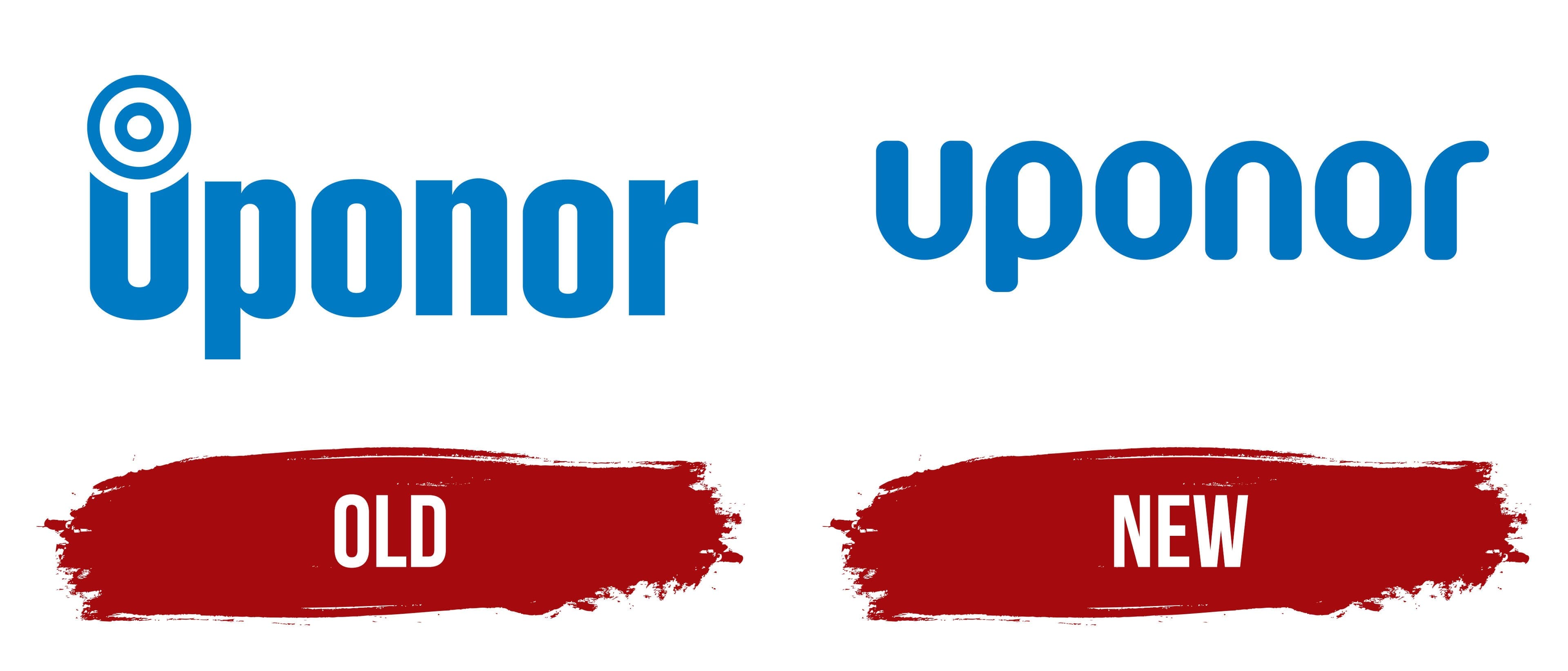
Old

The Scandinavian company has provided consumers with innovative infrastructure solutions for over 100 years. At the time of its foundation (1918), a corporate identity was also developed. The company name formed the basis of the logo. The designers chose a stylish blue to evoke trust, stability, and reliability.
The shade also symbolized the manufacturer’s responsible approach to machinery production. For a brand in this industry, building a friendly, trusting relationship with customers was especially important. After all, the solutions he was offering were bought for long-term use.
Customers choose such products quite carefully, so it is important to pay attention to every detail, down to the product’s badge. To maximize the essence of Uponor and show its value to customers, the designers added an elegant icon above the first letter of the name. It resembled a shooting-gallery target.
The standout element was Uponor’s ability to provide solutions perfectly suited to a specific request. The wordmark featured clearly defined letters with soft cuts and rounded edges. Medium-sized lines kept the logo recognizable and expressive.
New
Further on, Uponor steadily gained the attention of more and more customers and gradually took the lead. The company’s development was also reflected in the logo. The old badge was replaced with a more stylish version that removed unnecessary elements. The color remained the same, indicating the brand’s steady development along a consistent course.
The changes touched upon the font and graphic elements. The latter completely disappeared from the new logo, while the font became even smoother. Such a design refreshed the emblem, making it more modern. The new design was successful, authoritative, and innovative.
Font and Colors
The current Uponor logo, like the first version, is minimalist. It is based on just one inscription, which is, in fact, the emblem. It is in the original sans-serif font. The letters resemble the Mic32 New Rounded Bold style, with thick lines and smooth angles. This unusual font adds solidity to the badge.
Given the brand’s long history and its high-quality design portfolio, this design fits the company perfectly. In addition, the font’s softness is associated with the comfort that Uponor strives to provide to each of its customers. The brand value system is also evident in the perfectly matched colors. The letters in the name are light blue.
The neutral white base color was chosen as the background. Blue represents water and sky. It signifies tranquility, reliability, and inner strength. In this context, it reflects the product’s high quality, reliability, and stability. White is a universal background that highlights other shades while symbolizing simplicity and transparency. It means the company values its reputation and strives to deliver the best to customers.