 Veet Logo PNG
The Veet logo showcases the silky-smooth surface. The emblem visually conveys the results of the company’s work. Compositions for depilation act carefully and gently. No redness or irritation, just clean, beautiful skin.
Veet originated in 1919 in Canada, when Hannibal Pharmaceutical introduced a depilatory cream called Neet. The formula used thioglycolic acid and potassium hydroxide to break down keratin, allowing hair removal without blades.
In 1922, the brand was registered in the United States. In the United Kingdom, it appeared as Veet, while in continental Europe, it was sold as Immac. These parallel names defined regional positioning for decades.
Through the mid-20th century, the segment remained relatively narrow. In the U.S., Church & Dwight launched Nair in 1940 and expanded through radio, then television, campaigns. Neet and Veet held comparable roles but relied more on European markets.
In 1990, Reckitt & Colman acquired the brand and integrated it alongside Dettol, Disprin, and Harpic. The focus shifted toward restructuring the portfolio and aligning product identity across regions.
In 1999, Reckitt & Colman merged with Benckiser to form Reckitt Benckiser. By 2002, Teet replaced Neet in North America and Immac in Europe, completing a multi-year consolidation.
The rebranding was accompanied by increased advertising and product diversification. The line expanded to include creams, gels, mousses, and wax strips, each adapted for different skin types and body areas.
By the 2010s, Veet operated in dozens of countries and remained a leading name in chemical depilation. In 2020, Reckitt Benckiser reviewed options to sell brands including Veet, Clearasil, and Scholl, but no transaction followed.
In 2021, the company shortened its name to Reckitt, keeping Veet within its hygiene division as a long-standing product line.
Meaning and History
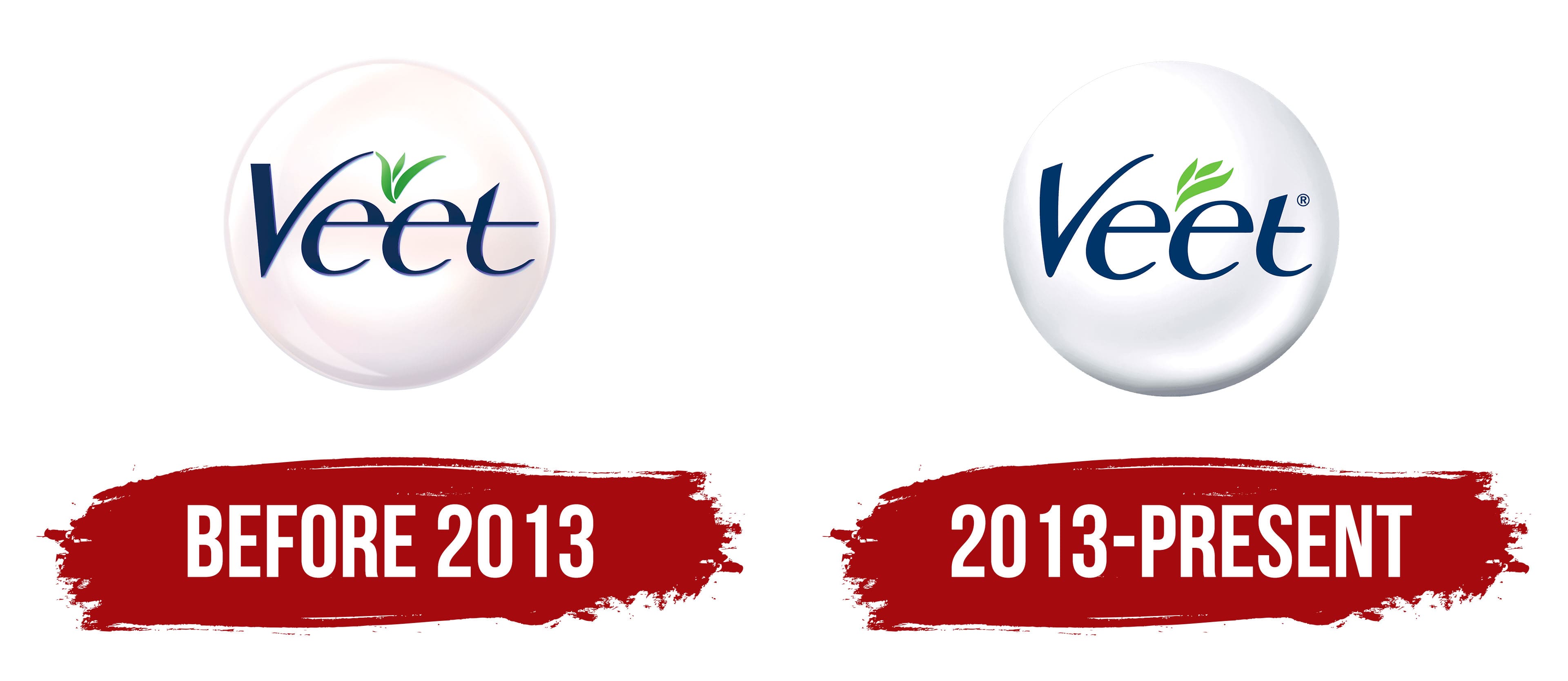
The trademark’s personal symbolism comes from its name, adopted in 1922. Initially, the company was called Neet, but it was renamed in the French manner because “veet” means “quickly.” As a result, the company’s name directly reflected how the products worked. Throughout its existence, the brand has had four logos.
What is Veet?
Veet is a Canadian brand of chemical hair removal products produced by the British company Reckitt Benckiser Group PLC (which purchased the trademark in 1990). The product line includes creams, mousses, waxes, gels, and lotions. The Hannibal company first produced it in 1919 under the name Neet. The current name, Veet, was introduced in 1922 and means “quick” in French.
before 2013

This version of the logo represents the word “Veet” in its original spelling. The two letters “e” and “t” are connected by a horizontal line, and the capital “V” is shaped like a large checkmark. Green grass sits in the middle between the signs (above), consisting of three stems. She says that the depilatory agent’s formulation acts gently and naturally, as if “mowing the grass” at the root. All elements are located in a small 3D circle.
2013 – today
At first glance, the changes did not significantly alter the Veet logo, but in reality, they did. The designers removed the similarity between the “V” and a tick: the capital letter now has a curved shape with a left-facing taper, not just a right-facing one. However, they rounded off the lower corner. The remaining characters have lost their connecting line, so “e” and “t” are now separate. The last glyph has half of its crossbar cut off and reduced in size. The grass stalks became smooth, flowing, and tilted to the right, as if they were under the wind’s onslaught. The color scheme has also changed drastically. The inscriptions are light blue, and the background circle is painted in a gray-white palette, making it look like a mother-of-pearl ball glowing from within.
Font and Colors

The brand name is set in a custom typeface designed for it. The inscription combines uppercase and lowercase letters. All signs are rounded, and the two “e”s and the “t” share a common stroke. The signature palette consists of blue, green, white, and a subtle pink gradient.