 Venmo Logo PNG
Venmo’s money transfer logo is simple yet symbolic. The emblem embodies the instantaneous movement of funds in users’ accounts and emphasizes the brand’s business nature. At the same time, the emblem looks friendly because the service must be trustworthy.
Venmo is an American mobile money transfer service built on a P2P (peer-to-peer) architecture. Account holders can instantly send and receive payments through a smartphone app. However, both the recipient and the sender must be in the United States. The service launched in 2009 to help relatives, acquaintances, and friends share funds to pay for tickets, rent, food, films, and more. Money transfers instantly, and transactions appear in the app’s social feed. Andrew Kortina and Iqram Magdon-Ismail organize the service. PayPal owns it, and it’s available on Android and iOS.
Two friends who met as freshmen at the University of Pennsylvania created Venmo. They came up with the idea while solving problems opening a store. Then they realized how difficult it is for businesses to use software. Once, at a jazz show, they figured out how to instantly buy an MP3 file with a single text message.
The idea got stuck when Iqram Magdon-Ismail forgot his wallet while traveling with a friend. Therefore, they soon began implementing the idea of transferring money using mobile phones. But instead of texting, they had to tackle applications. In 2010, the new company received $ 1.2 million in start-up capital from RRE Ventures. It started and continued until Braintree was bought in 2012 for $26.2 million. In the winter of the next year, the parent organization switched to PayPal, which paid $ 800 million for it.
In 2020, PayPal allowed users to buy and use several cryptocurrencies, including Bitcoin, Litecoin, Bitcoin Cash, and Ethereum, through Venmo. This decision took effect in the first half of 2021. The only limitation is that only a select group of users has access to this function. Developers will massively connect the rest of the base in the spring and summer. For security, PIN codes will be used as before.
Meaning and History
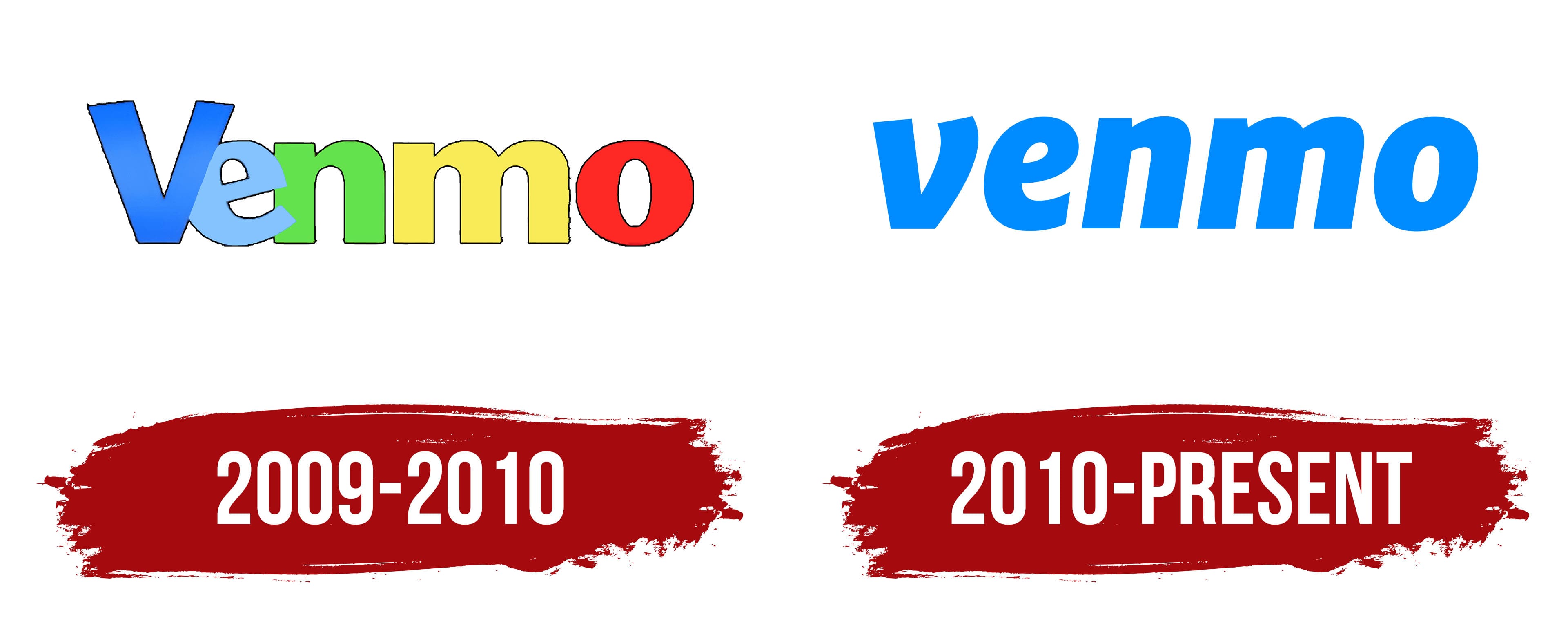
For its identity, the payment service has chosen an inconspicuous, strictly textual sign of personal identity. This was done for promotional and informational purposes to help people remember the new organization’s name.
In addition, this is a convenient form of marketing and information transfer because the visual component is closely tied to the text. This makes it easier for users to learn about the service and for it to expand its reach. Therefore, the owners rely on the wordmark, painting it in different colors or making it catchier with a single bright tint.
2009 – 2010

The word “logo” consists of a single inscription: “Venmo.” It is typed primarily in lowercase, except for the first letter, which is in uppercase. At the same time, the symbols are multi-colored: red, yellow, green, and blue. Each of them has a thin black border. ‘V,’ ‘e,’ and ‘n’ are outlined together, and the rest of the glyphs are outlined separately. The designers added another personal touch: they turned the “e” sideways, placing it diagonally and slightly overlapping the neighboring “n.”
2010 – today
This logo lacks the colorfulness of before; it is monochrome. At the same time, the emblem remains bright, as the designers chose a rich shade of blue. This color emphasizes the service’s business nature and digital focus well because many popular Internet platforms, services, and communities prefer it. The font has also been changed. Earlier, it mixed two registers (upper and lower); here, all letters are lowercase. There is more free space between them because the glyphs are farther apart than before. Among the same characters, “v” stands out: it retains its original typography, with the right side curved outward.
Font and Colors

A square with rounded corners occupies the upper part. It is light blue and centered. Inside is a white “V” formed by wide lines. Its left side is flat, and the right side is curved, with a slight rounding at the top. Because of this protrusion, her legs are slightly misaligned in height. The lower part of the letter is not pointed, as usual, but cut off, giving it a stable platform. She personifies the payment system’s strength and reliability.

The service’s full name is located under the icon. It is executed in wide-format lowercase characters. The letters are optimally spaced relative to one another (neither too close nor too wide); therefore, they read very well. The name “Venmo” has a slight rightward slope, except for the “V,” which matches the graphic symbol exactly.
The logo uses the typeface Helvetica Neue with minimal adjustments, with the “V” turned into an icon. It’s a sleek, bold sans-serif typeface.

The basic logo palette is blue and white. In the upper part, blue serves as the background for the white letter, whereas in the lower part, the blue inscription is on a white background.