


 Warka Logo PNG
The Warka logo reflects patriotism. The emblem pays tribute to the city where the brewery is located and honors the heroes who became famous in Poland’s battles. The sign links the drink to victory celebrations and key dates.
Meaning and History
As Warka points out, its roots go deep, dating back to the 15th century. In 1478, Bolesław V (Prince Mazovian) appointed the brewery as the exclusive beer supplier to his court. But since then, little is known about it, as alcoholic beverage production has declined and the company has lacked capacity. In 1968, construction began on a specialized brewery to provide the population with quality beer, as Warka had long been famous for beer production.
Construction lasted from 1973 to 1975, and the new brewery officially opened at the end of this period. The company began operating under the management of its parent company, Warsaw Brewing Industries (Zakłady Piwowarskie w Warszawie). But in 1976, the brewery was separated from the capital organization and became independent.
In 1994, the brewery changed ownership and became “Browary Warka Sp. z o. o.” The owners then re-equipped and modernized the company, turning it into the country’s largest beer supplier. In 1996, the Swiss company Welinvest acquired the brewery, which later sold it to the Australian firm Brewpole BV. In 1999, Heineken N.V. bought it and included it in a group of five alcoholic beverage producers.
In 2004, the Polish company underwent another renovation, after which it could produce up to 350 million liters of beer per year. It has three product lines: Warka Strong, Królewskie, and Warka Classic. The branded beverage’s bottles and cans feature a recognizable design in the national colors.
What is Warka?
Warka is a Polish brewery named after the city in which it is located. It owns the same-name brand, under which it produces three types of 5.2% lager. The company is part of the Żywiec Group and is owned by Heineken. Its establishment date is 1478. The renovated brewery launched in 1975.
Old

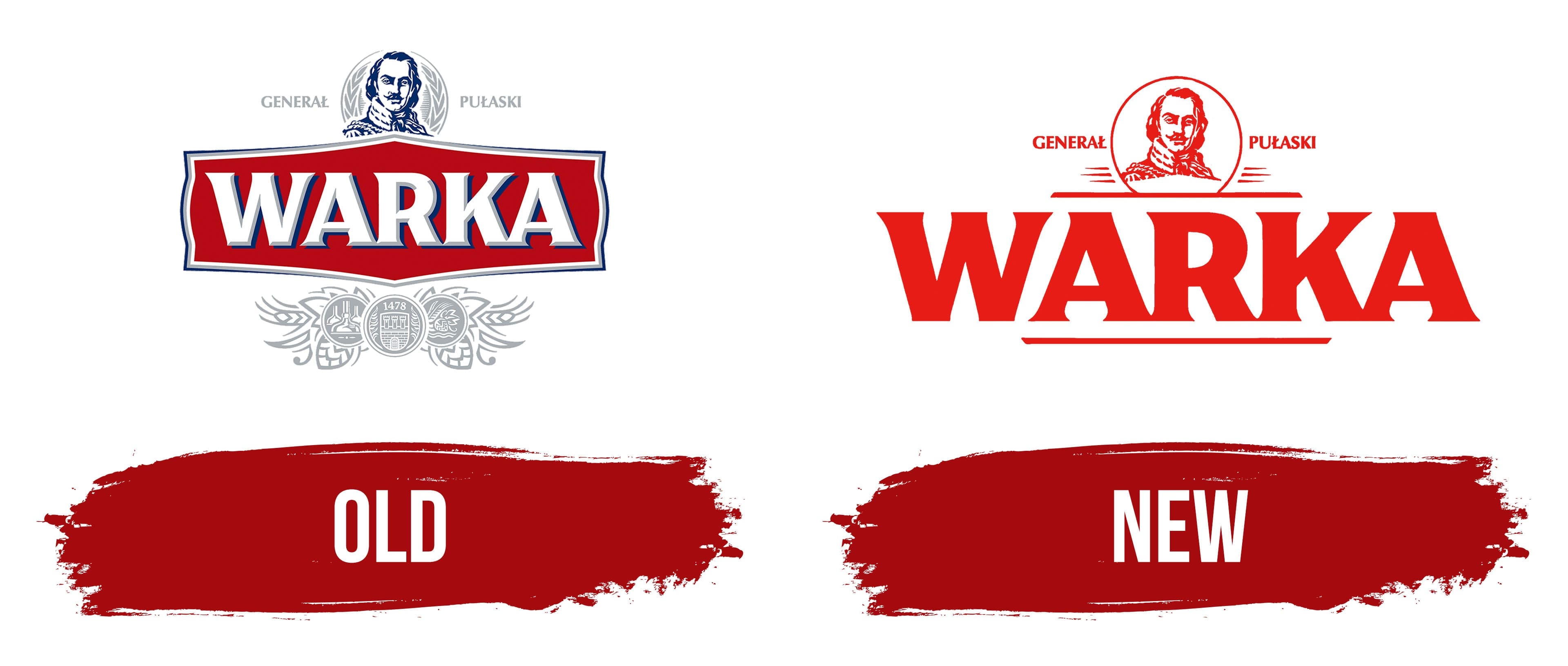
An elongated hexagon sits at the center of the logo, with a triple border of white, gray-blue, and blue stripes. In the center of a red background is the word “Warka,” with miniature serifs shaped like barbed protrusions. The inscription sits in the upper register and uses the same lines as the hexagon, but here they appear on the right as shadows that add volume to the letters.
Above the beer brand’s name is a portrait of Kazimierz Pułaski (in English, Casimir Pulaski), a famous statesman, participant in many political protests, officer of the US colonial army, and Polish patriot. On the right is his surname; on the left, his rank. In contrast, the general is in dark blue, and the elements around him are in light gray. At the bottom are the brand awards received in recognition of the product’s high quality. One of them marks the supposed year of its formation – 1478. Next to it, hops leaves and cones are drawn.
New
The changes touch on minor details in the modern logo, while the most important ones remain. These include the portrait of Casimir Pulaski in a circle, the Polish inscriptions “General” and “Pułaski,” and the bold brand name with small serifs shaped like sharp protrusions. Otherwise, the emblem is simplified: short and long lines replace many small components. They surround the portrait and sit above and below the word “Warka.” The red background is no longer limited to the hexagon; it now appears across all parts and takes a square shape.
Font and Colors

In modernizing the Polish beer brand’s logo, the designers retained key elements that emphasize Poland’s significant role in world history. With political overtones, the alcohol company’s updated palette uses the colors of the country’s state flag.
The typeface draws on the large antique lettering used on tavern signs. It is based on bold antiqua with short perpendicular strokes that blend harmoniously with the letterforms’ legs. The brand’s signature palette now consists of red and white, considered national colors. Earlier, it also used dark blue and gray-blue.