 Washington University in St. Louis Logo (WashU Logo) PNG
The Washington University in St. Louis logo represents a premier educational institution where scientific research, academic traditions, and professional training converge. The university unites students, faculty, and alumni, creating a community bound by knowledge and a drive for discovery.
Washington University in St. Louis was chartered on February 22, 1853, as Eliot Seminary after Missouri governor Sterling Price signed its founding act. Seventeen St. Louis civic leaders supported the project, while William Greenleaf Eliot Jr. became its principal organizer. The institution became Washington Institute in 1854 and adopted the Washington University name in 1857.
The law school opened in 1862 as the first chartered law school west of the Mississippi River. In 1869, it became the first American law school to officially admit women. The School of Fine Arts followed in 1870. St. Louis Medical College joined the university in 1891, Missouri Medical College followed in 1899, and their merger formed the basis of the later medical school.
WashU moved to its current campus in 1905, using buildings constructed for the 1904 World’s Fair. Architecture opened in 1908, business in 1917, and University College in 1925. In 1947, Gerty Cori became the first American woman to receive the Nobel Prize in Physiology or Medicine. That same year, the university began desegregating its medical and social work programs.
By 2024, WashU had been associated with 26 Nobel laureates, including Rita Levi-Montalcini, Stanley Cohen, Robert Furchgott, Paul Berg, and Douglas Dybvig. The Danforth Campus first hosted a U.S. presidential debate in 1992 and later held four more. A $360 million east-campus redevelopment opened in 2019 with five new academic buildings across 18 acres in St. Louis.
Meaning and History

What is Washington University in St. Louis?
This private research university in Missouri is one of the top institutions in the United States. It attracts students worldwide, and its Gothic-style campus creates a unique atmosphere and a sense of home. The institution is known for its strong medical, social work, arts, and architecture programs. Business and medical schools are highly respected; libraries house millions of books and rare manuscripts. The university hosts numerous research institutes, and its sports teams compete in NCAA Division III with a rich history of achievements.
Before 2024

Washington University in St. Louis has long used a logo that combines academic tradition and symbolism with deep historical roots. The composition consisted of a heraldic shield and a text part with the university’s name placed to the right of the graphic symbol.
The shield originates from heraldic models and features a pointed lower edge. Its background was done in a beige shade. Across the center ran horizontal red stripes, on top of which an open book was placed, serving as a symbol of education and science and reflecting the university’s mission as an institution of knowledge. In the upper part of the shield were three green five-pointed stars associated with honor, growth, and the aspiration for development. The lower segment was decorated with three heraldic fleurs-de-lis, which connect the university to the French heritage of the city of St. Louis and to the name of Louis IX, the sainted patron.
The text part of the logo was set in a serif typeface stylistically close to classical academic fonts such as Garamond or Sabon. Proportionality, a combination of uppercase and lowercase letters, and smooth stroke contrast distinguished the typeface. It gave the inscription a strict yet graceful character. The text was black.
The symbolism of the coat of arms was established in the mid-20th century through the university’s heraldic council. The final design, which became part of the official logo, was formed by the early 2000s. The red stripes in the book reflected the educational mission. The green stars symbolized development and forward aspiration. The fleur-de-lis confirmed the cultural and historical connection with the region.
The Washington University in St. Louis logo demonstrated continuity, emphasizing its connection to its founding city and the cultural tradition of St. Louis, and shaped the institution’s image as a guardian and continuator of classical university values.
2024 – today

The decision to give official status to the shortened name WashU became one of the key steps in updating the university’s visual system. In January 2024, a new logo was presented, developed by the Ologie agency in collaboration with the internal team. The goal of the changes was to simplify identity, strengthen recognition of the abbreviation, and preserve continuity with the historic coat of arms.
At the center of the composition remained the shield associated with the university’s heraldry. Its background is now white, which makes the coat of arms lighter and clearer to perceive. The three five-pointed stars and the fleur-de-lis are depicted in a shade of green that adds depth and evokes growth and tradition. The red stripes grew brighter, and the book in the center was given a more prominent depiction, highlighting the university’s educational mission.
The meaning of the symbols remained unchanged. The stars represent three directions of activity in education, research, and public mission. The book symbolizes knowledge. The fleur-de-lis symbolizes the French heritage of St. Louis and its connection to King Louis IX.

The inscription WashU received special importance in the new system. The word is set in a serif typeface similar to traditional academic fonts, but redesigned for a modern aesthetic. “W” and “U” are uppercase, which visually balances the composition and emphasizes the abbreviation. Moderate stroke thickness, clear proportions, and balanced spacing between letters distinguish the font.
The color palette consists of three primary shades: black, red, and green. Black conveys officiality and academic seriousness, red enhances emotional perception and adds brightness, and green emphasizes historical roots and continuity.
The new WashU logo reflects the university’s strategy to strengthen its identity, simplify communication, and create a closer connection with the modern academic and digital environment.
The Seal
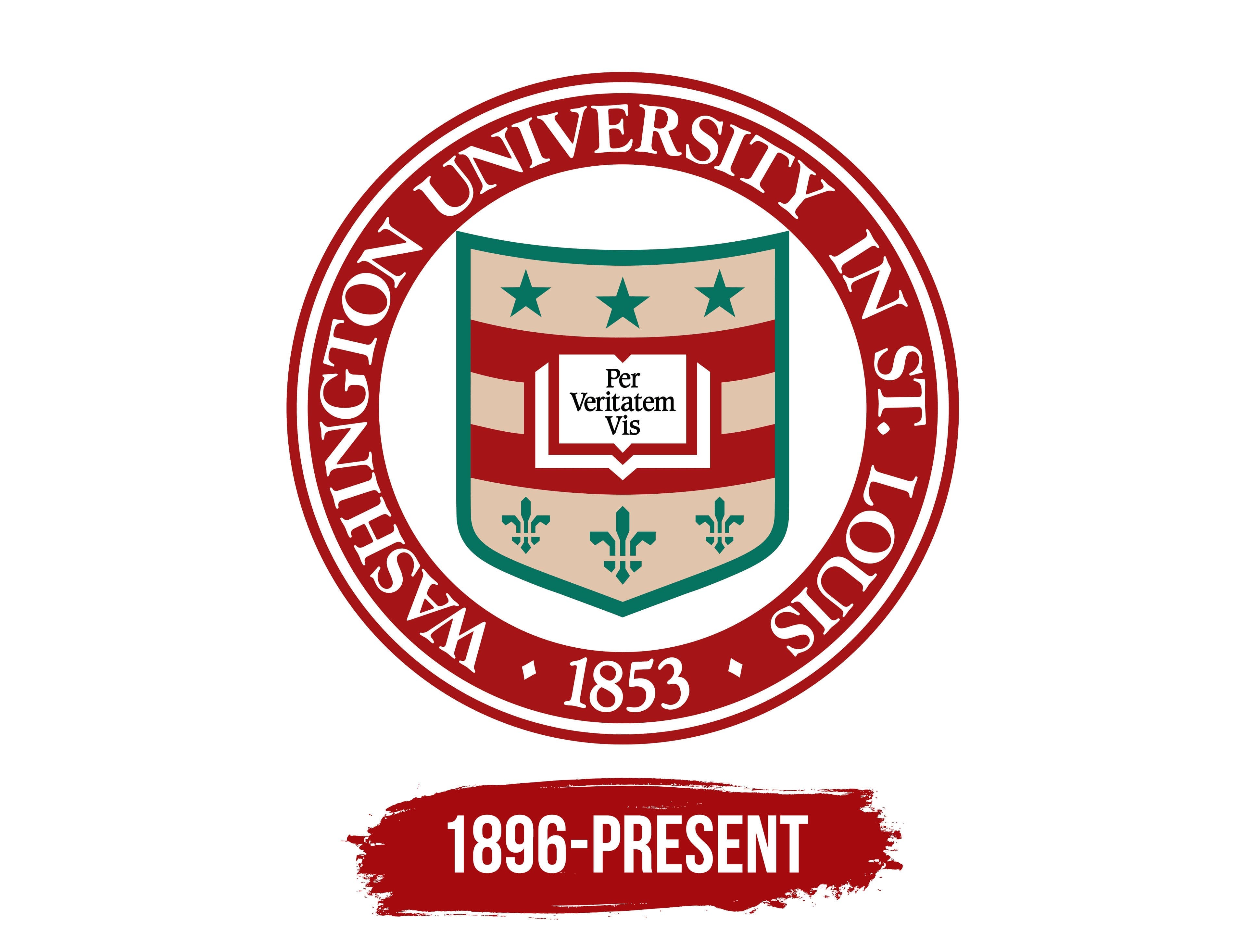
The university seal of Washington University in St. Louis was designed in 1896 by Professor Holmes Smith. It incorporates elements of George Washington’s coat of arms and fleurs-de-lis, symbolizing King Louis IX, the patron of St. Louis. The Board of Trustees officially adopted the seal in March 1897.
1896 – today

Washington University in St. Louis has approved a seal perceived as an official and ceremonial symbol. At the center of the composition is a shield of classical shape with a pointed bottom. Inside it are two horizontal red stripes divided by a neutral beige background. At the center is placed an open white book with the Latin motto “Per Veritatem Vis,” translated as “Strength through truth.” The book highlights the university’s educational mission and its dedication to scholarly pursuits. The upper part of the shield is adorned with three green stars, symbolizing the three primary areas of activity: education, research, and public service. The lower segment is complemented by three green fleur-de-lis, which refer to the French heritage of the city of St. Louis and are connected with the name of Louis IX.
The shield is enclosed in a double ring forming a strict round seal. The outer border is dark red, featuring the full name of the university, “Washington University in St. Louis,” and the founding year, 1853, written in white capital letters. A serif typeface is used for the text, reinforcing officiality and solidity. Between the words and numbers are placed decorative symbols that complete the design and emphasize symmetry.
The color scheme is built on the contrast of red, green, beige, and white. Red is associated with historical symbolism and the coat of arms of George Washington. Green is linked to growth, development, and renewal. Beige softens and balances the composition, while white adds clarity and highlights the key elements.