


 Weight Watchers Logo PNG
The Weight Watchers logo shows that the platform helps you “build” your body on your own. Create the desired volumes and curves. The emblem guarantees comprehensive information on this issue and round-the-clock support.
Weight Watchers began in 1961 with Jean Nidetch, a 38-year-old New Yorker who weighed 97 kg and had tried pills, hypnosis, and repeated diets. After joining a city diet program, she realized food rules weren’t enough. She needed support.
Nidetch started inviting women to her home on Thursday evenings. They spoke openly about eating habits, setbacks, and practical ways to stay on track. The meetings grew quickly. In 1963, she founded Weight Watchers Inc. in Queens with her husband, Al Lippert, and her sister, Felice Lippert. The first public meeting in May 1963 drew 400 people, each paying $2 a week. By then, Nidetch had lost 33 kg.
In 1964, Al Lippert built a franchise model. Former members who kept the weight off could open groups and pay the company 10% of revenue. By 1967, Weight Watchers had 102 franchises in the U.S., Canada, Puerto Rico, Britain, and Israel. The first Weight Watchers cookbook appeared in 1966 and sold over 1.5 million copies. By January 1968, global membership had passed one million.
The company went public in 1968. In 1978, H.J. Heinz bought it for about $71 million. He expanded the brand into frozen meals, while rivals such as Nutrisystem focused on packaged diet foods. Artal Luxembourg acquired Weight Watchers in 1999, and the company returned to the NYSE in 2001. Its Points system, introduced in 1997, later evolved into PointsPlus, SmartPoints, and PersonalPoints.
In 2015, Oprah Winfrey bought about 10% of the company and joined the board. In 2018, Weight Watchers became WW International, shifting toward digital subscriptions and a broader wellness market.
Meaning and History
The company’s success began with the founder’s inability to lose weight for a long time, despite many tried-and-tested methods. Nothing helped Jean Nidetch. Even after losing weight, she quickly gained it back. This continued until the sufferer went on a diet called the Prudent Diet, which was developed in the 1950s by Dr. Norman Jolliffe, head of the Bureau of Nutrition.
Noticing her weight loss and a simultaneous desire for something sweet, Nidetch realized she lacked motivation. And she didn’t like how information was presented at the clinic’s weekly meetings. So the patient began discussing the problem at home, inviting everyone from the group. At first, the support team consisted of six people. Two months later, it had grown to forty faces.
One day, her clients included Al and Felice Lippert, who gave her the idea for the service. As a result, in 1963, Nidetch and Lippert registered Weight Watchers Inc. in Queens. Al ran the company and handled franchise distribution. Jean taught courses on weight loss. Based on her work in recipe development and product research, Felice published a nutrition cookbook in 1966.
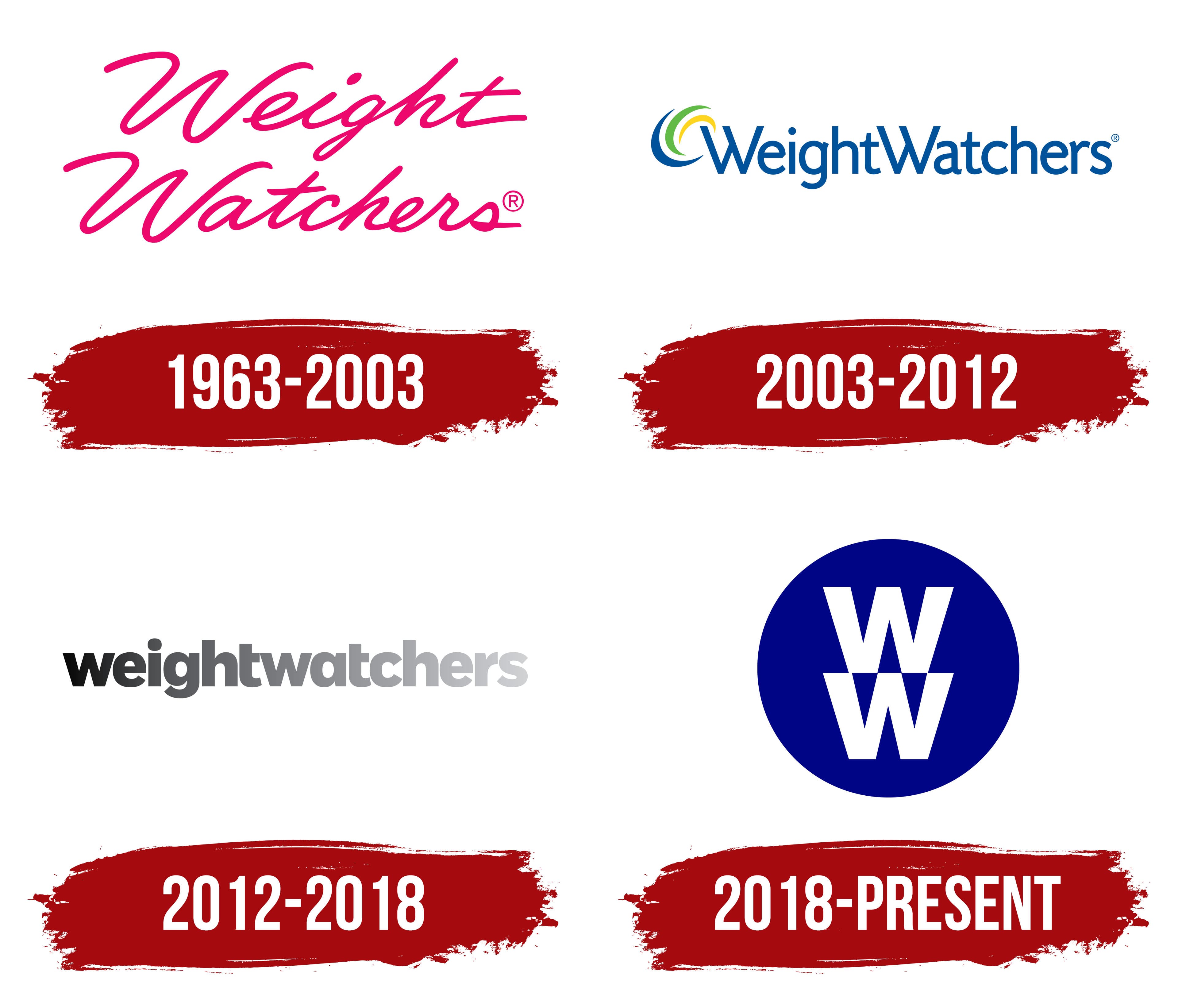
Their joint activities led to success but also attracted many competitors. As a result, the company struggled for some time. In 2015, she partnered with American celebrity Oprah Winfrey. In 2018, the company expanded its services and adopted a new name: WW. At the same time, she carried out a major rebranding, including updating the logo. She has four of them in total.
What is Weight Watchers?
Weight Watchers is a program designed to maintain a healthy body weight. It assumes that people can lose excess weight through a sensible diet, moderate exercise, and psychological support. Each participant has a set number of daily points they can spend on different products. Housewife Jean Nidetch developed the concept. The brand, under its current name, appeared in 1963 and is owned by WW International.
1963 – 2003
The debut logo was a simple handwritten cursive lettering. The phrase “Weight Watchers” appeared in two lines on a white background. It was painted in neon pink, close to fuchsia. The designers combined both parts of the name into a single letter “W”: it is identical in both the top and bottom rows.
2003 – 2012

In 2003, the company revised its magazine, adjusted its publication schedule, and carried out its first logo redesign. It was crucial, as the administration approved a new visual style. For the logo, the developers chose a sleek and even font from the grotesque category. The symbols were very tight, so both words merged into one. But despite the close arrangement, the first letters remained capitalized.
Moreover, both “W” looked like two Roman numerals, “V,” standing side by side. At the top left, three semi-oval strokes appeared: yellow, green, and blue. The inscription was also blue.
2012 – 2018

Since 2012, the company has had its electronic tools and a mobile application. During the same period, management decided to change the visual identity sign. This is directly related to the launch of digital products, as a corporate logo should look distinct across devices. For the logo, Weight Watchers again chose its name. To modernize it and make it easier to read, the designers combined the two words and converted the inscription to lowercase. In this version, all letters were classic, bold, and wide. The logo’s color scheme is monochrome, with a gradient transition from dark black to light gray.
2018 – today

2018 has brought major changes. The company expanded its services, so the slogan in the name became less relevant as its activities grew more diverse. The developers suggested shortening both words to the initial two “W.”This is how the current abbreviation came to be. The letters are stacked one on top of the other and look like four victory signs or four “V” ticks. They are painted white and placed inside a cobalt disc.
The corporate identity developed alongside the company’s expansion. If the logo initially looked like a modest italic inscription, it has now become a bright emblem in the form of a round seal. This greatly simplified the image, enabling it to be used as a trademark, icon, and product label.
Font and Colors

Different fonts were used at different times. The debut version featured cursive lettering that imitated handwriting. The second logo featured a Homizio Black typeface with a modified “W.” For the third version, the designers opted for the Tide Sans 700 Mondo font, with the left side of the “t” bar trimmed.

The signature palette has always been bright, except in 2012-2018, when it consisted only of black and white. The brand’s color palette includes neon pink (#ec016d), navy blue (#00519c), and deep cobalt (#000187).