


 Xerox Logo PNG
The Xerox logo is the word “Xerox” in red, set in a simple, concise font. The logo reflects the company’s innovative, technological approach, always striving to stay ahead of competitors in the industry. Although the Xerox emblem has changed significantly over the years, it remains a strong brand symbol that reflects the company’s values and quality.
Xerox began in 1906 in Rochester, New York, when Joseph Wilson Sr. founded Haloid, a small photographic paper company. For decades, it worked in the shadow of Eastman Kodak. The turning point came under Joseph Wilson Jr., after physicist and patent lawyer Chester Carlson created the first xerographic image in 1938 using electrostatics and dry toner.
IBM, RCA, General Electric, and more than 20 other companies rejected Carlson’s idea. In 1944, Battelle Memorial Institute agreed to develop the technology, and in 1947, Haloid obtained commercial rights. In 1949, the company released the Xerox Model A, its first commercial copier. It was difficult to use, but it proved the method worked. In 1956, Haloid formed Rank Xerox with Britain’s Rank Organization and, in 1958, became Haloid Xerox.
On September 16, 1959, Xerox presented the 914 in New York as the first fully automatic plain-paper copier. The machine weighed almost 300 kilograms and made seven copies per minute. Revenue rose to nearly $60 million by 1961 and passed $500 million by 1966. In 1961, the company became Xerox Corporation and was listed on the New York Stock Exchange. By the early 1970s, it held 93-95% of the U.S. copier market.
In 1970, Xerox created PARC in Palo Alto, where researchers developed the graphical interface, the Alto computer, Ethernet, and laser printing. Xerox introduced the 9700 laser printer in 1977. Antitrust pressure in 1975 forced Xerox to license more than 1,700 patents, helping Canon and Ricoh enter the market. By 1983, debt reached $2 billion. Later, Xerox rebuilt around quality control and digital document systems, bought Affiliated Computer Services in 2009, and split in 2017 into Xerox Holdings and Conduent.
Meaning and History
At the beginning of the last century, the American corporation Xerox was known as Haloid and produced paper for professional photographers. It launched its first photocopier in 1949, a development that would later shape its identity. The technology used was called Xerography, and the product was called Haloid Xerox 14. The invention’s resounding success made “xerox” a household name. The company was renamed after the popular new device and adopted corresponding visual symbols. In the early 1960s, the word “Haloid” on the brand logo was finally replaced by “Xerox.” The “X” trademark appeared a little later, splitting into pixel dots. It symbolizes the thin line between digital and paper documents.
As the company evolved and expanded its range, it needed a new logo that wasn’t tied only to copiers. To avoid the stereotype, the office equipment and paper maker converted the lettering to lowercase. They added a sphere of lines forming the stylized letter “X.” This logo embodied the American corporation’s connection to its customers and to progressive technology.
What is Xerox?
A world-famous American corporation in office equipment owns 8.5 thousand patents in this area. It makes printers, copiers, fax machines, computers, and military equipment.
1906 – 1938

Xerox began as a photographic paper manufacturer. The Haloid Company was founded in Rochester, New York, in 1906. Its name referred to halogens, whose compounds were used in photography. The light-sensitive emulsion on photographic paper contained silver halides, including silver chloride, bromide, and iodide. The name Haloid connected the business to the chemistry behind its products.
The torch in the early emblem continued the photographic theme. Its flame represented the light needed to expose photographic paper. The torch stood behind a horizontally elongated oval bearing the name HALOID. The oval covered part of the shaft, while the flame rose above the lettering. The uppercase letters varied in width and featured thick strokes with small, pointed terminals. Both the decorative lettering and the torch illustration were rendered in black and white.
The torch also represented superiority, reflecting the founder’s ambition to make the company an industry leader. Haloid grew in Rochester, where Kodak dominated through the end of World War II.
The company’s later adoption of dry-copying technology led to the name Xerox. It eventually replaced Haloid as the business expanded into printing equipment, document processing, and digital services.
1938 – 1948
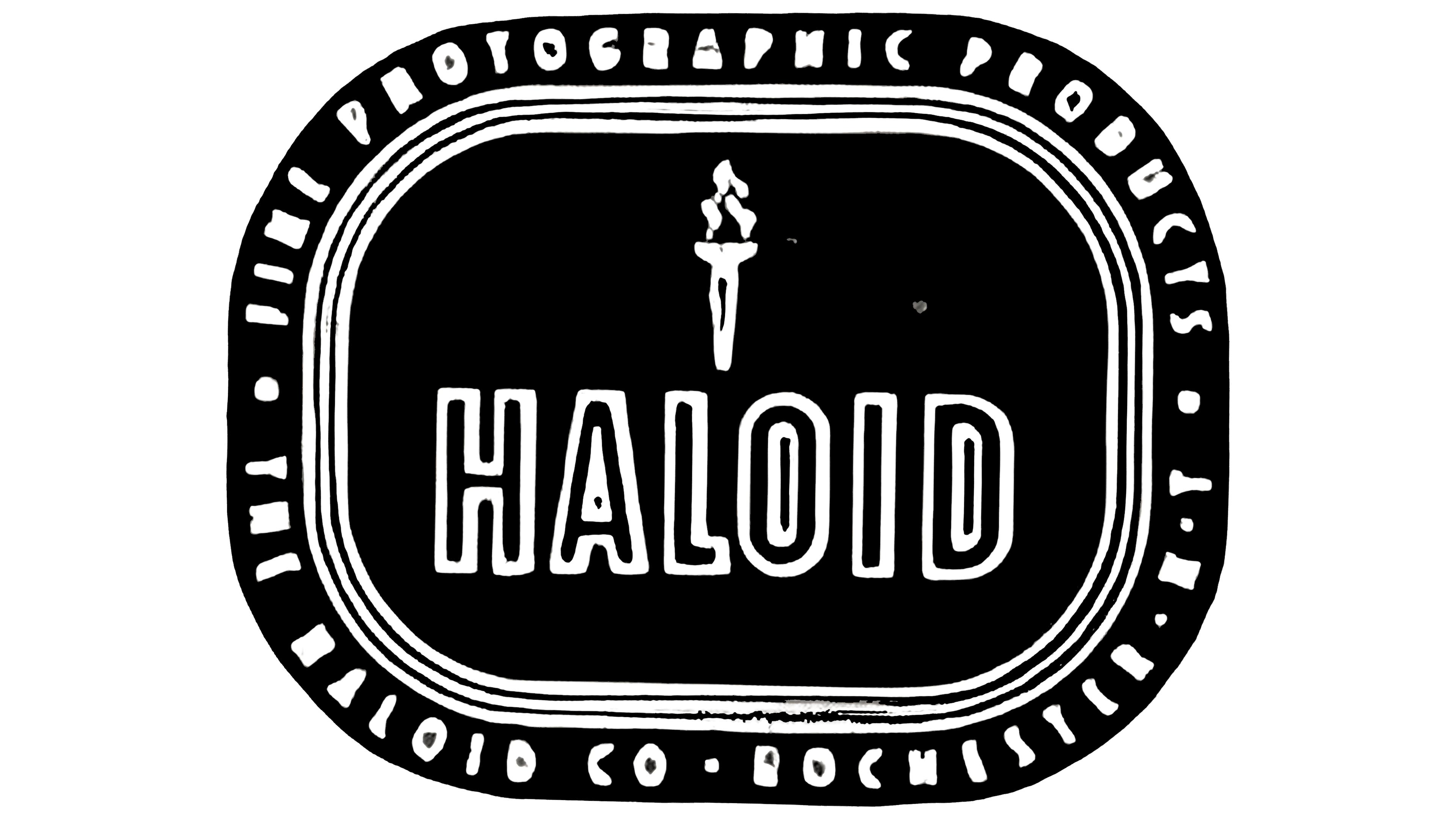
The next Haloid logo resembled a sheet of paper with rounded corners. White lettering appeared against a black background, while the torch maintained the connection to photography and the role of light in creating an image on photographic paper.
The large HALOID name and torch occupied the center of the design. Text around the edges described the company, its products, and its Rochester location. Differences in letter size distinguished the name from the surrounding information.
The HALOID letters received more regular outlines with white edging and filled the center more tightly. The new frame allowed company information to accompany the established combination of torch and name.
1948 – 1949
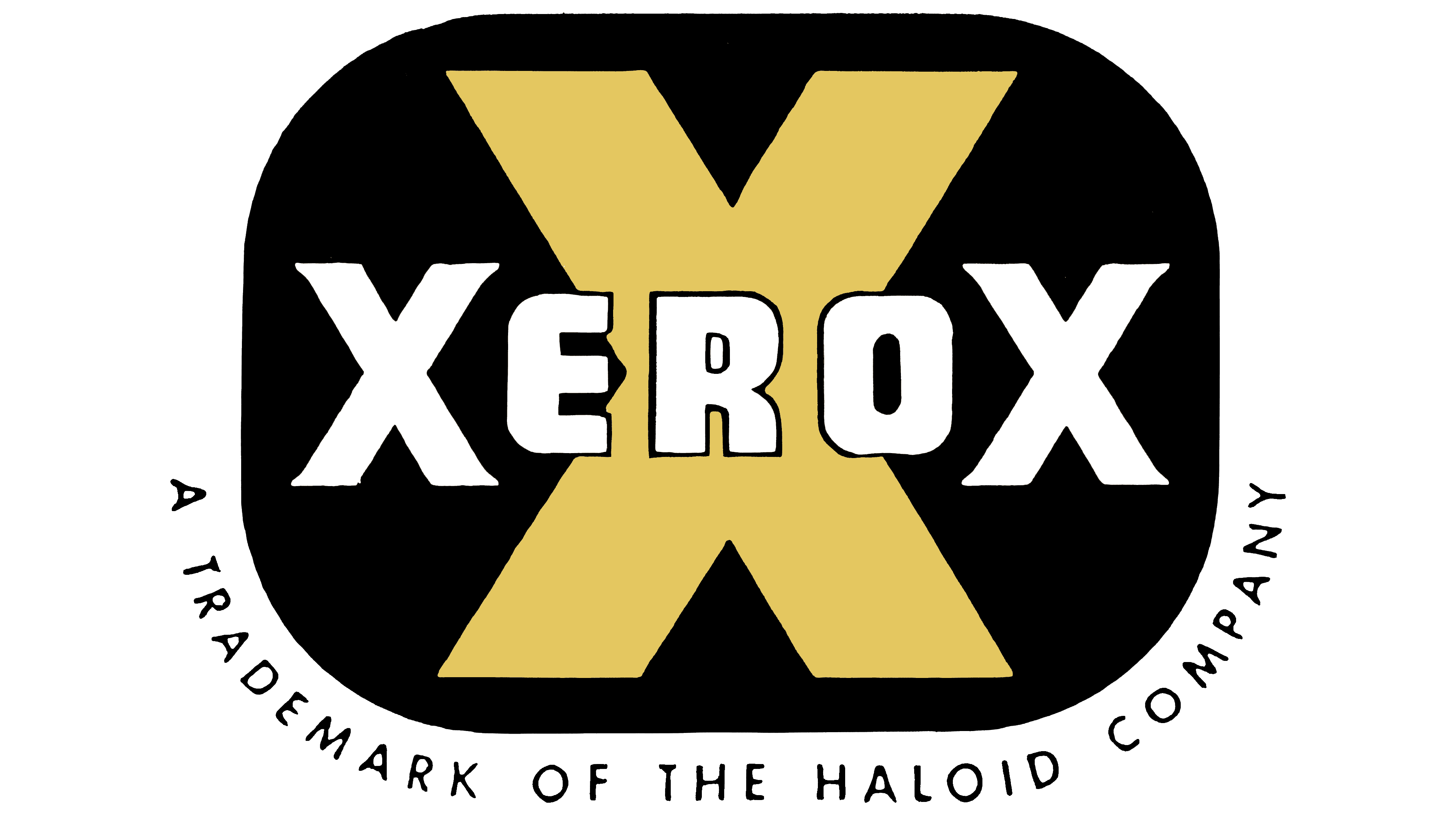
A large yellow “X” on a black panel with rounded corners became the basis of the Xerox emblem in 1948. It replaced the torch, with white XEROX lettering placed across it. The Haloid name gave way to a new brand created for copying equipment. The emblem appeared a year before the company’s first copier reached the market.
The name Xerox came from a search for a shorter term for electrophotography. At the request of Battelle Memorial Institute, a classics professor at Ohio State University proposed the word “xerography.” It combined the Greek words “xeros,” meaning “dry,” and “grapho,” meaning “to write.” The term described the dry-copying process and became the basis for Xerox. In the original spelling, XeroX, two capital X’s framed the lowercase letters. The paired X’s represented transferring an image between sheets, while black and white referred to the marking material and paper.
The technology grew out of Chester Carlson’s work. In 1938, the inventor produced the first image using electrophotography. Haloid customers who purchased photographic paper later expressed interest in the copying process. In 1947, the company agreed with Battelle Memorial Institute to develop a machine based on the technology.
The first Xerox Copier went on sale in 1949. Its promotion introduced buyers to dry copying, which was still relatively uncommon.
1949 – 1957

The 1949 emblem combined the Xerox name with information about its manufacturer. Buyers needed to connect the new products with Haloid, an established company. Xerox was the name used for the copying equipment, while the business continued to operate under its earlier name.
The design reused the 1938 logo’s frame, with explanatory lettering around the edges. White XEROX lettering appeared in the center of the black background, over a large “X” that changed from yellow to red. The product name dominated the emblem, while the surrounding text identified Haloid as the manufacturer.
1957 – 1960
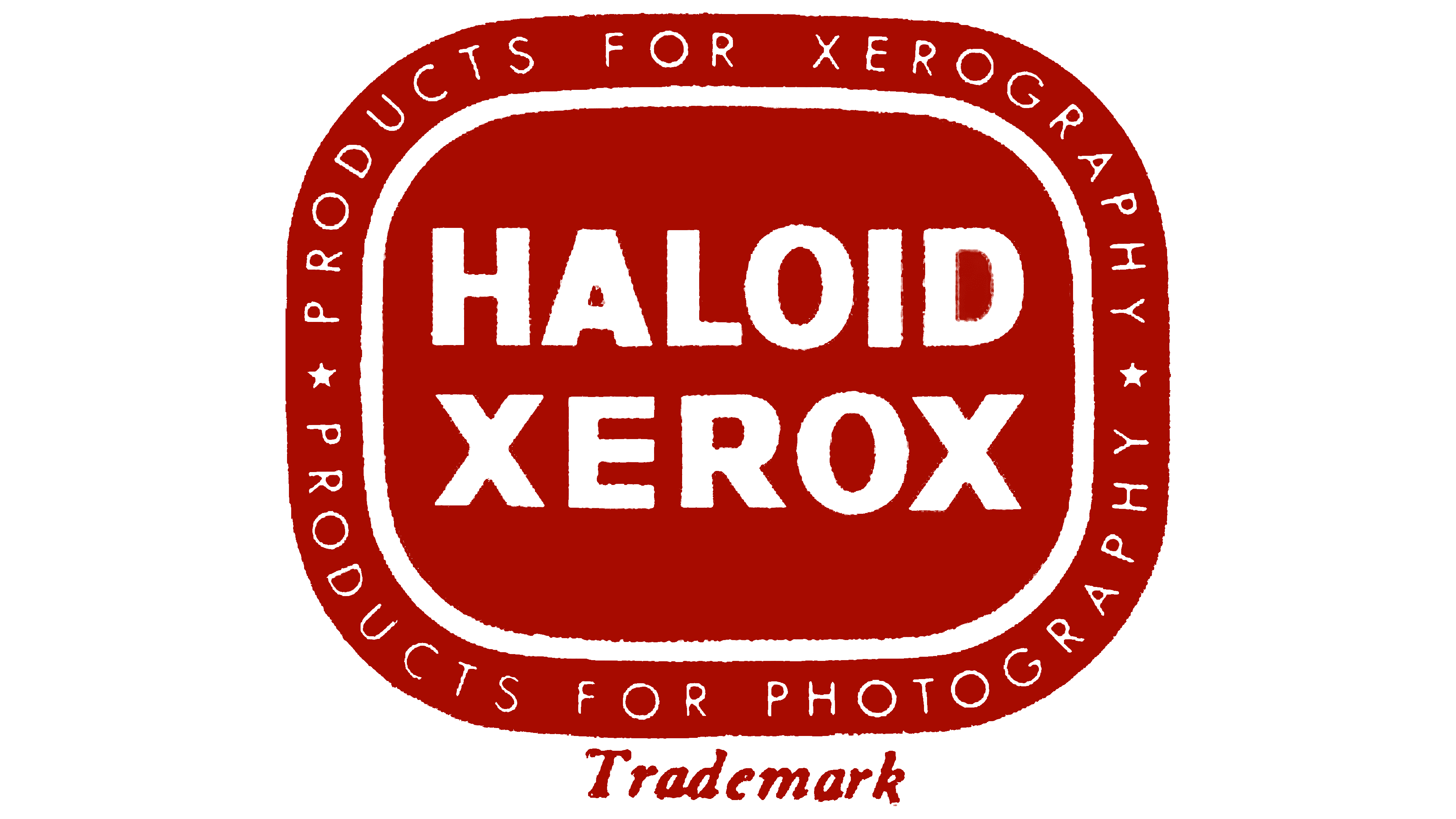
In 1958, the company adopted the name Haloid Xerox, bringing together its two areas of business. Haloid preserved the connection to photographic paper, while Xerox referred to xerography and copying equipment. The new name reflected the company’s expansion and helped buyers connect the products to the manufacturer.
Both words appeared in large letters at the center of the revised emblem. Text around the edges described products for photography and xerographic copying. The main lettering identified the company, while the surrounding text explained its business. The red background symbolized invention, new technology, and profitable deals.
In 1959, the company introduced the Xerox 914, an automatic copier that used plain paper. Its success helped expand the copying business and paved the way for another company name change.
1960 – 1968
The transition from Haloid to Xerox Corporation involved work with New York consulting firm Lippincott & Margulies. As xerography gained ground, the firm proposed using Xerox as the name for both the company and its products. A large XEROX wordmark replaced the colored panel, border, and explanatory text.
The name used dark uppercase letters with serifs and curved terminals. Two X’s framed the letters ERO. Their extended diagonals echoed the long, angled leg of the “R,” giving the letters a shared visual structure. The elongated strokes referred to the path of paper through a copier.
The smaller word CORPORATION accompanied the main name. The difference in scale separated the brand name from the corporate designation. Decorative detail now concentrated in the XEROX lettering, which replaced the earlier pictorial emblem.
1968 – 2008

Tom Geismar of Chermayeff & Geismar redesigned the Xerox wordmark in 1968, creating lettering that would serve the company for 40 years. The update came during a period of business growth and commercial success. CORPORATION was removed, leaving the five uppercase letters of the name.
Geismar made the letters more compact and angular. Short serifs replaced the long, curved terminals, while the main strokes retained their weight. The wordmark became blue. The diagonals of the two X’s appeared alongside the horizontal strokes of the “E,” the rounded top of the “R,” and the oval “O.” This mix of angles and curves defined the lettering.
The design remained in use until 2008. Over the decades, its color changed, and additional symbols appeared alongside it, but the letterforms stayed the same.
1994 – 2008

A red “X” breaking into small squares appeared in Xerox’s identity in 1994. Margo Zucker of Landor Associates created the Digital X emblem. She divided the upper portion of one diagonal into small squares resembling multiplied fragments of the letter. The design represented the shift from paper to digital documents and linked Xerox to digital document processing.
Digital X appeared beside the XEROX wordmark, which retained its 1968 letterforms. The name became red to match the emblem. The tagline “The Document Company” was added to reflect Xerox’s expansion from equipment manufacturing into services supporting the entire document workflow.
Initially, “The Document Company” occupied a prominent line above the name. In 2002, XEROX became the dominant part of the logo, while the tagline took a secondary role. It was removed in 2004. The red wordmark and pixelated “X” remained in use until the 2008 redesign.
2008 – 2019

Interbrand redesigned Xerox’s identity in 2008 as the company expanded its software and services business. The logo was intended to reflect changes in a company previously associated with printing and copying equipment. The agency reworked the wordmark and replaced the pixelated “X” with a three-dimensional sphere. The update was tied to technological development and Xerox’s international presence.
For the first time in decades, Xerox appeared entirely in lowercase. Soft terminals replaced the serifs. Rounded “e” and “o” letterforms complemented the curved diagonals of the two x’s. Within each “x,” the strokes mirrored one another, referring to the copying process. Red connected the wordmark to the sphere on the right.
Light-colored ribbons wrapped around the sphere, crossing to form an “X.” Gray gradients and shadows created volume, while white highlights gave the surface a glossy finish. The sphere evoked Earth and symbolized Xerox technology’s worldwide reach. The interwoven bands represented the company’s connections with customers, employees, partners, and the technology industry. The team created an animated version of the emblem, and the connecting-line motif extended into other materials.
Pantone 1797 became the primary red, supported by eight additional colors. The rounded wordmark was complemented by Xerox Sans, a typeface based on FS Albert by British designer Jason Smith. Work on the typeface began in 2007, ahead of the identity launch. Greek and Cyrillic characters were added to support its use in different countries.
2019 – 2026

In 2019, Xerox removed the sphere from its logo, leaving the red lowercase xerox wordmark. The existing letterforms remained unchanged. The company linked the move to a flat design to the needs of digital media. With the sphere gone, the wordmark filled the full logo area, making the name appear larger.
The primary version used red lettering on a white or light background. Xerox Red retained its Pantone 1797 designation. Xerox prepared a black version for single-color printing and a white version for dark backgrounds.
The update coincided with corporate structure changes. In 2019, Xerox became a subsidiary of a newly created holding company. The identity update accompanied the reorganization and business expansion. Its product range included copying equipment, computers, scanners, and paper.
2026 – today
Xerox added a square emblem to its red lowercase wordmark in 2026. The update followed the 2025 acquisition of Lexmark and brought the two businesses together under a shared brand. Chief Marketing Officer Darren Cassidy introduced the new identity. The company connected it to the combined capabilities of Xerox and Lexmark in printing, IT infrastructure, and digital services.
The emblem consists of a red square with rounded corners. White diagonal gaps divide it into sections and form a stylized “X.” The primary version uses a flat design. The square continues Xerox’s history of pairing its name with a separate symbol, replacing the sphere.
In 2026, the new identity appeared on the first devices released under the combined brand. These included color printers and multifunction devices in the C240/C245, C255a, and C300/C303a/C305ae series.
Font and Colors
In creating the Xerox logo, the designers reflected the company’s modern mindset and its constant drive for development and innovation. The resulting sign symbolizes the technological approach to manufacturing copiers and other office equipment. It embodies the energy and strength that the manufacturer puts into developing new products.
The logo’s main color is red. It conveys leadership, winning, and innovation. The company is actively developing, reaching new heights, and serving as the “engine” of its industry, continually developing new solutions.
The logo uses Xerox Sans, a font the company created.