Yelp Logo PNG
The Yelp logo conveys the essence of the company that operates an application and website for business and service reviews. Its light, memorable appearance suggests convenience and the positive feelings that come from finding the right information. The emblem expresses openness and trust between users and businesses.
In 2004, after struggling to find a doctor in San Francisco, Jeremy Stoppelman discussed user-driven recommendations with Russell Simmons at MRL Ventures, a venture capital firm founded by PayPal’s Max Levchin. The concept gained early backing, and the incubator provided initial funding. Both founders came from PayPal, where Stoppelman worked as VP of Engineering and Simmons as Chief Software Architect. The name Yelp, suggested by David Galbraith, combined “yellow pages” and “help”.
Yelp Inc. was registered in July 2004. The first version relied on email requests for recommendations, but users ignored them. Instead, they began posting reviews voluntarily. The team shifted focus to an open review platform. The first review of Truly Mediterranean in San Francisco appeared on October 12, 2004.
In 2005, Yelp raised $5 million from Bessemer Venture Partners. To grow engagement, Stoppelman launched the Yelp Elite Squad through offline events. By mid-2005, the platform had 12,000 reviewers, reaching 100,000 by 2006, with over one million monthly users. Benchmark Capital added $10 million.
In 2007, Yelp reached 1,000,000 reviews and 6,000,000 monthly visitors. The iPhone app launched in 2008, followed by the Monocle feature in 2009. Expansion began with the UK and Canada. That same year, Google offered the company over $500 million, but it rejected the deal, leading to direct competition with Google Places.
In 2010, Elevation Partners invested $100 million. Yelp acquired Qype in 2012 for $50 million and integrated it with Apple Maps and Siri. The IPO took place on March 2, 2012, raising $143 million. Eat24 was acquired in 2015 for $134 million and sold to Grubhub in 2017 for $287.5 million.
Meaning and History
What is Yelp?
It is an American company that owns a namesake mobile app and website that describes various businesses. Businessman Jeremy Stoppelman owns it. He, along with Russel Simmons, founded Yelp in 2004.
2004 – 2016

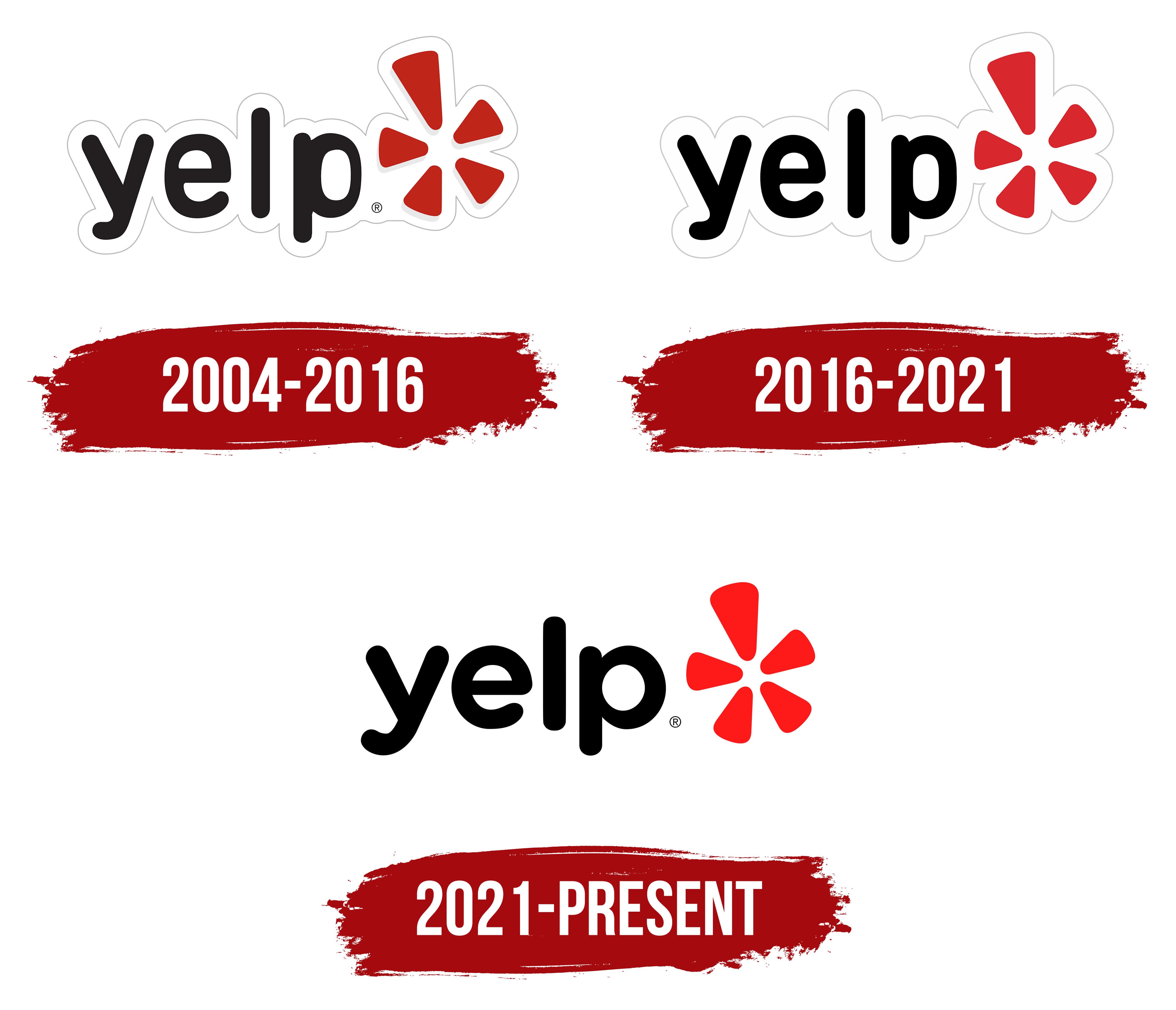
When designer Michael Ernst was tasked with creating a new Yelp logo, he tried dozens of sketches, ranging from animals to speech bubbles and even a barking dog. None of them worked until an unusual detail from the comic Calvin and Hobbes inspired him. In it, the character comes up with a new idea, and a small bright flash appears above his head.
Ernst initially drew this star too sharply, and it ended up looking like a flower. He softened the lines, making the shape abstract and avoiding a direct association with plants. This created a mark resembling a splash or a stylized burst of five red segments. The corners are smoothly rounded and directed inward, which is why the symbol is often compared to pizza slices. The symbol is rendered in a red shade (#af0606) and accented with a light shadow that adds volume.
The brand name is set in lowercase letters. Ernst originally considered capitalizing all letters except the e, but the final version ended up different. All letters are lowercase and friendly, with smooth lines and rounded endings. The wordmark is black, contrasting with the red symbol. The logo uses the Mesmer sans-serif typeface, although a serif option was initially planned.
The text and symbol are enclosed together within a soft gray outline that resembles a sticker. The logo’s white background makes the composition feel light, fresh, and positive, perfectly reflecting Yelp’s atmosphere, where users find what they enjoy. Interestingly, Chad Hurley, best known for his work at YouTube, created the company logo. At that time, the logo looked like a cartoon speech bubble, which the team decided to abandon because it felt too unserious.
Michael Ernst joined the company in 2004 through a connection with one of Yelp’s founders. He redesigned the site’s look, creating a style that reflects the brand’s bright, energetic spirit and encourages users to discover new things.
2016 – 2021

The updated Yelp logo changed little from the previous version. It retained the service name in lowercase. The typeface is visually close to the earlier version, slightly refined, and appears soft and smooth. It is rounded, sans-serif, and resembles a variation of Helvetica Rounded or Arial Rounded with delicate curves. The name remains black, accented with a thin white edge and a light gray outer line. Together, they form a sticker-like outline.
To the right of the wordmark is the brand symbol, a five-petal red flower radiating outward from the center. The petals in the new version follow the shape of the previous logo. In the earlier version, a light shadow beneath the petals added depth, which has now been removed. In addition, the petals’ red color became brighter, moving away from the calmer shade used before.
2021 – today

The new Yelp logo became even brighter. The main composition centers on the word yelp, set in lowercase black letters. The sans-serif typeface was slightly modified, becoming thicker and softer, with outlines that closely resemble the rounded forms of Helvetica Rounded.
To the right of the word is the brand star, composed of five elongated petals. Each petal is a tapered triangle with smoothly rounded edges that converge toward the center. The element’s shape has remained almost unchanged from previous versions, and the color has become more vivid, turning into a rich red without any muting.
In the current version, we removed frames, shadows, and outlines. The emblem now appears completely flat and minimalist. The logo is easy to perceive while retaining the energy and friendliness associated with the Yelp brand.
Font and Colors

The current logo uses a font with wider letterforms, resembling Proxima Nova Soft Bold from Mark Simonson Studio. They are almost identical, differing only in letter weight (now they are much larger than before). Moreover, the logo received a new shade of red: the icon on the right became scarlet.