


 ABT Logo PNG
Large elements, wide lines, and solid strokes all indicate that the ABT logo reflects the brand’s reliability. It symbolizes sustainable development, confidence in positive results, and a versatile approach to entrusted work. In this way, the designers achieved flexible marketing through the identity’s simple elements.
ABT Sportsline began in Kempten, Bavaria, on April 1, 1896, when Johann Baptist Abt took over a forge and carriage workshop. He first worked with horse-drawn transport, then developed sled runners for Alpine winters. In the 1920s, the family built ties with Horch and Audi, which later merged with Wanderer and DKW to form Auto Union.
After World War II, Rosina Abt kept the workshop alive. Her grandson Johann Abt grew up around damaged machines, built a race car from DKW wreckage at 14, and later trained at Borgward and DKW. In 1955, he became the youngest German motocross world champion with the DKW factory team, then worked in Italy with Fiat tuner Carlo Abarth. Across his racing career, he won more than 300 events, including the 1970 European Touring Car Championship.
In 1962, Johann Abt created a tuning department, first for DKW and then for Audi and Volkswagen cars. ABT Tuning was registered in 1967. The company focused on full technical upgrades, matching engine work with chassis and brakes. In 1975, Abt won the Trophée de l’Avenir with a tuned Audi 80, and in 1980 ABT introduced electronic chip tuning.
In 1991, the company became ABT Sportsline. Its motorsport work grew through Audi, DTM, ADAC GT Masters, and Audi Sport Team ABT Sportsline, competing with Mercedes-Benz AMG and BMW Motorsport. After Johann Abt died in 2003, Hans-Jürgen and Christian Abt led the firm. In 2014, ABT entered Formula E, where Lucas di Grassi won the all-electric series’ first race in Beijing.
Meaning and History
When Johann Abt opened a forge at the end of the 19th century (1896), he did not expect it to become a tuning workshop (ABT Tuning, 1976) and later a large company (ABT Sportsline GmbH, 1991). This happened because the founder’s grandson (Johann Abt Jr.) loved racing and passed that passion on to his children, Christian and Hans-Jürgen, who led the business. Thanks to the many high-profile victories Johann and Christian achieved in the cars they modernized, ABT has gained worldwide fame.
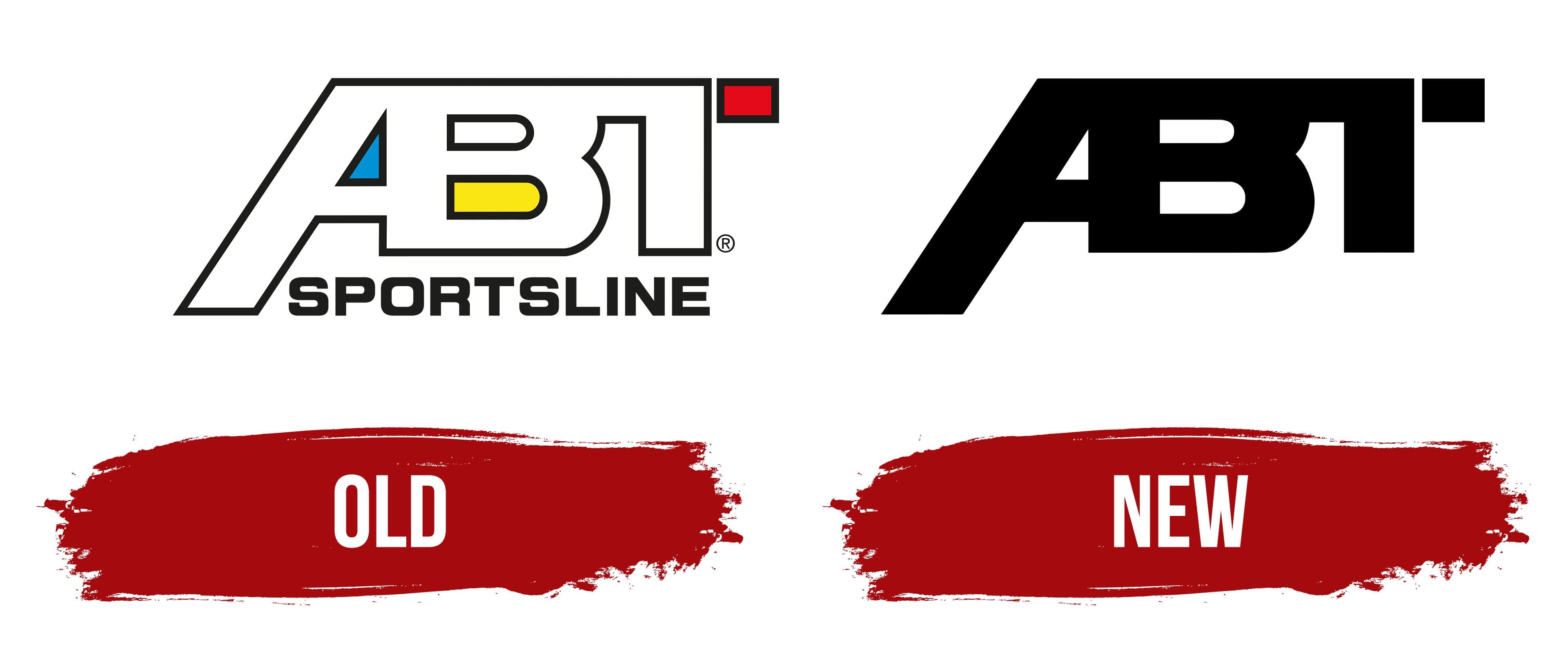
The company logo has been updated once. At the same time, the overall composition of the upgrades remained unchanged. Only the coloring has changed.
What is ABT?
A world-famous company, the Abt family business has repurposed cars into racing sports cars and has been based in Allgäu since 1896.
Old

The “tuned” surname of the business owners, the Abt family, was chosen for the logo. The letters in the logo have merged, forming a track with racing turns. The thick black lines bounding the inscription create a clear, closed road line. They suggest rules and distance. They show that the company’s tuned cars never leave the track. The main touring car races in which ABT cars have succeeded are STW and DTM, held at several closed-road circuits.
The letter A is especially highlighted in the name, with its first stroke very long. She symbolizes:
- Starting line for accelerating sports cars.
- Class A machines (mass-produced), which AVT specialized in. For tuning, they took the basic models and transformed them: lighter wheels, sport suspension, more power, etc.
- Audi. Most of the tuned Sportsline models are based on this brand.
The right side of the upper crossbar T is separated from the whole composition to avoid creating a dead end. It, in the form of a separate red rectangle, hints at:
- Alternating multi-colored rectangles on the inner ring of racing roads.
- A red racing flag is a stop sign that requires the race to stop immediately. A similar symbol, placed beyond the end of the track, conveys the message: “The company never plans to stop. Her cars will be driving circuits for a long time to come.”
- Red and black flag. The combination is used to mark the end of the qualifying race, which determines the cars’ starting positions. The badge shows that Sportsline sports cars always qualify successfully.
The three large letters of the logo are white. But the central holes A and B are painted over. “A” has a blue triangle on top, and “B” has a yellow oval on the bottom. Blue is the color of the Volkswagen logo and the cars the company transformed. In particular, the first successful model that brought the company fame was the Golf. The blue and yellow colors of the Seat logo have been used since ABT Tuning’s formation. In this case, the red rectangle “T” points to the Audi logo.
Such designations, combined with white letters in the foreground, capture the essence of the company’s work: taking a car of a certain brand and updating it. The car logos’ colors remain in the background.
Below, starting at the protruding edge of the letter A, add “Sportsline” in smaller print as a sports line. Black-letter stripes visually convey the essence of the word “line”. The inscription explains the company AVT’s line of work.
New

The new visual sign retains the previous composition but is made in pure black. Removing all color accents signals the renewal of the company’s activities and partner-brand logos. Seat and Audi opted for black emblems, with which AVT has the most active working relationship. Skoda and Volkswagen also use dark shades.
Black better reflects the color of racing roads. It hints at details like engine oil and the black checkers on the starting flag.
Font and Colors

The emblem’s main color is black. This symbolizes the company’s power, fame, and deep roots. No single font fully matches the visual sign. The letters have been specially modified to better convey ABT. They have been modified to be unique, like the machines the company works with.

ABT Logo Color Codes:
- Black: Hex code: #000000; RGB: (0, 0, 0); CMYK: (0, 0, 0, 100); Pantone: Process Black