


 AECOM Logo PNG
All attention should be directed to the AECOM logo; the building engineering company instills this idea in its clients. This marketing strategy works well because the corporation has become a leader in the international market. A monolithic, powerful, and dynamic logo inspires confidence in potential customers.
AECOM’s roots go back to 1910, when the Swiss Drilling Company was founded in Oklahoma and later became the Swiss Oil Company. In 1924, Ashland Refining Company was created under Paul Blazer, who built Ashland into a broad conglomerate spanning petrochemicals, road construction, and building materials. In 1966, Ashland added Warren Brothers, strengthening its road construction business.
By the mid-1980s, Ashland owned a mixed group of engineering assets. In 1985, it combined them as Ashland Technology Corporation. When Ashland later returned its focus to refining, President Richard Newman led an employee buyout. On April 6, 1990, Ashland sold 58% of the company to an employee stock plan, and it became AECOM Technology Corporation.
AECOM was formed from former Ashland businesses, including DMJM, Frederic R. Harris, Williams Brothers, Holmes & Narver, and Consoer Townsend. Through the 1990s, revenue rose quickly, reaching almost $725 million in 1997 and about $860 million in 1998, when employees gained full ownership. In 1999, AECOM bought Metcalf & Eddy and Day & Zimmerman Infrastructure, pushing revenue past $995 million.
International expansion began in 2000 with the purchase of Guy Maunsell International, followed by the 2001 acquisition of Warren Group. AECOM went public on the New York Stock Exchange in 2007, raising $468.3 million. Later deals included Earth Tech in 2008, Tishman Construction in 2010, and URS Corporation in 2014 for about $6 billion. The URS deal doubled the company’s scale and put it ahead of Jacobs Engineering and WSP Global by design revenue. In 2019, AECOM sold Management Services, moved its headquarters to Dallas in 2020, and named Troy Rudd CEO.
Meaning and History
AECOM’s origins date back to a 1910 drilling station that grew into the Ashland Oil & Refining Company. In 1966, the company added road construction and asphalt paving to oil production, and later oil refining and engineering services. Therefore, in 1985, it changed its name to Ashland Technology Corporation. In 1990, the oil refining business was spun off into a separate company, and all technology, construction, and engineering developments were united under the common name AECOM.
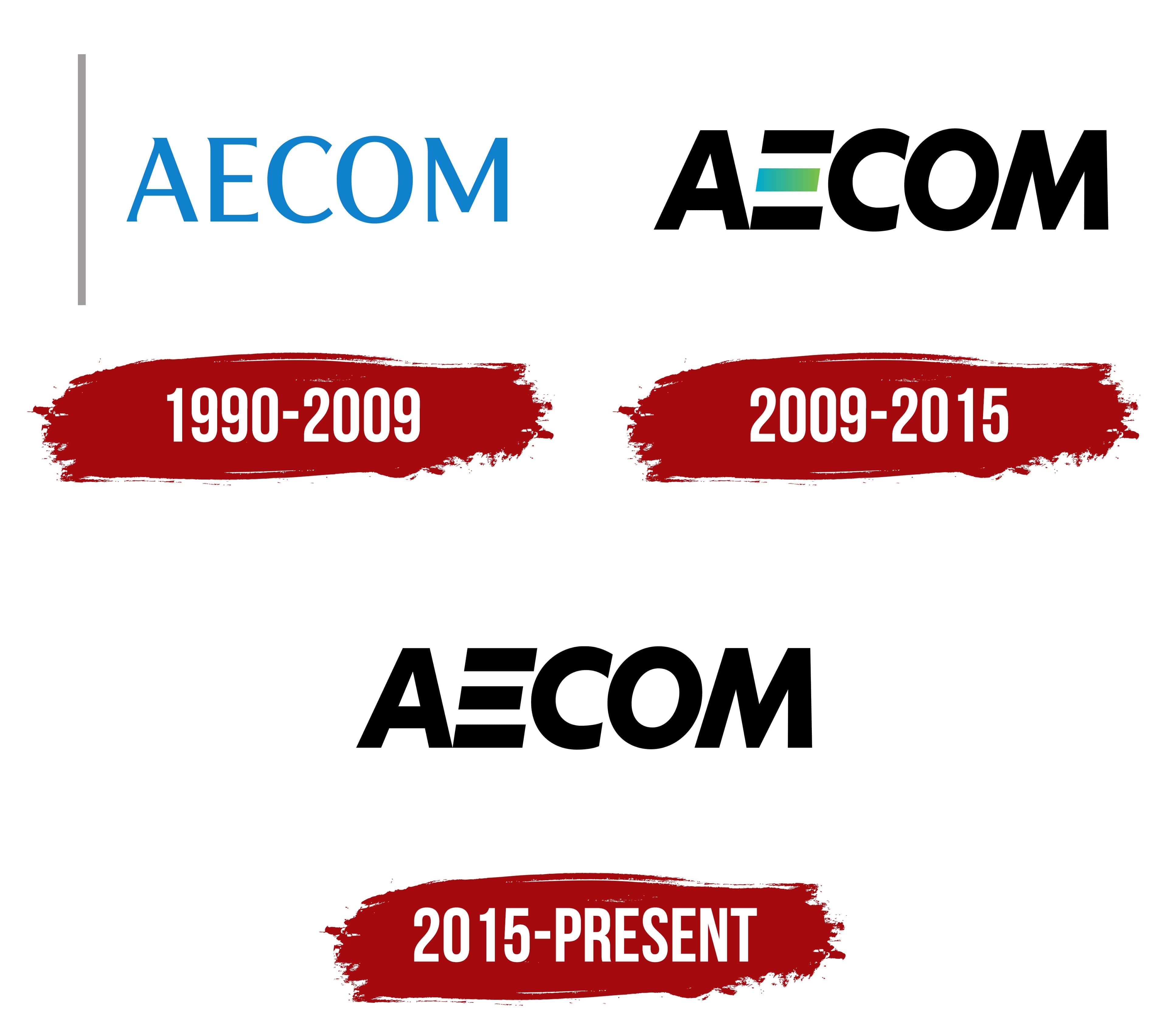
The company logo has always been its name in stylized letters. It has changed twice to reflect the corporation’s development.
What is Acom?
An American corporation engaged in architecture, design, landscape, management, planning, commissioning and decommissioning, consulting, etc. Its clients are enterprises in 150 countries, and its revenue reaches $ 20 billion.
1990 – 2009
In 1990, AECOM spun off from its parent company, which had a rich history. Its first logo pointed to this process. It was a vertical gray line followed by the newly acquired name in blue capital letters.
The dividing line marked a new start for the company, its separation from the parent company, and a move in a new direction. The wall seemed to create a barrier between the past and the future and to provide a starting point. The gray color suggested something taken for granted, rooted in the past. He hinted at the gray asphalt of the roads, the moment at which the roads diverge from the old corporation.
For the new company, the trait symbolizes a wall, a concept related to architecture and construction.
The name AECOM on the logo was an attempt to encompass all the areas of activity the company planned to cover. And it represented, in fact, an abbreviation:
- A – architectural business (Architecture),
- E – engineering (Engineering),
- C – design, construction (Construction),
- O – operation, production activities (Operations),
- M – management (Management).
The company could design, build, and launch production of any complexity. Acquiring small service-sector companies (8 firms, several individual engineers, and architects) over 10 years strengthened AECOM’s position.
The blue color symbolizes the sky, the tops of buildings, the pursuit of dreams, and the implementation of plans. The new company planned to reach new heights, and it succeeded.
2009 – 2015
In 2007, AECOM went public and began selling shares, resulting in a nearly $500 million capital inflow. AECOM used these funds, along with profits, to purchase five large firms in consulting, engineering, and construction. Representing an international corporation, the giant changed its logo to a more solid one that better reflects the current situation.
The new version still used an abbreviated name, but in larger, bolder black letters. The wall image was removed; the company had already moved far away from its parent company.
The name was distinguished by a stylized letter E, set without a vertical line, consisting of three stripes of different lengths. The middle horizontal line is a blue-green gradient. Three traits indicated three main areas of activity: consulting, engineering, and construction. They were symbols of floors, starting platforms on which the company climbed, taking increasingly serious positions.
The combination of blue and green symbolizes growth in the fields of exact sciences, planning, and management, as well as a logical approach. The company’s strength is constantly fueled by growth and the infusion of new resources.
2015 – today
The acquisition of URS Corporation makes AECOM the largest engineering company globally. To emphasize its power and global reach, the corporation changed its logo by removing a colored element. The visual mark is now a black monolith, demonstrating the solidity and achievement of the desired pinnacle. The stylized E remains a reminder of the steps taken on the way to the top. The stripes also reflect the business’s individual components.
Font and Colors
The emblem’s main color is black. It conveys scale, global recognition, and power. The corporation has practically no competitors left.

The font corresponds to Twentieth Century Pro Extra Bold Italic, but with a modified E. Capital letters and their boldness emphasize the company’s power. A slight rightward tilt suggests movement into the future.