Altria Logo PNG
The Altria logo conveys the diversity of its product range. It highlights the impeccable quality, appeal, and emotional breadth of its offerings. The logo has become key to the popularity of its branded products.
Philip Morris began in 1847, when Philip Morris opened a small tobacco shop on Bond Street in London. In 1854, he introduced his own cigarettes, including Cambridge and Oxford Blues, which became popular among British soldiers after the Crimean War. After he died in 1873, Margaret Morris and Leopold Morris took over the business. In 1885, Leopold joined Joseph Grunebaum to form Philip Morris & Company and Grunebaum, Ltd.
On April 6, 1902, the company registered in New York as Philip Morris & Co., Ltd., Inc., and began importing cigarettes into the US market. In 1919, an American branch was created, and in 1929, production started in Richmond, Virginia. In the 1930s, the Milton Biow agency built a national radio image around bellhop Johnny Roventini and his call, “Call for Philip Morris!”
Marlboro appeared in 1925 as a women’s cigarette, promoted with soft slogans and red filters. In 1955, Leo Burnett rebuilt the brand around the Marlboro Man, turning it into a symbol of rugged American masculinity. By 1976, Marlboro was the best-selling cigarette in the United States, and Philip Morris became the country’s largest tobacco seller and the second-largest worldwide.
The company later expanded beyond tobacco, buying General Foods Corporation in 1985 for $5.75 billion and Kraft Inc. in 1988 for $12.9 billion. Legal pressure grew after the 1964 US Surgeon General’s report, leading to the 1998 Master Settlement Agreement with 46 states. On January 27, 2003, Philip Morris Companies Inc. became Altria Group. In 2008, Philip Morris International was spun off, and in 2018, Altria invested in JUUL Labs and Cronos Group.
Meaning and History

Until 2003, the Philip Morris Company logo was used. A redesign, under the new name, appeared almost immediately. It should be noted that the company’s logo is associated with various popular brands owned by Philip Morris, including Kraft Foods. The updated logo was created by designers at Landor Associates. Landor creative director Richard Brandt said the company’s products were used as the basis for the logo.
What is Altria?
It is a tobacco company known far beyond the United States, and its products are available in more than 100 countries worldwide. We are talking about millions of dollars in revenue every day.
1985 – 2003
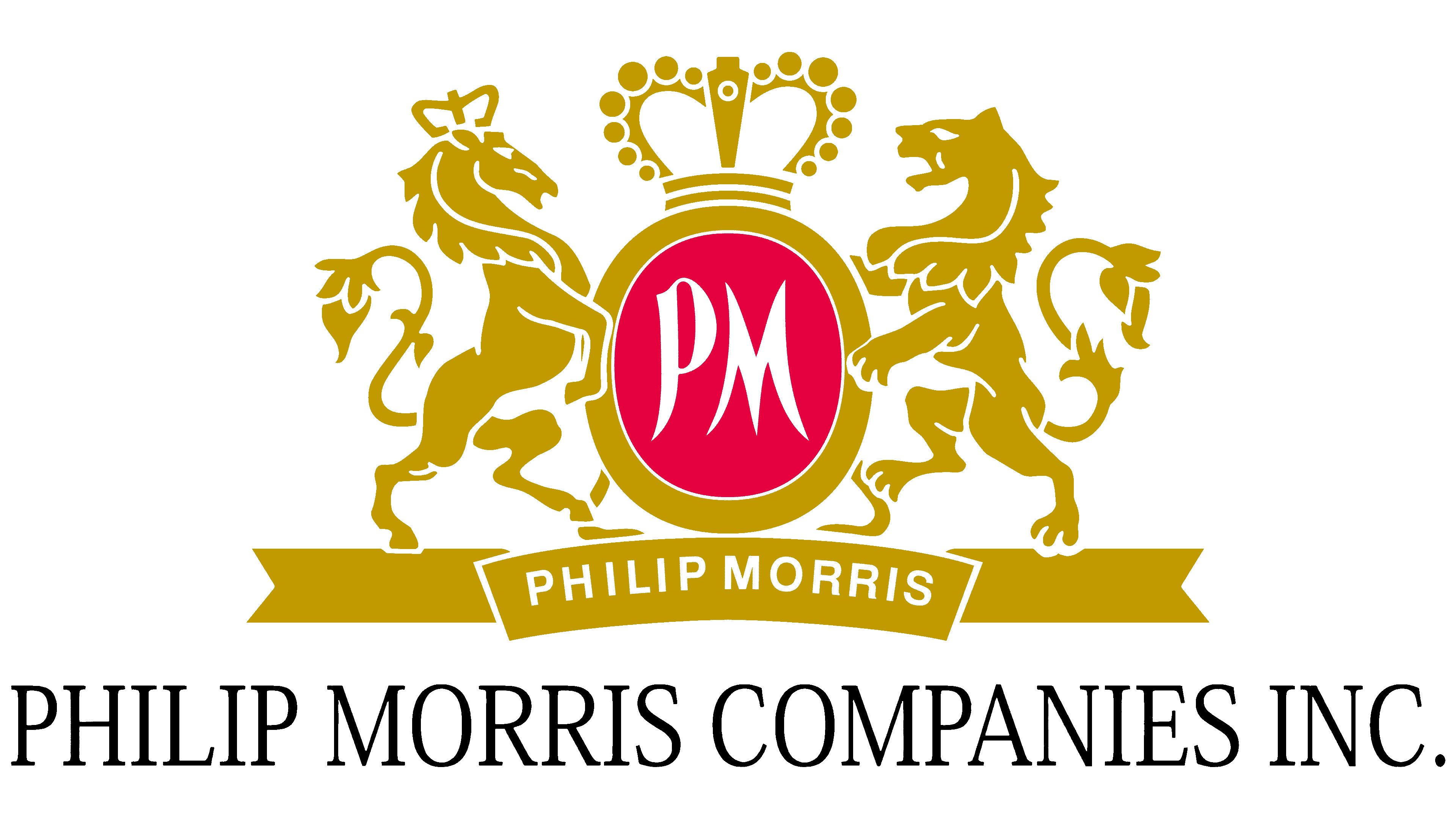
For the first 18 years, Philip Morris used the classic logo. It featured an oval frame with the letters “PM” in white on a red background. A unique and modern style was used for this inscription. The italicized letters look interesting and attractive. The oval frame has gold outlines in addition to the red fill. At the top, a crown directly indicates the company’s aristocratic nature. Two horses flank the frame, one of which also wears a crown. These proud animals were not chosen by chance, as horses have long symbolized British tradition. They stand on two hooves, and two of them support the emblem. Special attention should be paid to the tassel tail, which looks friendly and playful. They stand on a ribbon with an arc in the middle, where “Philip Morris” appears in white capital letters on a gold background. Below the logo, another inscription reads: Philip Morris Companies, Inc.
2003 – today
The current logo was introduced in 2003, as mentioned above. It represents the company name and the emblem. The latter consists of 25 multicolored squares, including blue, red, orange, and brown. In this way, Landor Associates tried to show the diversity of the company’s products. The proximity of the squares directly indicates the close relationship between the products. Many experts, such as Michael Berut of Pentagram, note that the logo’s vagueness plays to the company’s advantage, as the abstraction makes customers curious about exactly what it offers. The name “Altria” appears in a classic sans-serif font, set in dark blue with rounded corners. The lettering looks appropriate and doesn’t contrast too much with the logo.
Font and Colors
The company’s name was set in a classic, bold font, with all letters lowercase except the first.
The name was chosen in dark blue to reflect the company’s prospects and development, as well as its desire to satisfy the target audience. The logo consists of many colors and shades, divided into 25 squares. This range of colors shows customers the variety of its products.