


 Always Logo PNG
The Always logo shows stability and protection. The emblem promises women impeccable cleanliness, even in high humidity. The company’s products stay dry in any situation. This is the main quality of all Always products.
Always began in the early 1980s within Procter & Gamble, founded in 1837. Engineer Tom Osborne worked on improving sanitary pads, focusing on thinner absorbent layers and adding side wings to prevent shifting.
The project faced internal resistance because Kotex, a Kimberly-Clark brand, controlled the category. Test launches began in the US in 1983, and Always was released nationwide in May 1984.
The product changed usage patterns by combining reduced thickness with higher absorption and better fixation. By the end of 1984, Always had expanded to the UK, Canada, France, Germany, and markets in Africa and the Middle East, becoming one of P&G’s first large-scale global brands.
In 1985, winged pads became part of the standard line. In 1990, P&G introduced ultra-thin products, further reducing size while maintaining performance and shaping the brand’s technological base.
Expansion required regional adaptation. In Asia, the brand was introduced as Whisper to reflect cultural sensitivity. It entered India in 1989 and became one of the first to openly advertise sanitary products. In other regions, it used names such as Orkid, Lines, Evax, and Ausonia.
By the 2000s, Always had established a stable position across multiple markets, supported by continuous product updates and distribution scale.
In 2014, communication shifted with Leo Burnett’s #LikeAGirl campaign, reaching 85 million views. In 2015, a shortened version aired during the Super Bowl, bringing the category into a broader media context.
Meaning and History
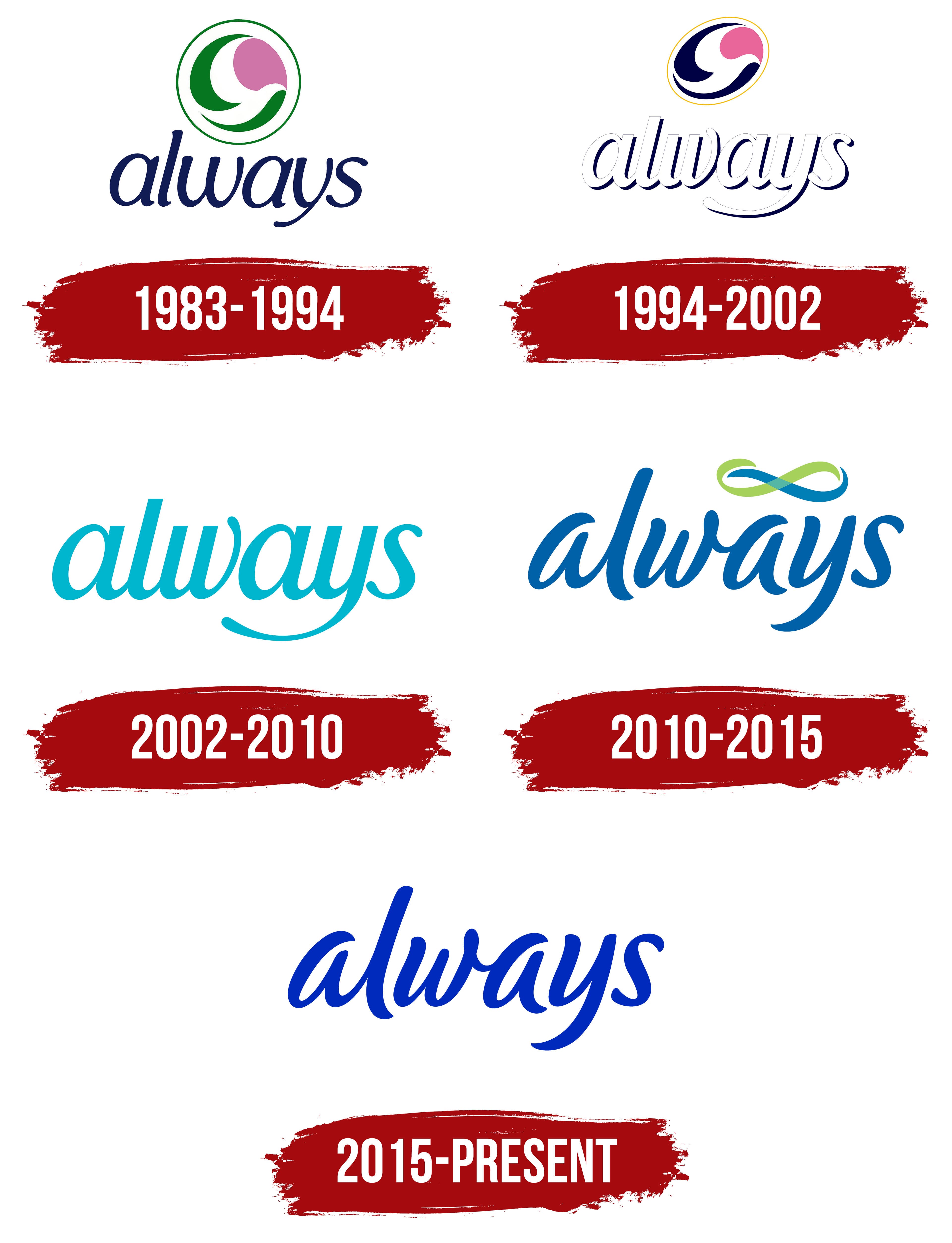
The Always brand acquired its logo right away, in the year it was founded. Throughout its existence, it has undergone four updates.
What is Always?
Always is an American company that specializes in producing all types of feminine pads. This Procter & Gamble subsidiary launched in 1983. Gradually, it expanded its product range to include vaginal wipes and disposable underwear.
1983 – 1994
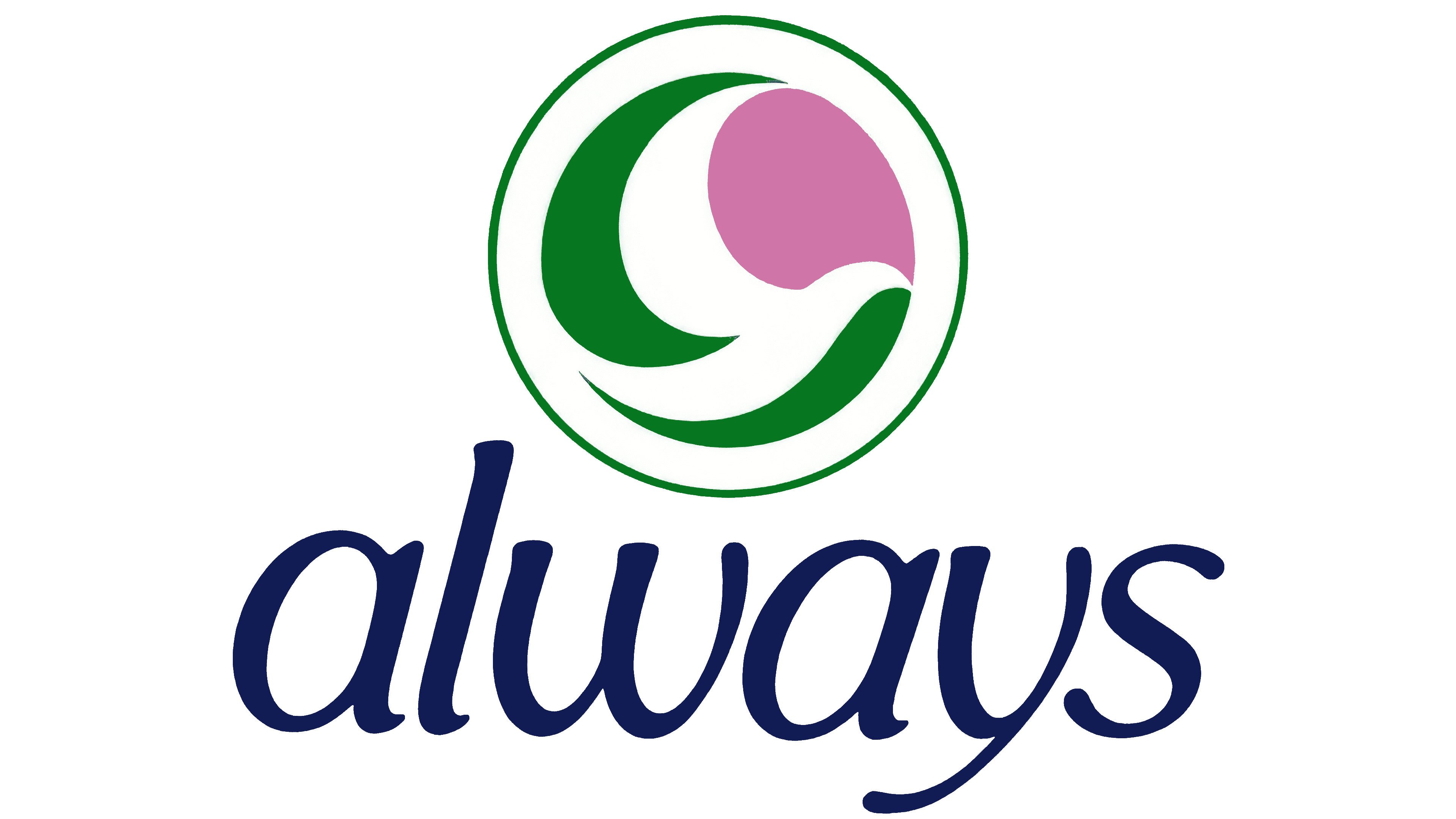
The debut emblem features an imitation flower in delicate pastel colors. It has one pink petal and two elongated leaves. They sit on the right and left, pointing in different directions with sharp ends. A thin green ring surrounds all elements. Below is the series title in italics.
1994 – 2002
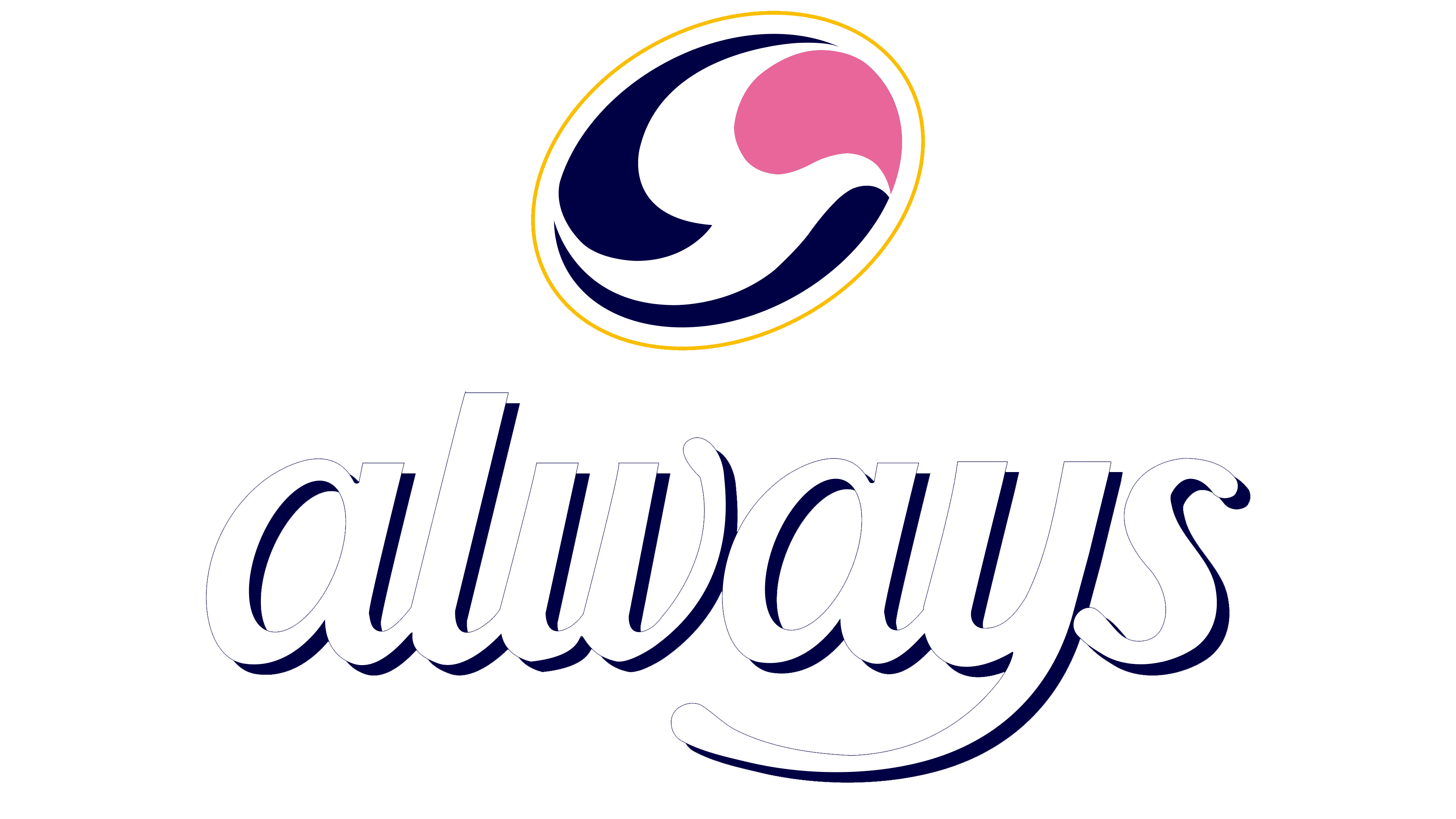
After the redesign in the second half of 1994, the trademark was updated. The developers replaced the circle with a diagonally placed oval. They changed the green leaves to blue and the letters to white, adding dark shadows for contrast. They also corrected the lettering style by lengthening the tail of the letter “y.”
2002 – 2010

During this period, the brand used a completely different emblem: a more minimalist one. The manufacturer ditched the graphic element and focused on the brand name. The word “always” was written in thin calligraphic handwriting, tilted slightly to the right. Above “y,” the designers placed a miniature bluebird – a symbol of dreams.
2010 – 2015
The current version of the logo is radically different from all previous ones. It uses a custom typeface that mimics sloppy handwriting. The infinity symbol replaced the bird.
2015 – today

Keeping the same writing style, the designers have reduced the letter thickness, making the word “Always” look more elegant. The handwritten cursive text is semi-connected: only the first four characters connect in pairs. These are “Al” and “wa.” The remaining characters are located separately. Because the fat content decreased, the “s” at the ends appeared thickened, like dots. The developers removed the figure element at the top, reminiscent of an infinity sign.
Font and Colors
Although the word “always” is the main element of the logo, it also includes a graphic representation. At first, it was a stylized flower in a circle, then in an ellipse. In 2002, a bird replaced it, and later an infinity sign made of two ribbons.
The brand name is in italics. At first, it used a classic font, but the developers later suggested a custom one. The logo’s color scheme consists of pastel shades of blue and green.
In the modern emblem, the letters are thinner than in earlier versions. In addition, a bright cornflower blue replaced the neutral blue.