


 Anthrax Logo PNG
The minimalist logo style for the rock band Anthrax is defined by the group’s textual name. Its appeal comes from an unusual, broken-geometry style that reflects the band’s distinctive playing.
Anthrax formed in 1981 in New York, with Scott Ian and Dan Lilker, two teenagers focused on heavy music. The early years featured lineup changes and small club shows typical of the local metal scene.
In 1983, vocalist Neil Turbin joined, and the band released the EP Soldiers of Metal, which led to a deal with Megaforce Records, which also worked with Metallica. In 1984, Anthrax released its debut album, Fistful of Metal, establishing itself as an early thrash metal band.
Soon after, Turbin and Lilker left, and Joey Belladonna and Frank Bello replaced them. With Scott Ian, Dan Spitz, and Charlie Benante, the group recorded Spreading the Disease in 1985 and signed with Island Records.
By the mid-1980s, Anthrax became part of the “Big Four” of thrash metal alongside Metallica, Megadeth, and Slayer. In 1987, Among the Living brought the band wider recognition and connected it with a broader audience.
That same period included collaboration with Public Enemy, linking metal and hip-hop. In 1990, Persistence of Time showed a stylistic shift, followed by lineup changes in 1992, with John Bush as vocalist.
The 1990s saw sales decline across the genre as alternative rock gained popularity. In 2001, the band faced public attention due to the anthrax attacks in the US, but kept its name.
In 2010, Belladonna returned, and in 2011, Anthrax reunited with Metallica, Megadeth, and Slayer for the Big Four tour. In 2016, the band released For All Kings, continuing its activity decades after formation.
Meaning and History
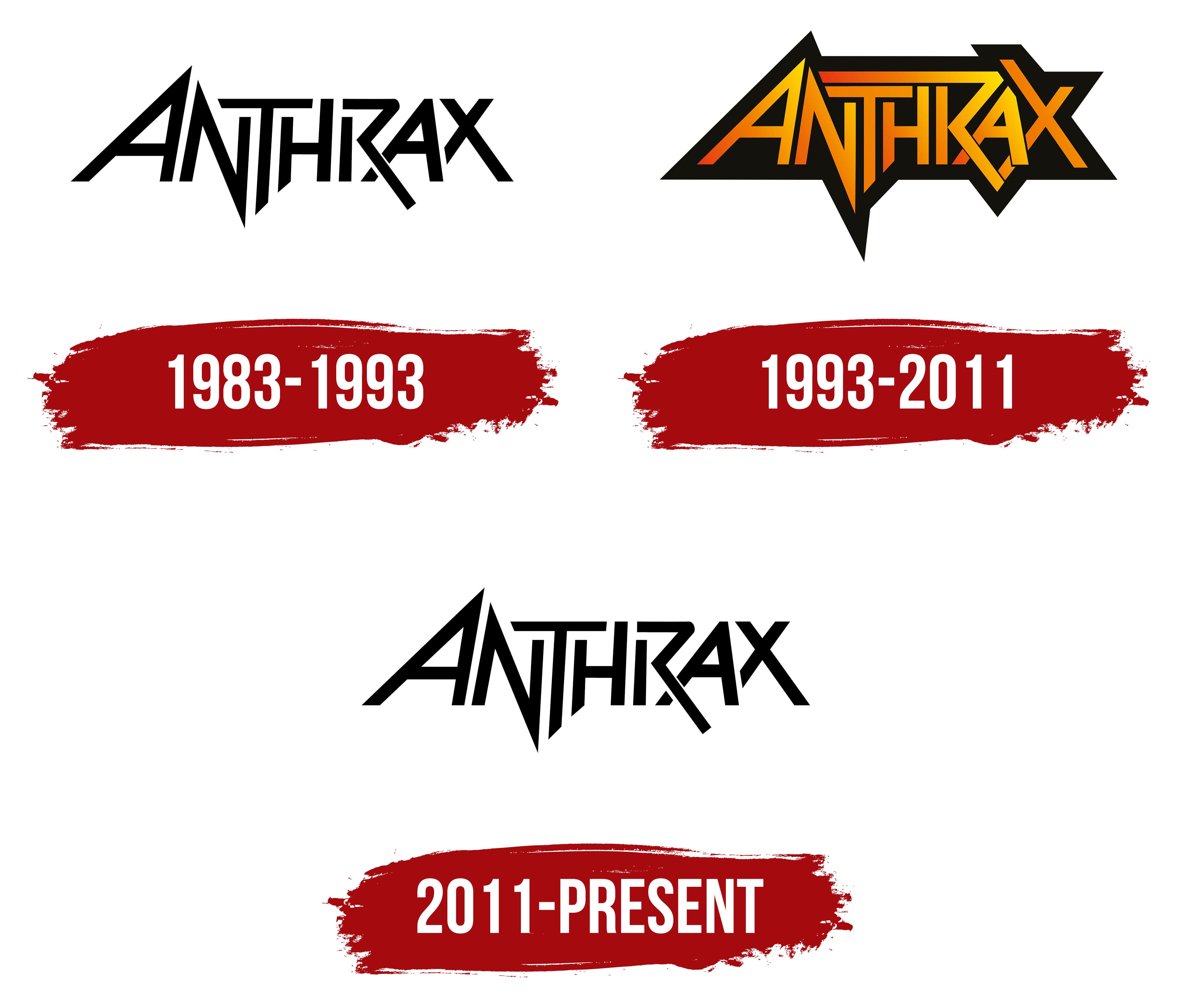
The band’s logo depicts its name. Scott Ian suggested using the word “Anthrax,” which he saw in a biology textbook, and decided it looked sufficiently intimidating. Lead guitarist Daniel Alan Spitz designed the logo. Drummer Charlie Benante developed the cover designs.
What is Anthrax?
Anthrax is a leader in thrash metal alongside Slayer, Megadeth, and Metallica. The group originated in New York in 1981 when a group of musician friends decided to conquer the rock scene together. They named their collective after a disease to reflect the heavy nature of their music. Their topical lyrics address acute political and social issues.
1983 – 1993, 2011 – today

The first Anthrax logo contains the band’s name in an unusual style. Initially, the letter heights violated the geometry: their edges extended beyond the boundaries of an imaginary line. Meanwhile, the printed characters were positioned so close that the horizontal stroke of the “T” literally lay on the “N” and “H.” A long line from the top of the “R” covered them. The protruding parts of “A,” “N,” “T,” and “H” from the top and bottom form triangles. The palette is black and white; the design is minimalist except for the letters’ unconventional shape.
The band returned to the old version of the graphic symbol on its album covers in 2011. Moreover, an unusual version with a yellow-orange gradient and black shadows was used for the Worship Music collection, giving the word a three-dimensional effect.
1993 – 2011

In 1993, the band released an album with an updated logo. The rock band’s second emblem also reflects its name. However, it became more complex as designers made the inscription colorful and added a wide black outline. Changes only affected two letters. First, the line from “R” to “N” disappeared. Secondly, the long stroke of “X” became short.
Font and Colors

Anthrax doesn’t have a graphic symbol; the group has always used a logo with its name on numerous album covers, documents, posters, and other promotional materials. Such a minimalist approach is characteristic of many rock musicians, who focus on creativity rather than logo design.
The logo uses a custom font with unconventional letters. Some lines are elongated and extend beyond the conventional line. Serifs are absent. The color palette is monochromatic: black and white complement each other perfectly. This classic palette also works well in any visual context, making the band’s trademark universal.