


 Arrinera Logo PNG
Brand cars fly forward like birds. They look to the future and strive for superiority, development, and victory. This love of speed is reflected in the Arrinera logo. All auto systems work smoothly, as reflected in the emblem’s smooth, balanced lines.
Arrinera Automotive S.A. was founded in Warsaw on September 1, 2008, by brothers Łukasz and Marek Tomkiewicz. They planned to create the first Polish supercar and sell it abroad, primarily in Britain and the United States. The company brought in Lee Noble, founder of Noble Automotive, who joined as a shareholder after leaving his own British supercar firm in 2008. He worked on the tubular-steel chassis and the independent multi-link suspension.
The team showed the prototype to investors on June 9, 2011. In August 2012, Arrinera named the model Hussarya, after Poland’s winged hussar cavalry. The project soon faced controversy after a Polish journalist called the car a cheap Lamborghini-style replica, using parts from the Audi A6 and the Opel Corsa. Arrinera sued for defamation, but the court cleared the journalist.
In 2014, Pavlo Burkatsky led a full redesign. In April 2015, the Hussarya 33 appeared at the Poznań Motor Show as a planned 33-car limited series priced from 200,000 euros. The car used a 6.2-liter General Motors V8 from the Chevrolet Corvette ZR1, rated at 650 hp, paired with an Italian CIMA gearbox. Arrinera added carbon fiber and Kevlar bodywork, scissor doors, and aerodynamic testing conducted with the Warsaw University of Technology at speeds up to 360 km/h.
In 2016, the Hussarya GT debuted at Autosport International in Birmingham under FIA GT3 rules. That year, it became the first Polish car to run at the Goodwood Festival of Speed, a venue used by Porsche and Lamborghini. In 2017, the GT raced at Hockenheim and Donington Park, but results and funding did not support the program. By 2018, development had stopped. On August 15, 2021, Arrinera announced insolvency, and Hussarya never reached series production.
Meaning and History
Three years after opening, the manufacturing plant announced production of its debut concept car, with rear-wheel drive and a mid-engine layout. The second sample was presented in 2012 and was first named Venocara, but was later renamed Hussarya.
The young company developed a racing version to meet the FIA GT3 profile requirements. The Hussarya GT sports car debuted in Birmingham, Britain, at the Autosport International exhibition in early 2016. That summer, the car already showed off in the supercar class at the Goodwood Festival of Speed, making Arrinera the first Polish brand to compete at this level.
But then the company suffered a series of setbacks. In 2017, the Hussarya GT entered the DMV GT and Touring Car Cup in Hockenheim. In the first race, the car finished 22nd out of 24 participants. In the second race, the car went off the track due to a generator failure. Later that year, the engine of the car driven by Jonny MacGregor exploded during qualifying. This happened at the Britcar Championship’s Donington round.
As a result, the Polish logo was not well known among professional circles or fans. Before this incident, the company had approved its logo twice: first at the brand’s launch, and again before the concept car’s show at Autosport International.
What is Arrinera?
Arrinera Automotive S.A. created the first Polish supercar. The company was founded in 2008 and, a few years later, introduced the Arrinera Hussarya model. The car was designed using modern technologies to improve its speed and handling. In 2017, Hussarya was supposed to participate in races, but its engine exploded. Four years later, it was announced that production had been suspended.
2008 – 2016
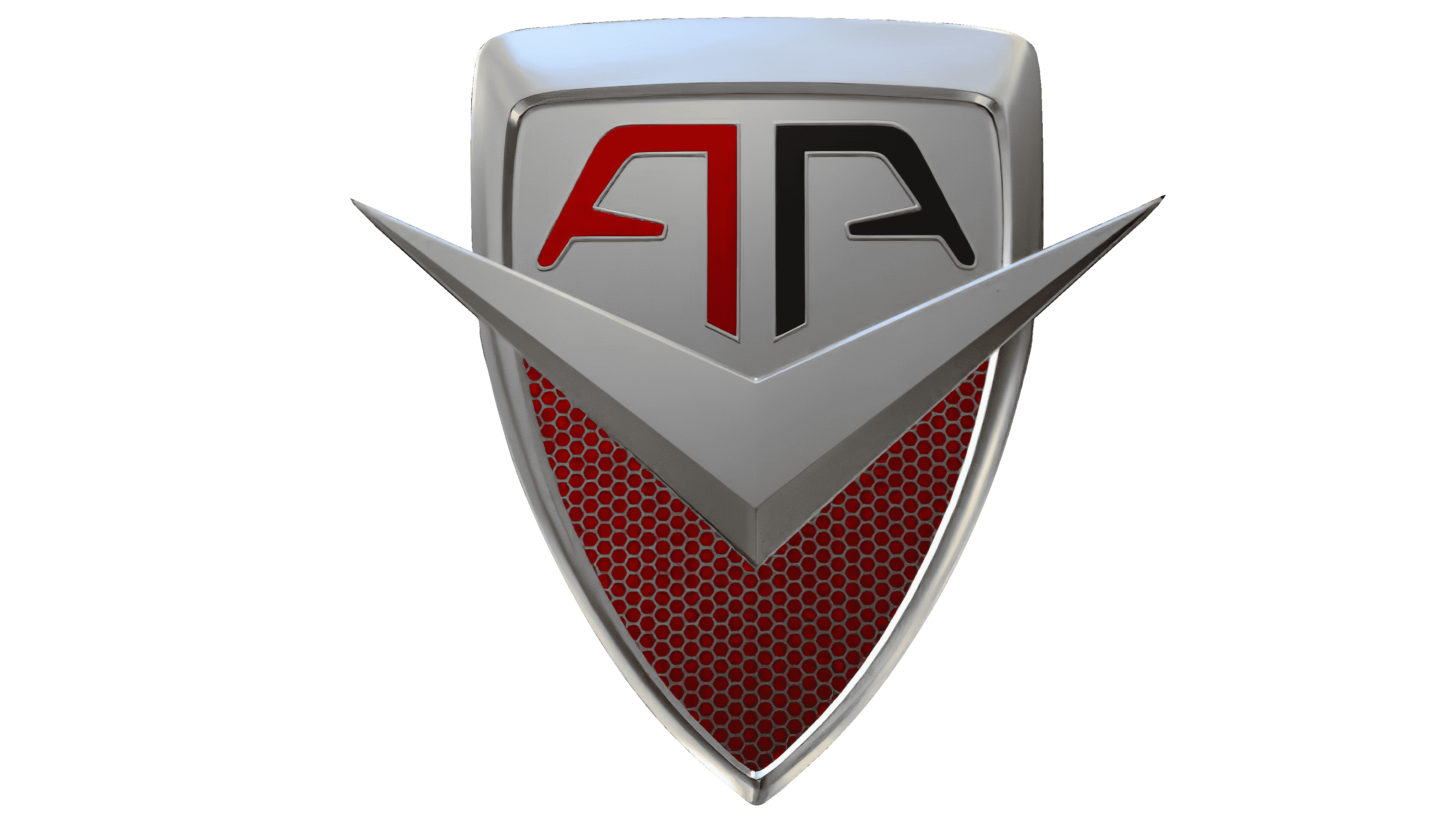
The opening personal badge consisted of two mirrored “A” s, actually the first and last letters of the word ARRINERA. It is also said these are two “R”s, deployed “back” to each other. In any case, one symbol was colored red, the other gray. In the background, they served as a signal flag, typically used in racing. It contains squares of the same size that alternate in color: black and white.
The letters lacked one leg. A third of the central crossbar was missing, so they were associated with two symbols at once: “R” and “A.” Below them was a winged sign resembling a flying bird or a wide “V.” Sharp strokes on the right and left added a wing-flap resemblance. The red shape at the bottom looked like a heart with elongated edges or like two tongues of flame. It was paved with tiny pink dots. Overall, the logo was a shield with wide edging. However, it was three-dimensional.
2016 – today
The Arrinera logo looks different now than it did before. The designers removed the shield and letters, concentrating on the image of a flying bird. They completely reworked the sign, giving it the shape of a diving silhouette: the wings are raised, and the head with its beak is lowered. Each wing consists of seven thin stripes of different lengths, thickening at the ends. Outwardly, such an element is very similar to a metal pen used for writing and graphics. The brand name appears on the right in a custom font. The letters are in uppercase and streamlined. A small, serif-like protrusion appears at the top of each symbol.
Font and Colors
The central image of the Arrinera logo is a flying bird. The wings’ flapping and configuration create these effects. Initially, the identity did not contain an inscription. It was added later, when the debut concept car was presented. The brand name consists of two words: “arintzea” (streamlined) and “vero” (true, genuine).
For the inscription, the developers chose an individual typeface with square symbols and top serifs. In line with the concept encoded in the company name, all letters are streamlined to emphasize the car’s high aerodynamic performance.
The color palette is discreet, consisting of red, black, white, and dark graphite #E31B22.