 Citrix Logo PNG
The Citrix logo is businesslike yet unconventional. It reflects the individuality that the software company, which focuses on virtualization products, aspires to. As a pioneer in this field, it wants to express its personality in everything, focusing on originality.
Citrix Systems was founded on April 17, 1989, in Richardson, Texas, by Edward Iacobucci, an Argentine-born engineer and former IBM employee. At IBM, he had worked on OS/2 with Microsoft and knew Bill Gates personally. His idea was to make OS/2 support multiple users connected to one server application. IBM rejected the concept, so Iacobucci raised $3 million, brought in five IBM colleagues, and created a company first called Citrus, later renamed Citrix, combining Citrus and UNIX.
The first product, Citrix Multiuser for OS/2, took two years to build, but Microsoft abandoned OS/2 in favor of Windows in 1991. Citrix nearly closed, yet investors added $5 million to rebuild the product for Windows. WinView arrived in 1993, followed by WinFrame in 1995, a Windows NT-based multiuser system that allowed up to 15 users and became an early thin-client solution for Windows applications.
Citrix went public on NASDAQ in December 1995, with shares doubling on the first day. Revenue rose from $14.6 million in 1995 to $44.5 million in 1996. In 1997, Microsoft threatened to build its own rival and stop licensing Windows NT code, sending Citrix shares down 62 percent in one day. Iacobucci negotiated a deal: Microsoft licensed Citrix technology for Windows NT Server 4.0 Terminal Server Edition, while Citrix released MetaFrame with its ICA protocol.
By 1999, Citrix products had 15 million users, including Sears, AT&T, and Chevron. Later products included Presentation Server and XenApp, with VMware as a major rival. In 2022, Vista Equity Partners and Evergreen Coast Capital bought Citrix for $16.5 billion, merged it with TIBCO Software, and placed it under Cloud Software Group.
Meaning and History
At its inception, the company was named Citrus, reflecting its mission to create a comprehensive multilingual programming environment that would serve as its foundation. However, it was later renamed due to the lack of originality in the name: it was too common and found in various fields. An existing company with the same name protested, claiming trademark rights. As a result, the software developer was forced to adopt a new name.
The word “Citrix” is formed from two bases. The first is “Citrus” (the owners still did not completely abandon it, using it in a less recognizable format), and the second is “UNIX” (an operating system). The original version was also preserved because it perfectly aligned with the company’s concept: citrus fruits consist of many independent segments, forming a whole product in a single shell.
What is Citrix?
Citrix (more precisely Citrix Systems) is an American software giant with offices in California, North Carolina, Paris, London, and Sydney, and development centers in the United Kingdom, Greece, Japan, India, and Australia, all managed from the head office in Fort Lauderdale, Florida. The company specializes in virtualizing workspaces, desktops, and cloud technologies, and in remote collaboration solutions, offering corresponding programs and applications. It was founded in 1989 by Ed Iacobucci, one of the pioneers of virtualization.
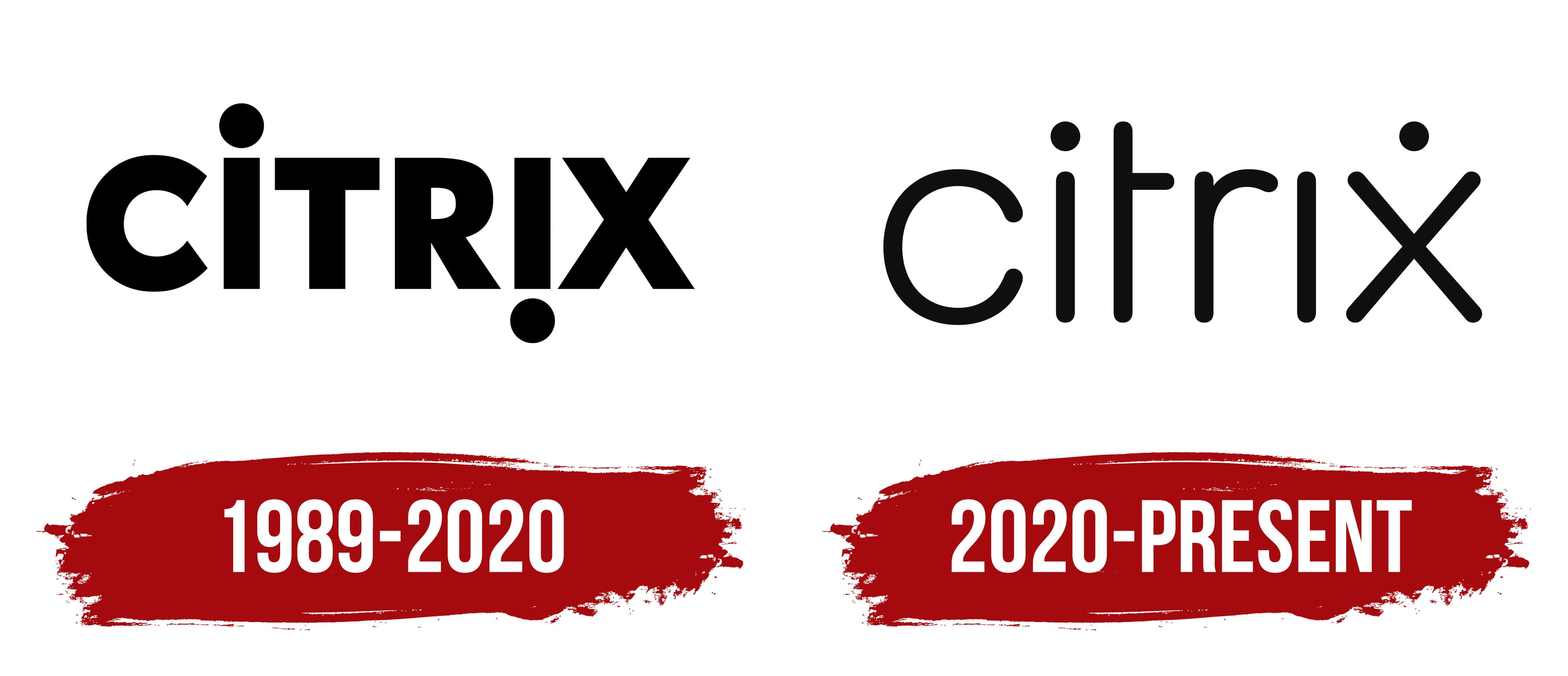
1989 – 2020

The logo included the name set in bold uppercase font. The exception was the lowercase “i”: to better express the software developer’s ideology, it was supplemented with classic dots. To illustrate the concept of a virtualization revolution, the letters were placed mirror-wise: the first glyph occupied its usual position, while the second was inverted. The upper dot moved down and extended beyond the word’s boundary. At the same time, all symbols were strict, even geometric, and chopped.
2020 – today
After modernization, the Citrix logo became softer and lighter. To achieve this, designers reduced the line thickness, converted the letters to lowercase, elongated them upward, and rounded the ends. The dots on the “i” convey the informal atmosphere: the first glyph’s dot is standard and in its proper place, while the second is moved to the neighboring “x.” As a result, the last symbol in the word looks like a simplified human figure with widely spread legs and raised arms. The dot, in this case, appears as a head. The other letters are even and thin, made in the form of vertically standing sticks, except for the semi-circular “c.” The left part of the crossbar is removed from the “t,” and the “r” is shaped like a cane.
Font and Colors
The inscription style in the Citrix emblem is a brand-specific hardware style. All letters are thin, smooth, vertical, and lowercase. The early name version was set in a bold font resembling Avenir Standard Black, while the later one used thin letters with rounded ends without serifs. The palette is predominantly dark on a light background, with the text usually set in black.