


 Cub Scout PNG
The Cub Scout logo symbolizes the program’s serious focus on knowledge and children’s approach to the natural world, teaching survival and navigation skills. The emblem embodies courage and bravery, showing that play is the foundation of everything.
Cub Scouts grew out of the Scout movement, founded by Robert Baden-Powell in 1907 after his first camp for 20 boys on Brownsea Island. As scouting spread, younger children began asking to join before the accepted age, creating demand for a separate junior program.
In 1914, Baden-Powell began developing a program for younger boys, using Rudyard Kipling’s 1894 book The Jungle Book as its symbolic basis. With Kipling’s permission, the new program used the wolf pack, Akela, Baloo, and Mowgli as core images. In June 1916, Baden-Powell published The Wolf Cub’s Handbook and announced the creation of Wolf Cubs. In 1917, the name Wolf Cubs became official.
In the United States, the idea was discussed since 1920, but BSA moved cautiously. In 1925, psychologist Harold W. Hurt studied Boy Rangers, Boys Clubs, and YMCA branches to shape an American model. BSA had rights to The Wolf Cub’s Handbook from 1916 and held informal Wolf Cub activities from 1918. A trial Cubbing program began in 1929, and Cub Scouting was officially established in 1930 with 5,102 boys registered in its first year.
The program was revised many times. Webelos appeared in 1941, Cub Scouts became the official name in 1948, and Tiger Cubs were introduced in 1982. In 2017, BSA announced that girls would be admitted starting in 2018, drawing objections from the Girl Scouts of the USA. In 2024, BSA removed Bobcat as a separate rank, and Webelos and Arrow of Light became separate annual levels within a six-level structure: Lion, Tiger, Wolf, Bear, Webelos, and Arrow of Light.
Meaning and History
The Cub Scout emblem is complex because each participant and pack has unique badges based on location, educational program, program level, and achievements. Nevertheless, many groups share a common symbol, the wolf.
The choice of the wolf is not accidental. Outdoor walks are the foundation of all scouting activities. During training, children learn to behave in natural settings and develop survival and navigation skills, as well as knowledge of local animals and plants. Hiking trips and sports competitions are integral parts of scouting meetings.
What is Cub Scout?
Cub Scouts is an international youth organization for young scouts, founded in 1916. It is a preparatory program for children up to age 11 who can later join the senior scouts.
The young scouts’ program is based on Rudyard Kipling’s book “The Jungle Book,” whose main character, Mowgli, is a boy who grows up in a wolf pack. The movement’s founder suggested calling the younger generation “wolf cubs” or “wolf-cubs.”
In the program, children begin as cubs, then advance to the Bear and Lion levels. The final stage before transitioning to adult troops is called Webelos, which is formed from the first letters of the stages: wolf (wolf), bear (bear), lion (lion), and scout (scout). Troop leaders are named after Mowgli’s mentors: Akela, Bagheera, and Baloo.
The organization’s logo depicts a cubic emblem with a wolf’s face, the organization’s name, and a heraldic fleur-de-lis on a yellow background.
The emblem’s shape is not random: the cube symbolizes youth, as the word “cube” is similar to “cub,” meaning “young one.” The figure’s four vertices represent the four stages of development leading up to acceptance into the Boy Scouts at age 12. The diamond-shaped base with an upward angle emphasizes growth and development: to reach the top, one must grow up and gain knowledge and skills.
The cube’s outline emphasizes protection and ongoing guidance from experienced, caring adults. The organization aims to protect the younger generation from physical injuries and negative influences. Children are provided with only verified knowledge through approved programs.
The image of only the animal’s muzzle recalls the carnival masks children wear to play a specific role. This highlights the beast’s inner essence and the qualities children should assimilate: strength, agility, speed, and the ability to navigate the forest.
The heraldic fleur-de-lis symbolizes the scouting movement. The logo indicates that the children are gradually moving towards transitioning to the Boy Scouts. Originally, the fleur-de-lis symbolized French kings and embodied grandeur and dignity. In the scouting movement, the flower’s three petals symbolize a young scout’s duty to self, society, and God.
Font and Colors
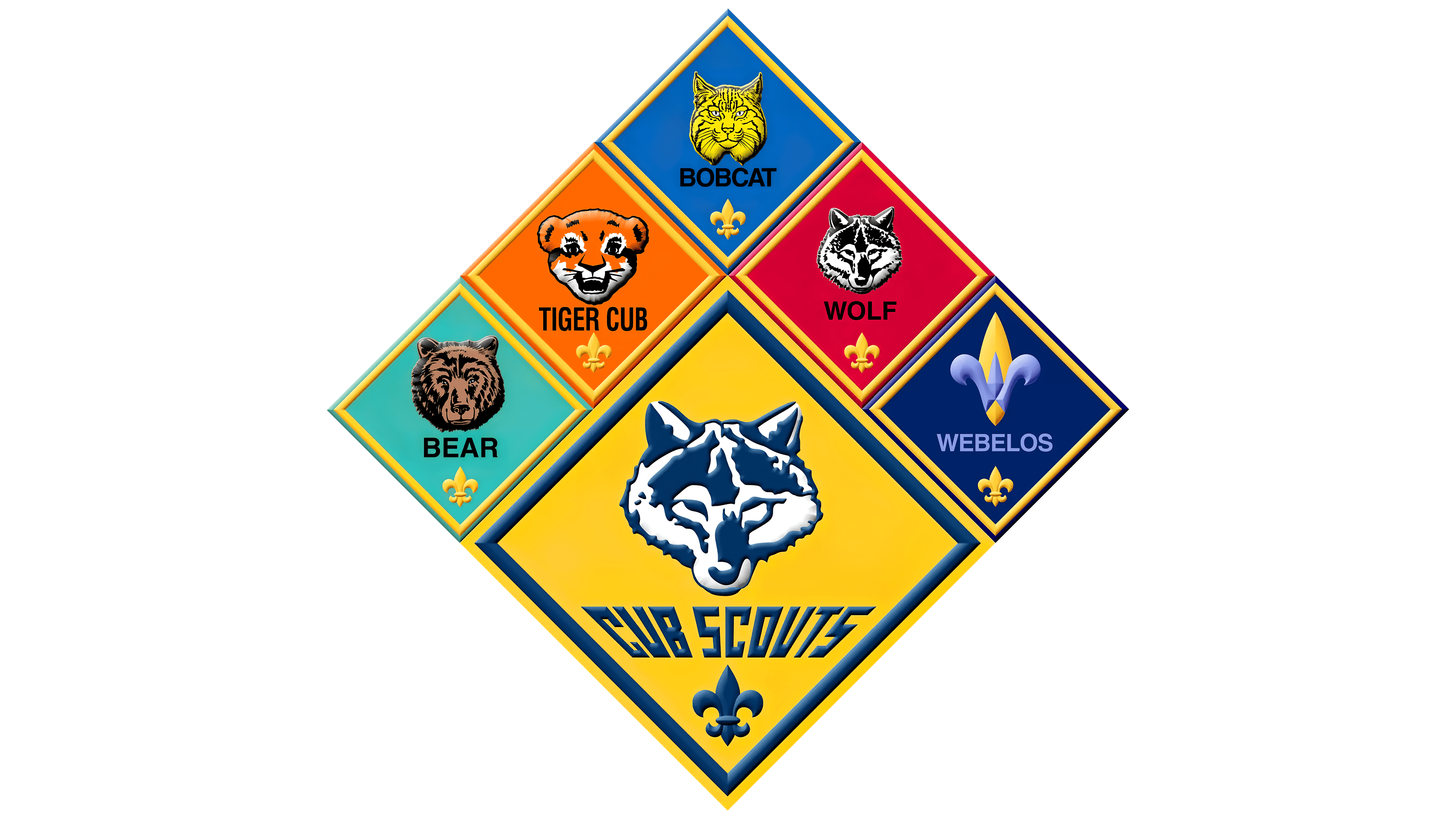
The emblem’s main colors are blue and yellow.
Blue symbolizes learning, knowledge, and growth, reflecting the program’s main goal: imparting important skills. This shade also represents protection, privileged status, and stability. In scouting, blue represents loyalty, reliability, discipline, and focus.
Yellow represents the color of childhood. It shows that knowledge is transmitted playfully, and group meetings are filled with fun, joy, and good spirits.
The small amount of white color hints at the participants’ youth and their initial stage in the large-scale scouting movement.
The unusual lettering of the organization’s name suggests the viewer is looking at the emblem from top to bottom, emphasizing the youth of the movement’s participants. Capital letters emphasize the importance of participating in the program to develop valuable character qualities. Children lay the foundation for strong health, responsibility in preserving natural resources, and an understanding of their duty to society.
The font resembles Ryden Oblique.