


 Daimler Logo PNG
The Daimler logo is strict and stylish. It embodies the founders’ logical minds and graceful approach to problem-solving. The emblem is environmentally friendly, constantly updated, and developed.
Mercedes-Benz traces its history to two inventors who worked separately but followed the same technical idea. Gottlieb Daimler, born in 1834, left Deutz in 1882 with Wilhelm Maybach to develop high-speed combustion engines. Karl Benz, born in 1844, worked in Mannheim. In 1885, Daimler and Maybach built the Reitwagen, an early motorized two-wheeler. In 1886, they motorized a four-wheeled carriage, while Benz presented the Patent-Motorwagen, the first officially recognized car with an internal combustion engine.
Benz founded Benz & Cie. in 1883, and Daimler and Maybach created Daimler-Motoren-Gesellschaft, or DMG, in 1890. A turning point came through Emil Jellinek, an Austrian diplomat and DMG investor. In 1899-1900, he ordered a racing car from Maybach and promised to buy 36 vehicles for 550,000 gold marks. His condition was that the engine carry the name Mercedes, after his daughter. The Mercedes 35 hp went on sale in 1901, and the name was registered as a trademark in 1902.
In 1909, DMG registered the three-pointed star, while Benz & Cie. registered the laurel wreath. On June 28, 1926, the two companies merged to form Daimler-Benz AG, and their cars began to use the Mercedes-Benz name. The star and wreath were combined into one mark. Karl Benz joined the board of the new company and remained on it until he died in 1929.
During World War II, Daimler-Benz produced DB aircraft engines, trucks, tanks, and military equipment. After the war, recovery was slow, but the Ponton series helped restore profits in the early 1950s. In 1954, the 300 SL debuted with gullwing doors. Later milestones included the G-Class in 1979, the M-Class plant in Alabama in 1997, the DaimlerChrysler merger in 1998, the Chrysler sale in 2007, the Daimler Truck split in 2021, and the adoption of the Mercedes-Benz Group name in 2022.
Meaning and History

Behind the simplicity of the company’s logos lies a 200-year history of carmakers. The emblems immortalize the memory of the most significant names, outstanding engineers, and geniuses of thought. That is why, in most variations, there is no image, and the viewer’s attention is focused on the corporation’s names, which change as new giants join and grow.
What is Daimler?
Automotive giant with assets of 259 billion euros, founded in Germany through the merger of Gottlieb Daimler and Karl Benz. It specializes in the creation of passenger cars on gasoline and electricity. More than 170 thousand people work at the conglomerate’s factories.
1883 – 1890
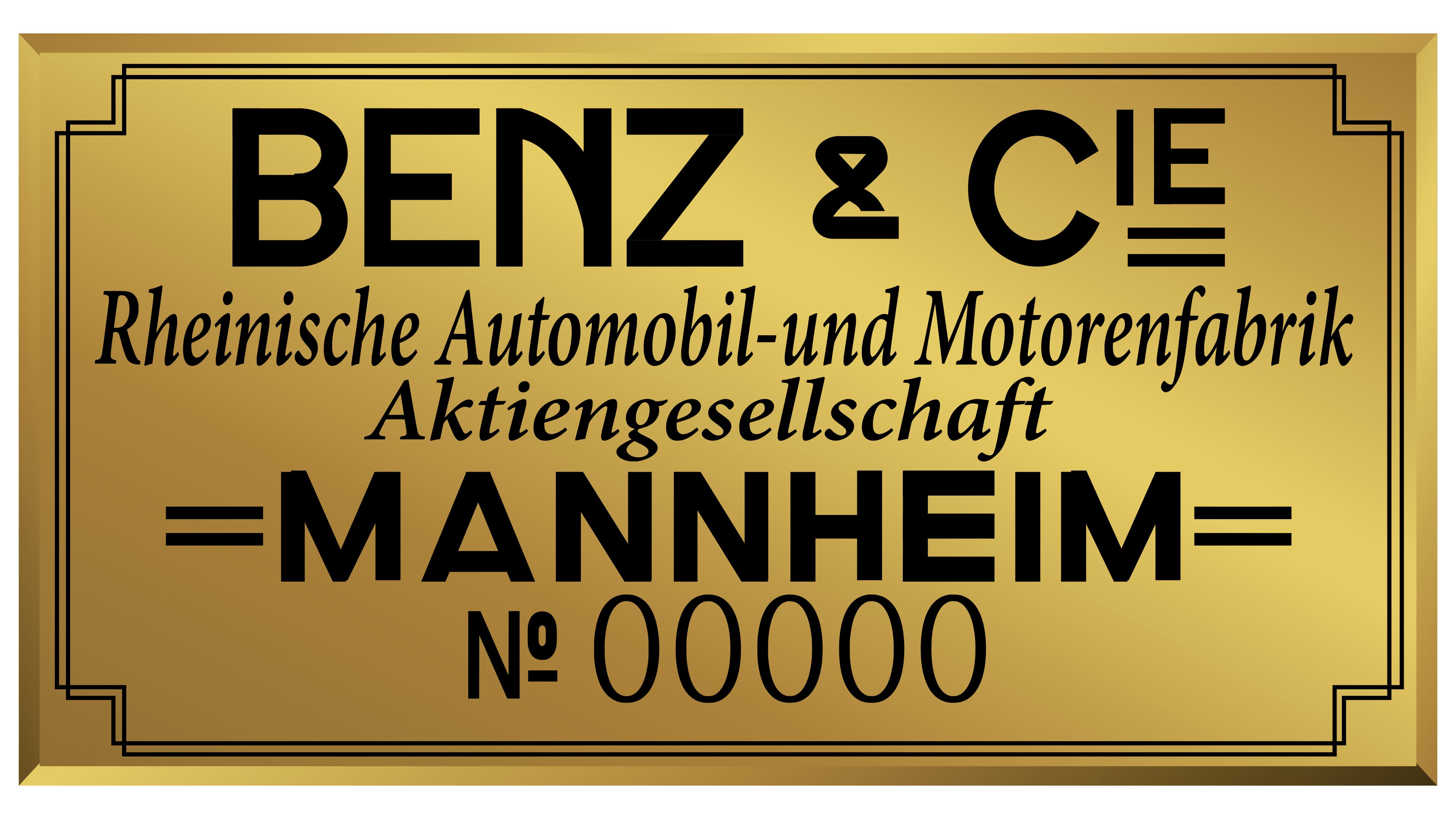
The logo is a metal plate that the owners apparently placed on the company’s new horseless carriages.
At the head of the emblem is the inscription: Benz & Cie. This association was founded in 1883 by the engineer-inventor Karl Benz and two bicycle repairmen, M. Rose and F. Eßlinger. The addition of “Cie” comes from the abbreviation “companies,” since the collaboration’s full name was “Benz & Compagnie Rheinische Gasmotoren-Fabrik.” For convenience, the name was abbreviated.
Benz had a fairly rich experience before this company, as a result of running its factory, where it invented and produced a two-stroke engine, and later a system patented by him, which became the basis of modern cars (a complex of ignition, spark plugs, carburetor, battery, clutch, radiator, and gearbox gears). Therefore, his name is central to the logo.
Below is a detailed transcript: Rheinische Automobile und Motorenfabrik Aktiengesellschaft. The inscription tells which plant the company manages and what it does. At the factory, Benz continued to shape the future of the car by combining its developments with bicycle design features. The result was Motorwagen, the first car in history.
The logo was completed with the inscription “Mannheim No. 0000.” Production took place in the third-largest German city, and the four zeros hinted at many future modifications to the new invention.
1890 – 1926
The restless genius of Benz continued to bring the world more and more new creations: several car models, the first trucks (1895), the first buses (1895) powered by internal combustion engines, and a flat engine (1986).
However, in the production of cars, he had another German competitor, Daimler-Motoren-Gesellschaft (DMG), founded in 1890 by another German engineer, Gottlieb Daimler. He, along with Wilhelm Maybach, invented the gasoline-powered internal combustion engine.
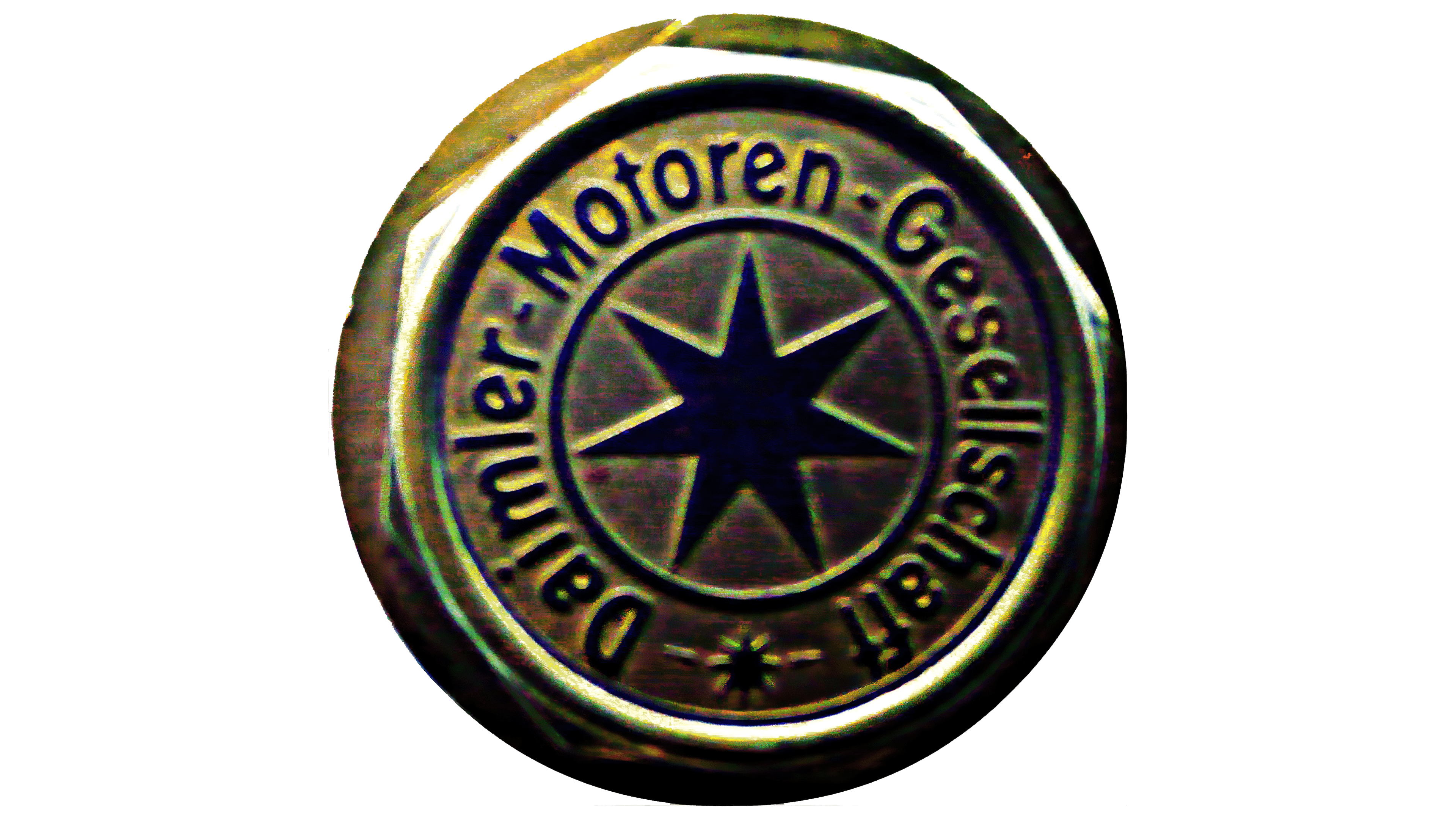
Daimler’s logo was an embossed metal circle resembling a wheel. Inside, the company’s name was spelled out in a circle, and in the center was a seven-pointed star. The beams looked like the inner spokes of vehicle wheels, especially those of the Petroleum Reitwagen, the world’s first motorcycle built by Gottlieb.
The combination of spokes in the center and a convex rim along the edges enhanced the resemblance to a wheel.
1926 – 1998

In 1926, the two giants finally met and merged into a single corporation called Daimler-Benz. The new logo reflected the unification. It consists of the founders’ names, written in elegant, thin letters, each in capital letters.
Interestingly, by that time, none of the designers were working in these companies. Gottlieb Daimler died in 1900, and Maybach left the firm a few years later. Benz also left Benz & Cie as a developer and started another company with his sons.
However, the designers’ names were chosen for the new corporation and logo as a tribute to their contributions and talent. Thin, graceful letters personify a flexible mind and education. They echo the light wheels of new cars. The lack of separation between the surnames indicates close cooperation and connection of developments.
1998 – 2007
In 1998, one of the major intercontinental mergers took place. Germany’s leading and the US’s third-largest corporation merged to form DaimlerChrysler AG.
The association’s logo retained the previous logo’s style and included the company’s name. The font of the inscription has also remained the same. However, its letters are smaller. The solution helps keep it compact, as both parts of the title are quite long.
Firm names are listed in order of precedence. Therefore, Daimler precedes Chrysler, as it is 25 years older. Plus, there were lengthy proceedings over the fact that Daimler-Benz effectively absorbed a younger company and did not close the deal on equal terms.
The emblem’s color has also changed from black to blue. The hue indicated the rise of the possibilities of a joint corporation to heaven, thanks to the combination of knowledge and experience.
2007 – 2015

The expected rise in the joint corporation’s development did not occur. Since 2002, each of the firms has continued producing its cars. In 2007, part of Chrysler was sold. Therefore, the company retained only the first part of the name, like the logo.
The emblem features a large blue inscription in capital letters, with serifs that represent progress, development, and growth. The company occupies a leading position in the car market. There are several successful partnerships. Along with the Chinese BYD and Denza luxury cars, MV Agusta motorcycles are bought by Italians.
2015 – 2022
The 2015 logo takes on volume and a light gray-and-white gradient. The redesign indicates renewal, a new starting point for development. In partnership with other automotive companies, the company has acquired Here Technologies, a developer of navigation systems and maps. This is one of the brand’s steps towards implementing a new strategy: becoming a mobility supplier. For the same reason, Daimler is partnering with young start-ups. The next step was electric vehicles. And, in this vein, the light logo is a symbol of environmental friendliness.
In 2022, the company was renamed the Mercedes-Benz Group, marking the end of the Daimler logo’s history.
Font and Colors
Over the years, the logo’s color has evolved from black to blue to white. The clarification process showed the company’s ability to revive itself, renew, and create new masterpieces. In white, it conveys concern for the environment, new partnerships, and a rethinking of one’s place in the modern, robotic world. The founders’ names continue to live on through new inventions. The company strives to remain the flagship, as it was when it was created.
The font is close to Pliego Medium, with delicate serifs that convey a chic, technological sense of excellence.