


 Doubleday Logo PNG
The Doubleday logo represents books that found their way to readers, writers whose stories became part of the culture, and pages that reshaped literature. This name unites bold ideas, unexpected plots, and voices that echoed through time, leaving a lasting imprint in books that endure.
Doubleday & McClure Company was established in New York City in 1897 by Frank Nelson Doubleday and Samuel McClure. Doubleday had started his publishing career at Charles Scribner’s Sons, rising rapidly from an entry-level position to a management role.
Following McClure’s departure, the firm was renamed Doubleday, Page & Company in 1900, with Walter Hines Page joining as a partner. Early publications featured notable authors such as Joseph Conrad and Rudyard Kipling. In 1910, the company established Country Life Press in Garden City, Long Island, a state-of-the-art printing and publishing facility.
In 1927, it expanded significantly by merging with George H. Doran Company, becoming Doubleday, Doran & Company, and then simplified to Doubleday & Company in 1946. Post-war expansion was marked by the establishment of the Literary Guild book club in 1947 and the publication of prominent writers, including John Steinbeck, William Faulkner, and Ray Bradbury, in the 1950s and 1960s.
In 1986, Bertelsmann AG purchased Doubleday for $475 million and later integrated it into Random House in 1998. Following the 2013 merger that formed Penguin Random House, Doubleday continued as a prominent imprint, releasing bestsellers such as Dan Brown’s Inferno (2013) and Origin (2017).
From 2021 to 2024, Doubleday remains an influential division within Penguin Random House, actively supporting established authors and nurturing emerging talent, adapting to digital formats, and striking a balance between literary prestige and commercial success.
Meaning and History
What is Doubleday?
This is one of the largest publishing houses in the United States, producing both fiction and non-fiction. Its catalog includes bestsellers, books by renowned authors, and works recognized with prestigious literary awards. Careful manuscript selection and thorough editing ensure the production of high-quality publications. The company releases hardcover books and supports emerging writers, helping them find an audience and turn their works into successful publications.
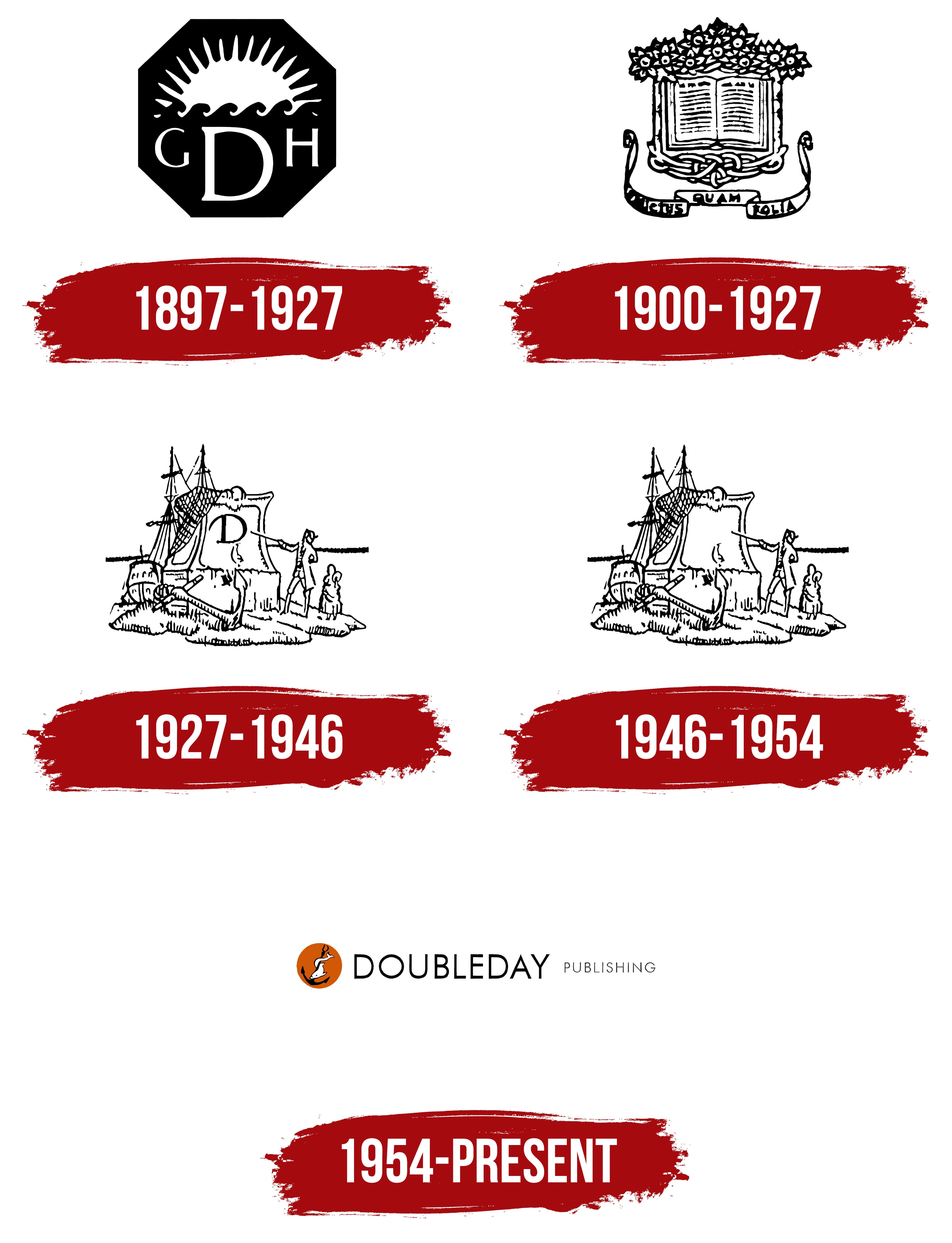
1897 – 1927

The design of the George H. Doran Co. publishing logo is defined by strict geometry. The design is placed within an octagon with beveled corners. The shape conveys a sense of completeness and reflects the traditional look of marks from the late 19th and early 20th centuries, which were commonly used in book design.
At the top is an image of the sun. It is depicted in a white silhouette with long straight rays and stylized waves at the base. The rising sun is interpreted as a metaphor for a new day, light, and enlightenment. The wavy line combined with the sun’s rays enhances associations with the ocean and transatlantic connections, reflecting the idea of spreading literature between the Old and New Worlds.
Below the sun symbol is the abbreviation GDH. It is written in a serif typeface close to classical Roman fonts. The letter D is larger in proportion. The G and H are thinner and contrast with the massiveness of the central letter.
The black-and-white design reinforces the seriousness and traditional character of the emblem. The George H. Doran Co. mark combines the image of the sun, a symbol of knowledge and enlightenment, with classical typography. The octagonal frame unites the elements into a cohesive composition associated with the cultural authority of a publishing brand from the early 20th century.
1900 – 1927

The mark of Doubleday, Page & Company is based on the image of an open book. Detailed pages with horizontal lines mimic printed text, emphasizing the nature of publishing and the emblem’s connection to the book, the company’s main focus.
The book is enclosed in a frame resembling a braided cord or decorative ornament. This style was typical of woodcut design in the late 19th and early 20th centuries, reflecting the high value placed on craftsmanship, durability, and artistry. The frame added formality and created the impression of a solid foundation.
At the top of the symbol is a wreath made of stylized flowers. Its dense decoration visually resembles a crown. The wreath serves as a sign of fertility and intellectual growth, symbolizing reward and recognition for intellectual labor. The company conveyed the idea of cultural authority and the importance of knowledge through this symbol.
The lower part of the composition features a ribbon with a Latin motto. The inscription “Vincit qui patitur” (“He conquers who endures”) is written in a decorative uppercase font. The letters are massive, slightly rough in shape, with a handwritten character adapted to high embossing. In engraved versions, some distortions occurred, but the main meaning remained intact. The motto expressed the value of perseverance and endurance as the foundation of publishing, linking it to effort and cultural mission.
The Doubleday, Page & Company logo incorporates ornamentation and decorative elements. These elements distinguished the publishing house from competitors and strengthened its image as a guardian of culture and educational values.
1927 – 1946

The merger of Doubleday and George H. Doran was reflected in the new emblem, which, for the first time, adopted a maritime theme for the Doubleday brand. The sharp visual shift reflected the influence of Doran’s tradition, which had previously used imagery of travel and the sea. The composition assumed an illustrative character, reminiscent of a book engraving, rich in detail and allegorical imagery.
In the center of the scene is a large scroll bearing the letter D. The design is rendered in a serif typeface with smooth, curved lines. The proportions and shape make the symbol heavy and monumental, turning it into the key visual focus.
To the right of the scroll is a man wearing a cloak and a tricorn hat. His pose, with a pointing stick directed at the letter, is interpreted as an allegory of the mission of enlightenment and the dissemination of knowledge. Next to him are a woman and a child, adding depth and emphasizing the scene’s educational and family-oriented nature.
The left part of the composition is organized differently. In the background is a sailing ship, symbolizing the exploration of new territories, specifically referring to the fields of knowledge and literature. The foreground features maritime elements, including an anchor, nets, and a barrel. They form a chain of associations related to reliability, tradition, and stability.
The design is based on black-and-white contrast. The engraving technique effectively highlights the high level of detail, creating a sense of historical depth and authenticity. The composition is perceived as an allegory of discovery and cultural exploration, expressing continuity and authority.
The Doubleday Doran logo demonstrates the union of the two publishing houses’ traditions. From Doran, it inherited the maritime motif, which had previously been absent from Doubleday’s style. At the same time, the overall structure and illustrative approach built the image of a reliable and educational brand that aspired to the status of a cultural institution in the publishing world of its time.
1946 – 1954

The change in the logo following the transition to the name Doubleday & Co. was expressed through the removal of the large letter D, which had previously occupied the central position on the scroll. The focus shifted from the letter symbol to the scene’s imagery, thereby enhancing the emblem’s allegorical interpretation.
The composition retained its structure, reminiscent of a book engraving. The foreground still featured the characters and maritime objects that formed a complex visual arrangement. The figure of the man in the cloak and tricorn hat was now perceived not as a supporting element but as the main character. His pointer, aimed forward, gained new meaning in the absence of the letter D, emphasizing his role as a navigator. The image conveys ideas of intellectual exploration, the advancement of knowledge, and the discovery of new literary horizons.
The family group, comprising the woman and child, became a symbolic representation of the publisher’s focus on a diverse audience across generations.
The removal of the letter from the logo shifted the emphasis to the narrative scene and its symbolism. The central meaning centers on maritime and historical motifs that express Doubleday & Co.’s values.
1954 – today

The updated Doubleday emblem introduced a mark featuring a dolphin and an anchor, distinguishing it from earlier, more complex illustrative versions. The company shifted its aesthetic from engraved richness to minimalism and restraint, creating a modern symbol.
The visual focus is on an orange circle containing a white dolphin entwined around a black anchor. The dolphin combines the ideas of intelligence and the pursuit of knowledge, typical of the publishing field, with the image of the anchor, which symbolizes reliability. The combination of elements expresses the idea of movement toward new knowledge and the dependability of the publishing brand.
The design is executed in a minimalist style. The contours are simplified, the lines thick and smooth, and the shapes are expressive and legible even at a small size. The orange background enhances the emotional tone, evoking energy and warmth, and makes the emblem stand out.
The word DOUBLEDAY on the right is written in uppercase letters using a strict geometric sans-serif font. The spacing between letters is evenly adjusted, emphasizing structure and seriousness. Further to the right is the word PUBLISHING. It is rendered in a thinner, more elongated gray font, signifying a secondary role and leaving the main emphasis on the name.
The color palette is limited to orange, white, and black, with gray used for the secondary text.
The Doubleday logo represents a transition from historically rich, allegorical compositions to a modern, minimalist style. The changes reinforced the company’s image as a publisher that respects tradition while aligning with the mid-20th-century aesthetic.
