


 Dyson Logo PNG
The Dyson logo feels soft and smooth because its shapes subconsciously build consumer trust. The emblem symbolizes the safety of all company appliances, from vacuum cleaners to hair dryers.
Dyson began in the late 1970s, when James Dyson worked in a shed behind his home after leaving his own company. Trained at the Royal College of Art, he had earlier launched a ballbarrow business in 1974, where he first saw an industrial cyclone separating dust from air.
At home, his Hoover Junior kept losing suction as the bag filled. This led to the idea of a bagless vacuum using centrifugal force. His board rejected the concept, believing companies such as Hoover and Electrolux had already developed it.
Between 1979 and 1984, Dyson built 5,127 prototypes. The first working machine appeared in 1983, but no British or American manufacturer agreed to license it because of the profitable dust-bag market.
In 1986, Japan became the entry point. Apex launched the G-Force vacuum, a premium product that gained attention and won a design award in 1991. Using royalties, Dyson founded Dyson Appliances Limited in July 1991.
Production began in Wales with Phillips Plastics, but after a dispute in 1993, Dyson opened his own factory in Chippenham. On July 1, 1993, the first vacuum left the line.
The DC01 entered the UK market with direct advertising that challenged competitors such as Miele, Bosch, Siemens, Electrolux, and Philips. Within two years, it became the UK’s best-selling vacuum.
In 1999, Dyson sued Hoover for patent infringement, leading to a £4.2 million payment in 2002. Manufacturing moved to Malaysia the same year. By 2005, Dyson led the US vacuum market in revenue, and later expanded into products such as the Air Multiplier (2009), the Supersonic (2016), and the Airwrap (2018). In 2019, the company moved its headquarters to Singapore.
What is Dyson?
Dyson is a technology company founded in the early 1990s in the UK and moved to Singapore in 2019. It is named after its founder, James Dyson, who invented the bagless vacuum cleaner. The company’s product range includes innovative heaters, fans, air conditioners, hand dryers, and other modern appliances. All of the company’s household appliances are known for their high efficiency, functionality, and performance.
1993 – 1994
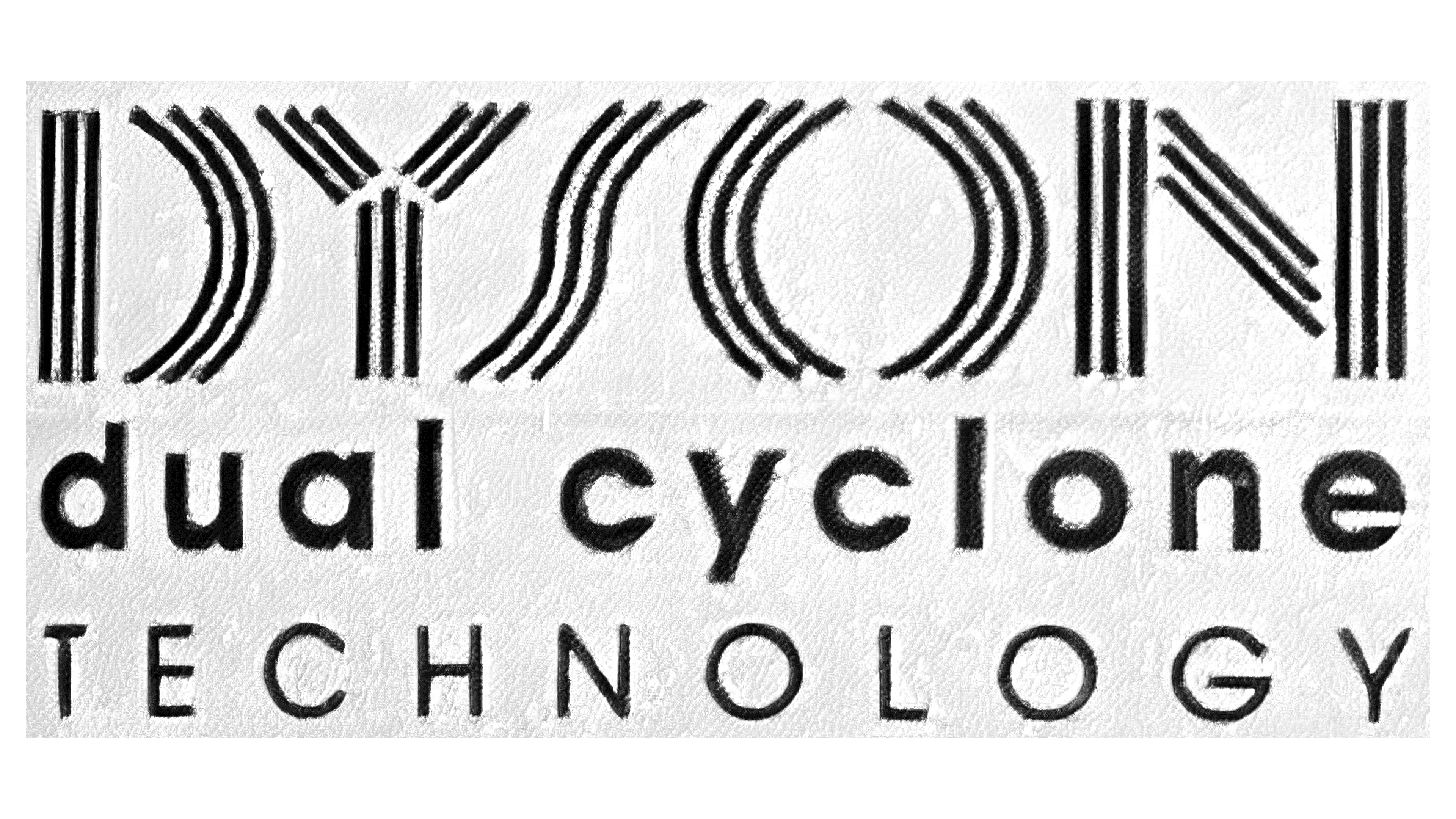
The original Dyson logo consisted of the brand name and signified originality. It was an innovative product for its time, featuring three-line inscriptions. The first was the company’s name. It used capital letters formed from three thin stripes. Each glyph contained several components of different shapes. The most interesting were “S” and “O.” The former had a wave shape, and the latter, vertical arches. The middle row featured the phrase “Dual Cyclone,” typed in lowercase, bold, and black. The third row contained the word “Technology,” typed in thin capital letters.
1994 – today
The brand was created through innovation and exists solely for it. Thanks to this approach and impeccable aesthetics, the brand has become one of the most recognizable worldwide. This is reflected in its logo, which successfully combines relevance, simplicity, and classic style. This principle holds that the manufacturer should not speak for itself; its product should.
As a result, the brand emblem is recognized as a standard of modern design. According to the developers’ concept, bright, high-tech products complement the strict black-and-white sign. The artists’ main element was the brand name. The unified inscription “Dyson” is monochrome, elegant, and minimalist.
Font and Colors
The company chose the individual Dyson Sans font for the wordmark, which fully conveys its values: innovation, originality, reliability, luxury, practicality, and creativity. Thanks to its concise form, the logo embodies perfection, with nothing more important than a well-executed idea.
The inscription is set in wide, lowercase sans-serif letters. The symbols are evenly distributed in the word and are slanted and rounded. The “D” lacks the lower part of the stem, and the “n” looks like an inverted “u” without a stick.
The brand palette is monochromatic. It uses both white and black backgrounds. Gray is used for product labels. A dark blue version is used in the internal administrative network. The official version consists of light letters on a dark substrate.