


 Easy Logo PNG
Innovative and original logo. It easily wins customers’ hearts with a bright, multifaceted emblem. Its smooth curves and lines reflect a convenient network that makes everything easy to find. Colorful and detail-oriented: this is the core style of its brand identity.
Easy grew out of Cencosud, the retail group Horst Paulmann Kemna created. In 1960, he opened the Las Brisas supermarket in Temuco, Chile, and in 1975 launched the Jumbo hypermarket in Santiago. The model later expanded to Argentina, where Cencosud opened its first Jumbo in Buenos Aires in 1982. In 1988, Cencosud opened Unicenter near the Argentine capital, the country’s first regional shopping center.
In 1993, Cencosud introduced Easy as a new retail format for home improvement and construction goods. The first store opened in Argentina, and the same concept reached Chile that year, with a location in Alto Las Condes, Santiago. Easy focused on building materials, flooring, tools, furniture, garden products, and home repair items. In Chile, its main competitor was Sodimac, part of Falabella.
The largest step came in 2001, when Cencosud bought four Argentine Home Depot stores for $90 million and converted them into Easy stores. The group also acquired Chilean chain Proterra, strengthening its position in construction retail. At the time, Argentina generated about 70% of Cencosud’s sales, so the market remained central to the group’s plans.
In 2007, Cencosud entered Colombia through Easy Colombia S.A., created with French retailer Casino Guichard-Perrachon. That same year, it bought Blaisten in Argentina, adding a more specialized format for ceramic tile, bathroom fixtures, and kitchen equipment. By the late 2000s, Easy had more than 80 stores across Argentina, Chile, and Colombia, with over 8,400 employees. In Colombia, it competed with Homecenter, a local chain already strong in building and finishing materials.
Meaning and History
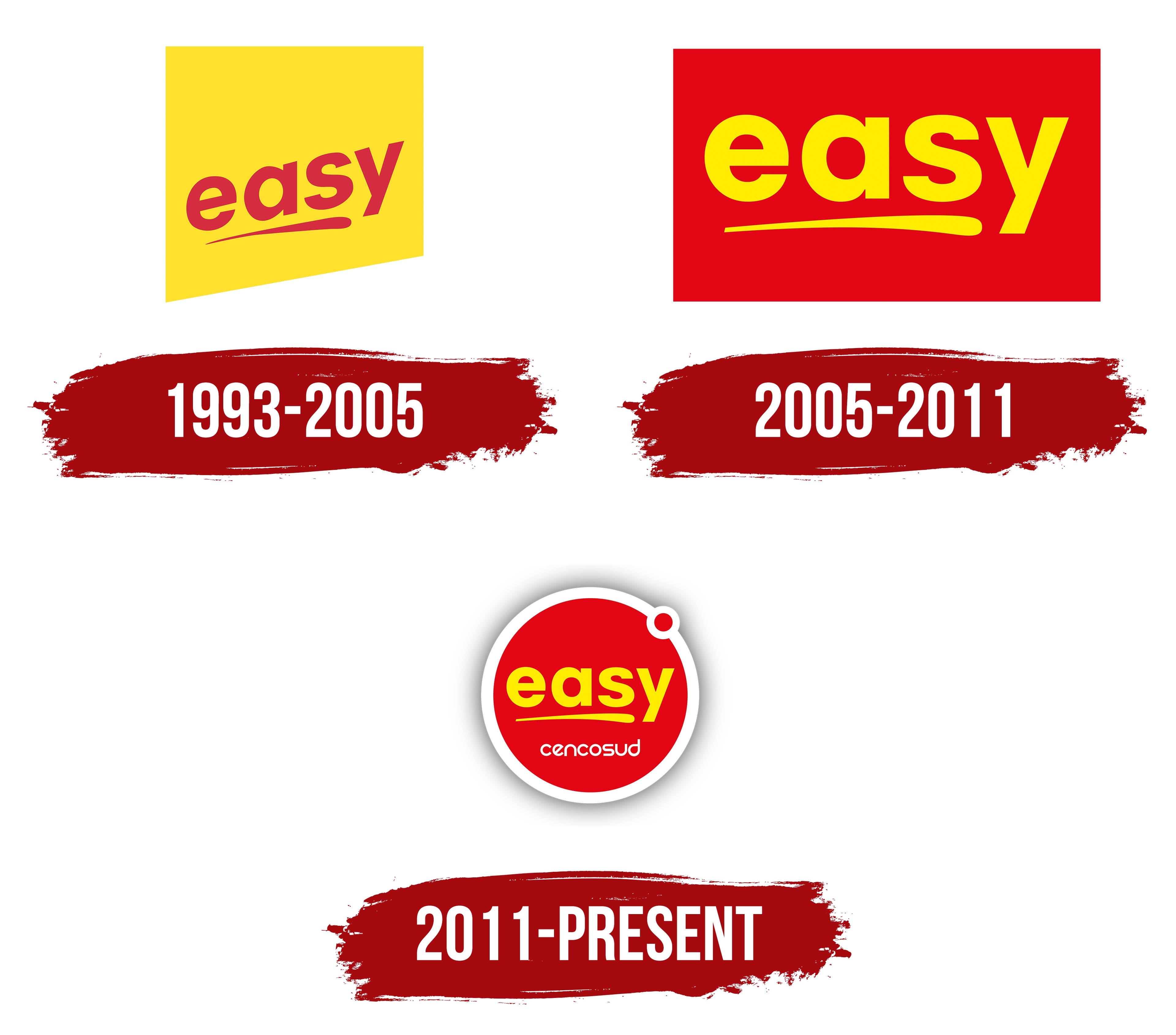
Easy was established over 20 years ago as a small company with a limited geographic footprint. But management didn’t stop there and decided to expand its operations. As a result, the company has created over 100 branches in different countries. Today, Easy is considered one of Chile’s largest and most successful brands. Its emblem is incredibly recognizable. Its bright, expressive coloring attracts attention and pairs well with a stylish font.
Two inscriptions sit at the base: the brand name and the parent company name. The first inscription is larger and more massive. The second, by contrast, is written in smaller letters. It is more elegant and sophisticated, creating a perfect balance in the overall visual identity. The colors are also in perfect harmony, which emphasizes the company’s prosperity.
What is Easy?
Easy is a subsidiary of the large conglomerate Cencosud and has more than a hundred points of sale in different countries (South America, Chile, and Argentina). It offers a wide range of home improvement products and building materials. The head office is in Chile, and the company’s annual turnover exceeds $ 1 million.
1993 – 2005
The first version of the logo was created in 1993, when Easy was founded. The original badge had only two elements: the brand name and a distinctive stroke. The latter was a strip that resembled an artist’s brushstroke. It was a bright symbol of a creative approach to home improvement. The stroke also carried the semantic load of absolute freedom of choice and flight of fancy. In Easy, you can find everything you need to bring even the boldest room-decorating ideas to life.
The name itself was designed in a minimalistic style. The letters had soft, smooth lines and had no serifs. This conveyed comfort, accessibility, and coziness, which is especially important for a retailer of such goods. The elements were located inside a figure resembling a price tag. The feature perfectly reflected the brand’s essence. The bright yellow background was chosen to symbolize optimism and cheerfulness, and the main elements were red.
2005 – 2011
As a result of the 2005 rebranding, the company received an updated emblem. It was a balanced icon that retained the content but changed the characters’ positions and the prevalence of colors. In the new version, the Easy name was not slanted, as in the previous version, but straight and level.
This symbolized the brand’s stronger position and stability as it developed. The font and stroke remained on the emblem. They demonstrated the company’s unwavering focus on helping clients design their homes creatively. In the new version, however, the color changed from bright red to rich yellow.
At the same time, the background color changed to red; its predominance symbolized passion, energy, and progressiveness. The proportions of the shape containing the components have also changed. The disproportionate figure was replaced with a rectangle on the wide side.
2011 – today
The next update to the visual identity already happened in 2011. The old emblem was replaced by a more modern design that combines elements of previous versions with new components. A three-dimensional circle replaced the rectangle with a white outline, a small shadow, and a red dot. The new figure contained two inscriptions: “Easy” and “Cencosud”.
The latter was the parent company’s name, emphasizing its role in developing the store chain. It was set in a futuristic sans-serif font. The main inscription remained the same, including the shape and colors. Beneath it was also invariably located the symbol of creativity, a neat stroke. The small dot on the contour had a special meaning.
In the company’s view, it meant the chain’s stores offered such a wide range of products that customers didn’t need to go anywhere else. This design showed respect for the brand’s traditions and history, as well as for its pursuit of new goals. Another advantage is its more modern design, which remains relevant today.
Font and Colors
The Easy logo is a prime example of how you can smartly upgrade an older version while keeping the core and adding stylish modern elements. The logo follows the traditional visual concept, with an expressive palette and characters set in a fixed font. The stroke symbol also remains from previous versions.
This demonstrates the company’s commitment to a single course since its founding, aimed at stable development. Among the innovations is the name Cencosud, set in an original font with unusual angles and cuts, and using a circle. The last element has a thick white outline and a tiny red circle directly above it.
In addition, red, white, and yellow colors were used in the logo. The first demonstrates openness, honesty, and conscientiousness. Yellow is a symbol of positivity. Easy provides a friendly, welcoming attitude toward each visitor and strives to create the most favorable shopping atmosphere.