


 Express Mail Service (EMS) Logo
Reliability, speed, and cost are the company’s main criteria. Therefore, the Express Mail Service (EMS) logo contains elements that directly reflect its main characteristic. Designers used a combination of bright colors, adding expression and dynamism to the sign. The broad lines, original glyphs, and geometric layout also convey these.
Express Mail Service grew out of the international postal system created by the Universal Postal Union. On October 9, 1874, 22 countries signed the Treaty of Bern. They formed the General Postal Union, replacing many bilateral mail agreements with one coordinated postal territory. In 1878, it became the UPU, and in 1948, it gained the status of a specialized United Nations agency.
The idea of express postal delivery developed later. In 1970, the U.S. Postal Service launched an experimental accelerated delivery service, which became permanent in 1977. Other UPU members followed the same direction, but during the 1970s and 1980s, urgent international mail still relied mainly on separate agreements between national operators.
The key step came at the 1989 UPU Congress in Washington, where members approved the EMS Framework Agreement. It created common rules for urgent cross-border mail while keeping flexibility for country-to-country arrangements. The same process standardized barcodes and tracking methods, providing EMS with the technical foundation for international parcel monitoring.
In 1998, UPU postal administrations established the EMS Cooperative, which began operations after the 1999 Beijing Congress. Based at the UPU International Bureau in Bern, it coordinated service standards, operator audits, EMS Performance Awards, and pay-for-performance rules. EMS competed with DHL Express and FedEx, but its advantage was the reach of national postal networks. By 2015, EMS was available in more than 190 countries and territories, with 170 to 182 participating postal operators in different years.
Meaning and History
To intensify the forwarding of correspondence, the heads of the Universal Postal Union proposed creating a decentralized service to speed up mail delivery between countries. Postal operators in many countries have joined the service, provided that the senders or recipients pay the express delivery costs. A special body regulates the Express Mail Service – the EMS Cooperative. It promotes cooperation between member countries to provide clients with high-quality services.
To accurately convey the service’s activity, the designers depicted a triangle on the logo, shaped like wings from Mercury’s headdress and sandals (in some cultures, Hermes). Because of its speed, this god is considered the patron of the postal service. Such an element perfectly underscores the organization’s core concept: accelerated delivery of shipments to all corners of the world. At this time, two company logos are known. They are completely identical in style and differ only in small details.
What is Express Mail Service (EMS)?
Express Mail Service (EMS) is an international organization designed to facilitate cooperation among the postal services of different countries. It represents the express mail delivery service. Operates as an interstate network with strictly established rules governing mail exchange among 192 participants to improve customer service quality.
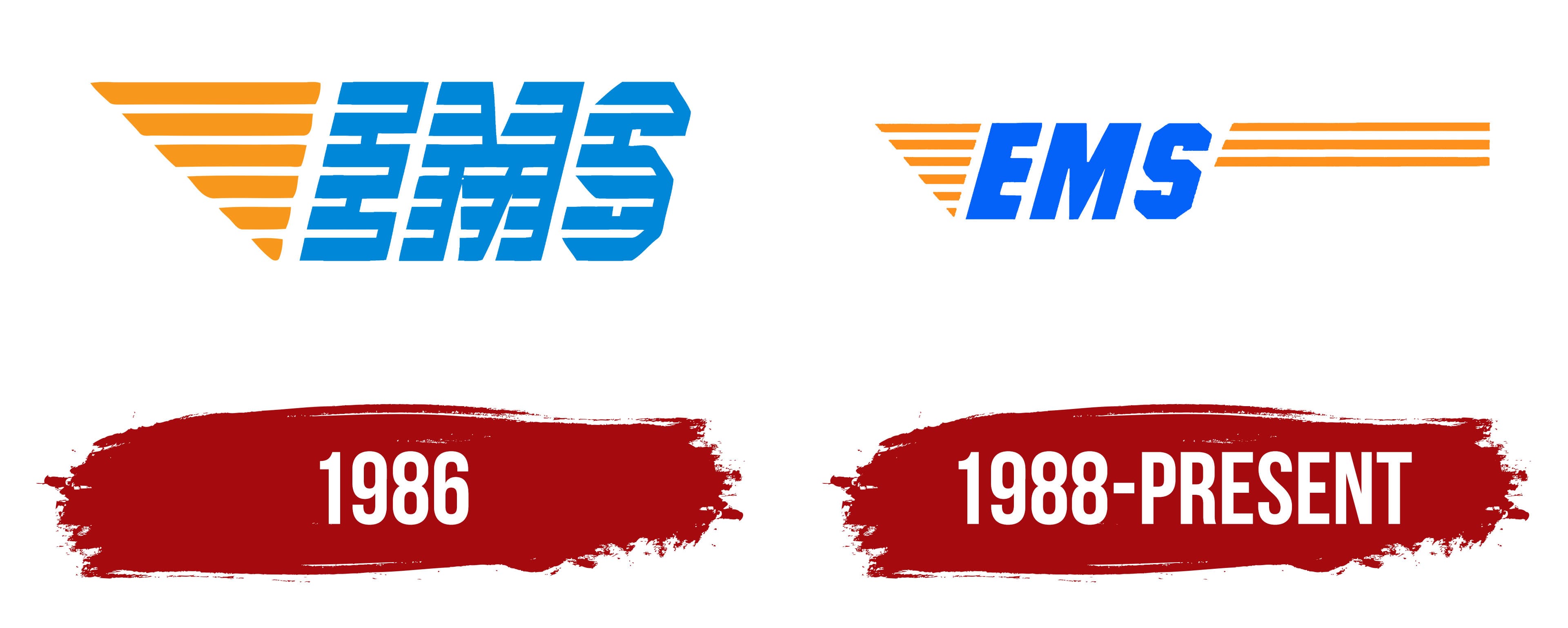
1986

The intergovernmental postal organization Express Mail Service has a two-part debut logo. The first is a striped triangle located on the tip. Thus, the rib turned out to be the top one because of a clear similarity between the geometric figure and the wing of the god Mercury. This element represents speed and is colored orange and white. The lines alternate evenly and are repeated in the adjacent letter of the EMS abbreviation.
The designers chose a font with very wide glyphs for the inscription, similar to hand-drawn ones. Light stripes from the left pierce them but not completely, so the right sides of the signs appear as shadows, making the name look three-dimensional. The characters lack serifs and are angled. However, it is not italic. The “S” looks the most original because it has a polyhedral shape with many angles. The name of the express delivery service is colored blue.
1988 – today
The modern version of the logo consists of three parts. The first two are the old elements, already well known to those who have long used the Express Mail Service (EMS). The third is a novelty, as if demonstrating the continuation of services. In particular, in addition to the triangle and the abbreviated name, three long orange stripes appeared on the emblem, which go far to the right and end with even cuts. On the left side, they run obliquely, with each subsequent line slightly shorter than the previous one. In this version, the designers have removed the letter shading and colored the letters completely blue. They retained the symbols’ shape.
The evolution of the Express Mail Service’s visual identity is a testament to the complexity of the design. As a result, the personal sign of the international postal service became three-part. The only advantage of this approach is ease of reading, as the longitudinal lines have disappeared from the letters. The developers moved them to the right and slightly lengthened them. However, the most important symbol of high-speed correspondence delivery is a triangle resembling a bird’s wing. It is present in both versions of the logo.
Font and Colors
The inscription is set in a custom-designed font. It was based on the Miller Type Foundry version of Blunt Semi Condensed Italic. Still, with a modified “S.” This sign is geometric and angular, with cuts, reminiscent of a similar glyph from the Anitlles Expanded Italic typeface. If you focus on the palette, you can notice two colors: orange and blue, which in the current logo are a couple of tones lighter than in the previous one.