


 Hard Rock Cafe Logo PNG
The Hard Rock Cafe logo demonstrates the brand’s strong connection to music culture and the entertainment industry. Its concise, recognizable style emphasizes the establishment’s status as an iconic venue for leisure and entertainment.
Hard Rock Cafe opened in London on June 14, 1971, founded by Americans Isaac Tigrett and Peter Morton. They rented a former Rolls-Royce showroom on Old Park Lane and built an informal restaurant around burgers, steaks, and milkshakes. The name drew inspiration from rock culture and from wording seen on The Doors album Morrison Hotel. British artist Alan Aldridge created the logo.
A defining custom began in 1973, when Eric Clapton gave the restaurant a guitar to mark his preferred seat at the bar. Pete Townshend soon sent another, and musicians later donated instruments, costumes, manuscripts, and personal items. By the 1980s, the London site held a collection of rock memorabilia that became central to the restaurant format.
Morton opened the first U.S. location in Los Angeles in 1982, while Tigrett developed markets outside America. Tigrett sold his international stake to Rank Organization for $108 million in 1988, and Morton sold his U.S. restaurants to Rank in 1996, placing the chain under one owner. Hotels and casinos followed, including Las Vegas in 1995, Orlando in 1996, and a Tampa casino partnership in 1999. The supplied history records no connection to the Colorado Rockies.
The Seminole Tribe of Florida bought Hard Rock International for $965 million in 2006 and continued opening restaurants, hotels, and casinos worldwide. In 2021, Hard Rock acquired the Mirage from MGM Resorts for $1.075 billion. It announced a replacement Las Vegas resort with a guitar-shaped tower.
Meaning and History
What is Hard Rock Cafe?
It is a globally renowned restaurant chain that combines American cuisine with a rock ‘n’ roll atmosphere. Restaurants attract visitors with unique music memorabilia, such as instruments, stage costumes, and gold records. Interiors resemble those of music museums, and branded t-shirts are popular souvenirs among tourists. The menu includes classic American dishes and cocktails. In addition to restaurants, the brand owns hotels and casinos, offering guests dining and entertainment experiences tied to rock culture.
1972 – 1981
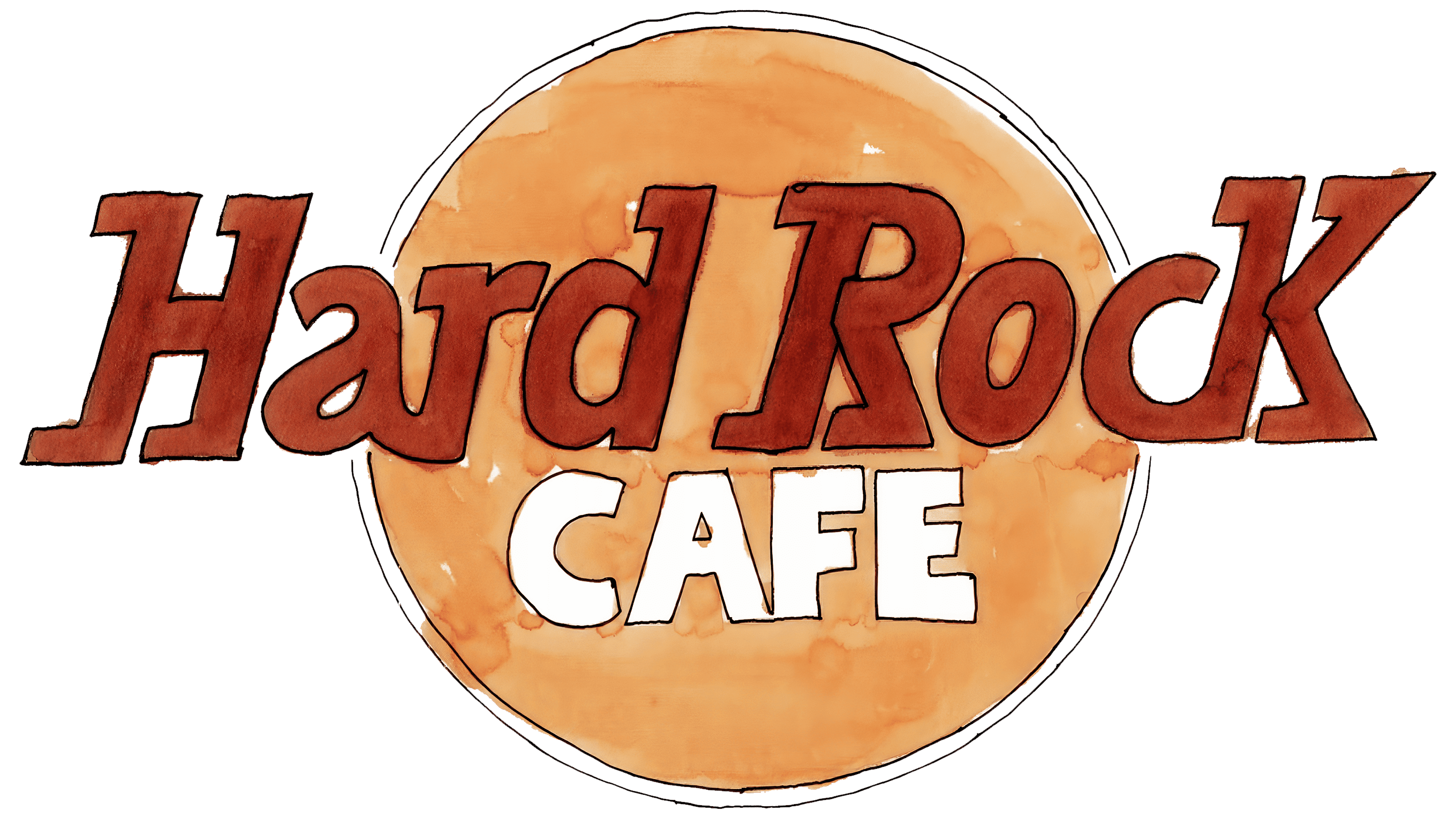
The original Hard Rock Cafe logo, created in 1972 by British illustrator Alan Aldridge, reflected a period when the brand’s visual language sought a connection with American retro aesthetics and automotive culture. Aldridge, previously known for designing record covers and books for musical acts such as The Beatles and The Who, was invited by the cafe’s founders, Isaac Tigrett and Peter Morton, to develop a brand image with a recognizable American character, in the spirit of classic 1950s and 1960s Chevrolet emblems.
Initially, the logo was intended to use a bright palette of red, white, and blue, evoking American symbolism. However, this idea was abandoned in favor of less aggressive tones, such as warm brown and mustard yellow, to avoid a direct visual reference to national themes.
The “Hard Rock” lettering was set in a typeface with rough, intentionally “hand-drawn” strokes, a rightward slant, and wide, thickened letterforms, reminiscent of mid-20th-century classic car emblems. In contrast to the main inscription, the word “Café” was placed within a circle just below and set in a simple, geometric sans-serif font with uppercase letters of uniform stroke weight.
The circular background behind the text featured clear signs of a watercolor technique, with light, drippy brushstrokes and uneven strokes. This style brought a sense of handcrafted creativity and artistic improvisation, matching the venue’s rock-and-roll and psychedelic aesthetic at the time.
The emblem gained broad popularity after 1973, when the accidental distribution of leftover T-shirts bearing the logo to patrons led to large-scale sales and created excitement among the cafe’s fans.
During this period, the Hard Rock Cafe visual concept connected with U.S. musical counterculture and automotive symbolism, combining the emotional expression of psychedelic pop art with the media image of American rock and roll.
1981 – 1984
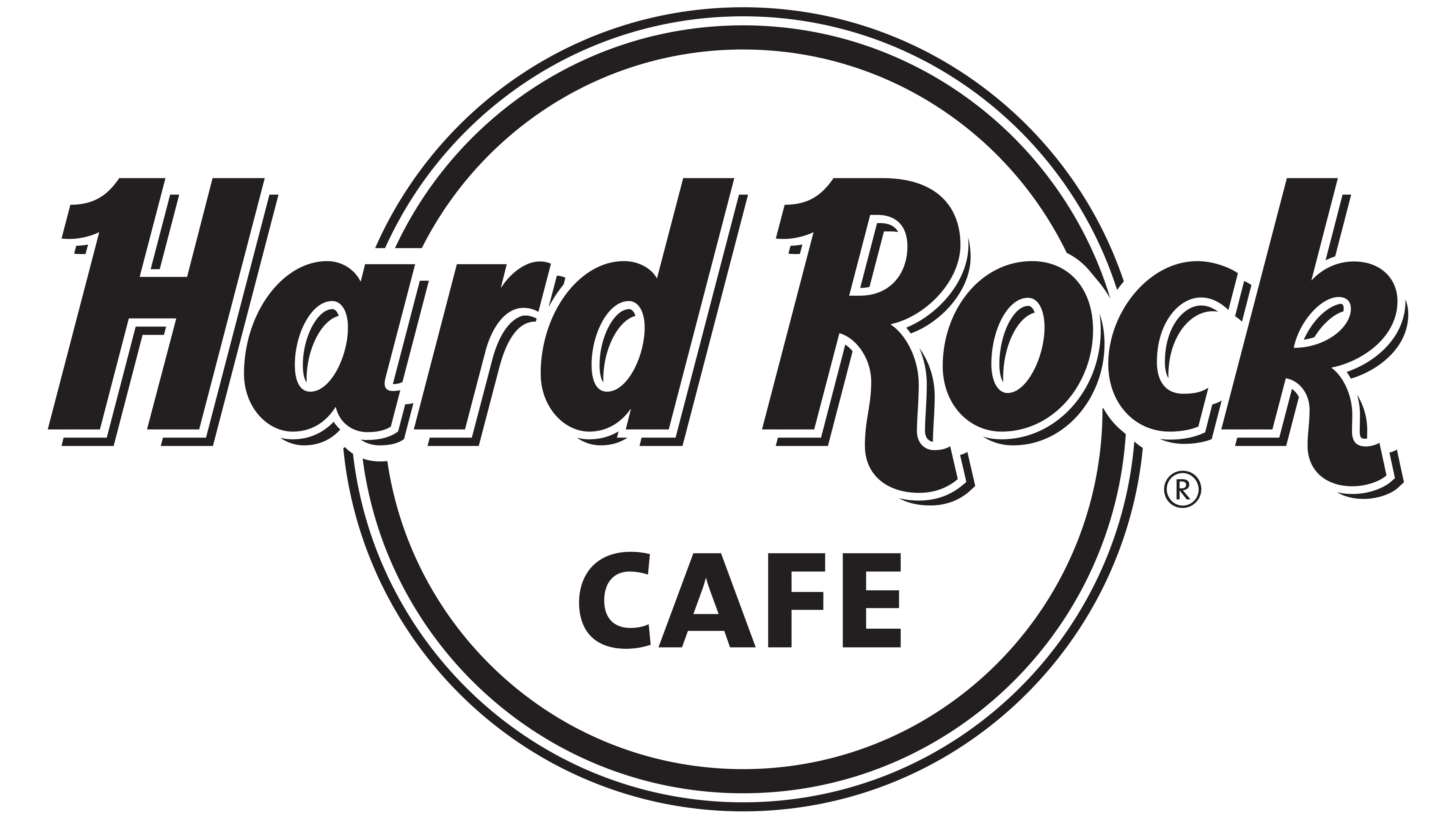
The updated Hard Rock Cafe logo marked a shift from artistic spontaneity to a more formal, corporate style. The new design removed the hand-rendered elements of the earlier stage, eliminating rough outlines and impulsive watercolor strokes. In their place came minimalism and precision, expressed through orderly lines and balanced typography.
The color palette was simplified to black and white, underscoring the brand’s intent to standardize its image for an international audience.
The main “Hard Rock” text block gained refined, orderly letters with a rightward slant. The letterforms had uniform stroke widths and precise contours, enhanced by a subtle drop shadow that gave depth and dimension. The style evolved to resemble a classic italic, evoking traditional mid-20th-century automotive lettering without direct ties to a specific era or style.
The word “CAFE” became smaller than before and was set in uppercase letters in a strict, simple sans serif, adding to the composition’s businesslike and neutral feel.
The circular frame from the previous version remained, but it gained precision and symmetry through a consistent line weight and balanced construction.
This new design expressed Hard Rock Cafe’s intent to move away from its earlier bohemian and avant-garde image in favor of a more restrained, professional look suited to an expanding international network of locations.
1984 – today
The modern version of the Hard Rock Cafe logo emerged during the company’s period of rapid expansion. It was introduced to the public with the opening of locations in New York and San Francisco. The updated design organically preserved the heritage of the original concept while incorporating brighter accents and a commercially polished finish, necessary for the brand’s successful development in the international market.
Color returned to the palette, but now it took on a warmer, more balanced character. The background circle is rendered in a soft yellowish tone, reminiscent of the morning sun or freshly baked bread, creating a warm and welcoming atmosphere. The “Hard Rock” name is set in a brownish-red hue associated with classic American aesthetics, recalling the finishes of vintage musical instruments or the leather elements of rock-themed accessories.
The typography became the key change. For the main word, a custom italic sans-serif typeface was created, clearly inspired by Lucifer Sans ExtraCondensed SemiBold Italic, but with distinctive custom modifications. The letters feature elongated elements and dynamic, curved stroke endings resembling comet tails, adding motion and vibrancy to the wordmark and aligning with the brand’s energetic spirit.
The additional “CAFE” text is placed below the main name and uses a strict geometric sans serif font with clean, simple lines. This ensures instant readability and creates the necessary contrast with the dynamic primary lettering.
An important aspect of the update was the company’s intention to move away from the strictness of the black-and-white composition and emphasize the brand’s accessibility and emotional appeal. The colors and fonts became tools to visually convey both traditional American values and the ease of rock and roll, coinciding with the cafe’s growing popularity across regions worldwide.
Font and Colors

The font is a custom variation of a bold italic grotesque, similar in its characteristics to Lucifer Sans ExtraCondensed SemiBold Italic but with significant individualization of certain glyphs. The letters have elongated, slightly curved endings that resemble smooth musical transitions, adding emotionality and rhythm to the entire wordmark. The typeface reinforces the brand’s connection to music, creating a recognizable and lively typographic composition.
The color palette features warm, saturated tones. The base is a muted yellow that subtly references traditional American cafes and elements of retro culture. The “Hard Rock” text is in a brownish-red shade with a slight mahogany tint, visually linked to musical instruments, interior finishes, or vintage leather accessories. White outline strokes around the letters, along with black accents on the “CAFE” text, enhance depth and create a clear contrast among all elements.