


 Cracker Barrel Logo PNG
The Cracker Barrel logo welcomes all visitors, inviting them to step into a cozy restaurant and immerse themselves in the nostalgic atmosphere of rural life. The emblem conveys a sense of hospitality, tranquility, and simplicity associated with the culture of the American South.
Cracker Barrel began in 1969, when Dan Evins opened the first Old Country Store in Lebanon, Tennessee, positioned near an interstate exit for long-distance travelers. The format combined a roadside restaurant with a retail shop, inspired by rural general stores. Early menus focused on Southern staples, while the retail area sold nostalgic goods tied to domestic life and travel culture. The concept gained traction across the Southeast during the 1970s.
The 1977 public listing supported steady geographic growth through the 1980s and 1990s. Locations multiplied along major highways, and retail became a key revenue stream alongside dining. Branded food products entered supermarkets in the late 1990s, extending the business beyond its dining rooms. By the early 2000s, the chain had expanded to several hundred restaurants and had refined its internal service standards.
During the 2010s, menu adjustments reflected changing eating habits, and side projects tested alternative formats. Acquisition activity added fast-casual expertise, while delivery partnerships with DoorDash and Uber Eats expanded access beyond physical locations. Recent years have brought interior updates, digital ordering tools, and loyalty features, keeping the roadside model aligned with current dining patterns without altering its core structure.
Meaning and History

What is Cracker Barrel?
This is a well-known restaurant franchise that combines Southern-style dining with rustic retail. The restaurants offer comforting, nostalgic dishes such as country-fried steak, chicken and dumplings, and all-day breakfast. The interior features retro elements and antiques, creating a warm atmosphere. In addition to food, visitors can find unique items in the retail store, including decor, vintage candies, and local culinary products. The brand has become a popular spot for travelers due to its convenient locations along major highways, offering a sense of warmth and comfort reminiscent of small-town America.
1969 – 1977
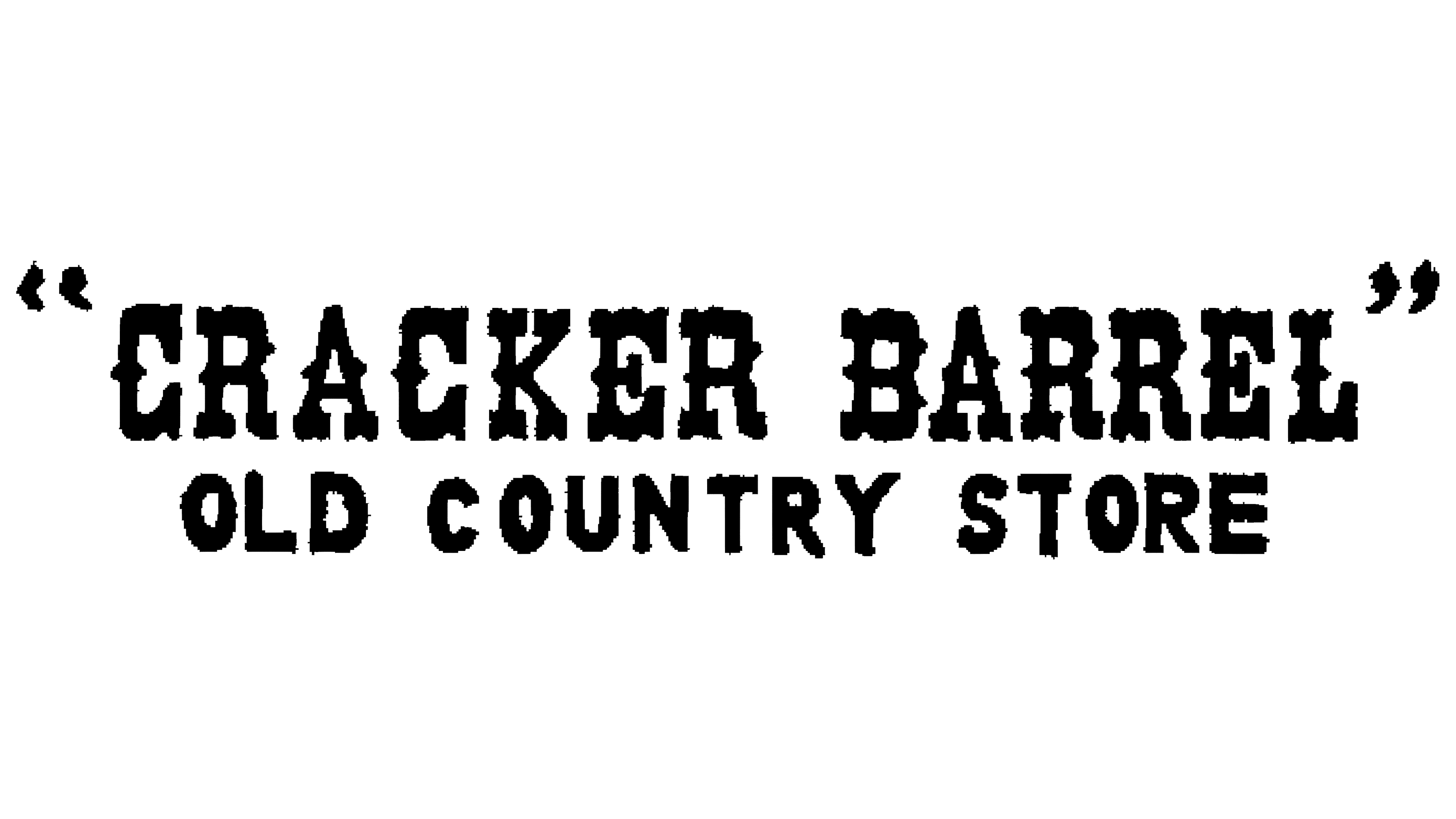
When the first Cracker Barrel location opened, it had no proper logo, only a large yellow inscription adorning the building’s brown facade. The welcome sign became the brand’s unofficial emblem for eight years. Its unique Western-like style conveys the rustic theme of the store and restaurant chain.
The retro vibe is most noticeable in the top line, where the phrase “CRACKER BARREL” is located. Its vintage font resembles late-19th-century designs, when printers used wooden type for signs and newspaper headlines. This font category, known as Wood Type, is associated with the American Old West, old stores, and saloons.
The letters are rough, but the large, decorative serifs that extend above, below, and even in the middle give them elegance. The angularity and unevenness create an aged effect, as if time has slightly worn the inscription. The retro design adds a few extra decades to the company’s visual identity, creating a deceptive impression that it originated in the 19th century rather than 1969.
The logo intentionally transports visitors to an earlier era, immersing them in the nostalgic atmosphere of simple country life, as Cracker Barrel aims to make visitors feel at home. The font seems heavy and “unpolished,” which has charm: the rough style emphasizes the idea of naturalness associated with the good old days. The brand’s name is placed in quotation marks, a nod to tradition.
In the second line, where the phrase “OLD COUNTRY STORE” is located, a completely different font is used, a regular bold grotesque without decorative elements. Its neutral design contrasts with the brand name, creating a balance between creativity and practicality. This helps maintain visual harmony, preventing the logo from becoming overloaded with large lettering. Both parts of the inscription are colored black, a universal shade that suits both vintage and modern styles.
1977 – 2006
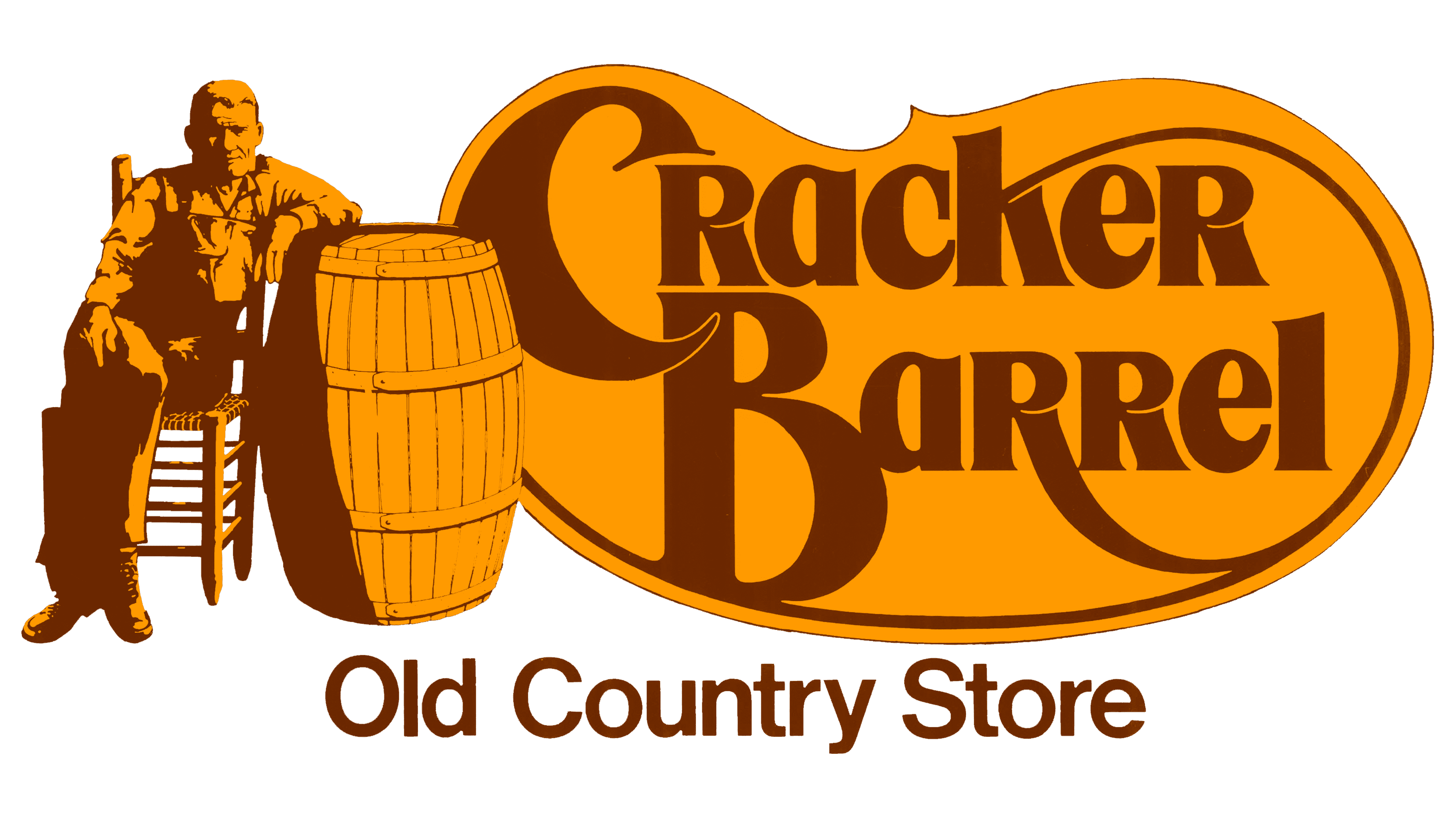
In the mid-1970s, it became clear that the chain, which had expanded to 13 locations, needed a new visual identity, nostalgic but not clichéd. At this stage, it was decided to create a full-fledged logo illustrating the name Cracker Barrel. This led to the creation of the brand’s signature character: an old man sitting in a chair beside a barrel.
The man is dressed simply, like an average Southern American farmer: in overalls, a shirt, and laced-up boots. His image was believed to be modeled after Danny Wood Evins’s uncle, Herschel. This man devoted his efforts to growing the business and helped promote his nephew’s restaurants. However, there is no evidence that the emblem specifically depicts Herschel.
Stories about typical visitors of old country stores inspired the artist who created the logo. He sketched the idea on a napkin and later refined the drawing, using a random person with a similar appearance and build as a model. Certainly, it was not Herschel.
The elderly man is seated on a chair, one leg crossed over the other, resting his elbow on a large wooden barrel. This object is not merely decorative; it is a key feature of many rural stores from the late 19th to the early 20th centuries. Salted crackers were once stored in such large barrels, and people often gathered around them to discuss the latest news.
Thus, both the logo and the name Cracker Barrel symbolize a cozy place to enjoy a good meal and find friendly company. This is a big plus for the brand’s visual identity, which seeks to be associated with the hospitable culture of the American South.
Nearby is a shape resembling an oval, like a giant orange bean. The brown inscription “Cracker Barrel” occupies the interior space, which is split into two levels. It is rendered in a custom font, with each glyph designed uniquely. However, there are common features that unite almost all the letters:
- Small, sharp serifs;
- Vertical form;
- A mix of thick and thin lines;
- Gentle curves;
- Slight asymmetry.
The letter case is inconsistent and does not affect their size: for example, all the “r” characters appear uppercase, yet they match the size of lowercase characters. The logo has only two large glyphs: the initial “C” and “B.” They enhance the logo’s informality, giving it an old-fashioned feel, as if it were a 19th-century sign.
Below is another inscription: “Old Country Store.” The font used is Helvetica Bold, a classic grotesque that makes the text simple and clear. Its style is distinct from the brand’s trade name design, creating a pleasant visual contrast. Yet, something common ties all the elements of the logo together: its colors.
Brown is associated with rural life, stability, and reliability. Orange symbolizes hospitality, communication, and joy. These colors give Cracker Barrel restaurants the image of a cozy place where one can expect a warm welcome and homemade food.
2006 – 2015
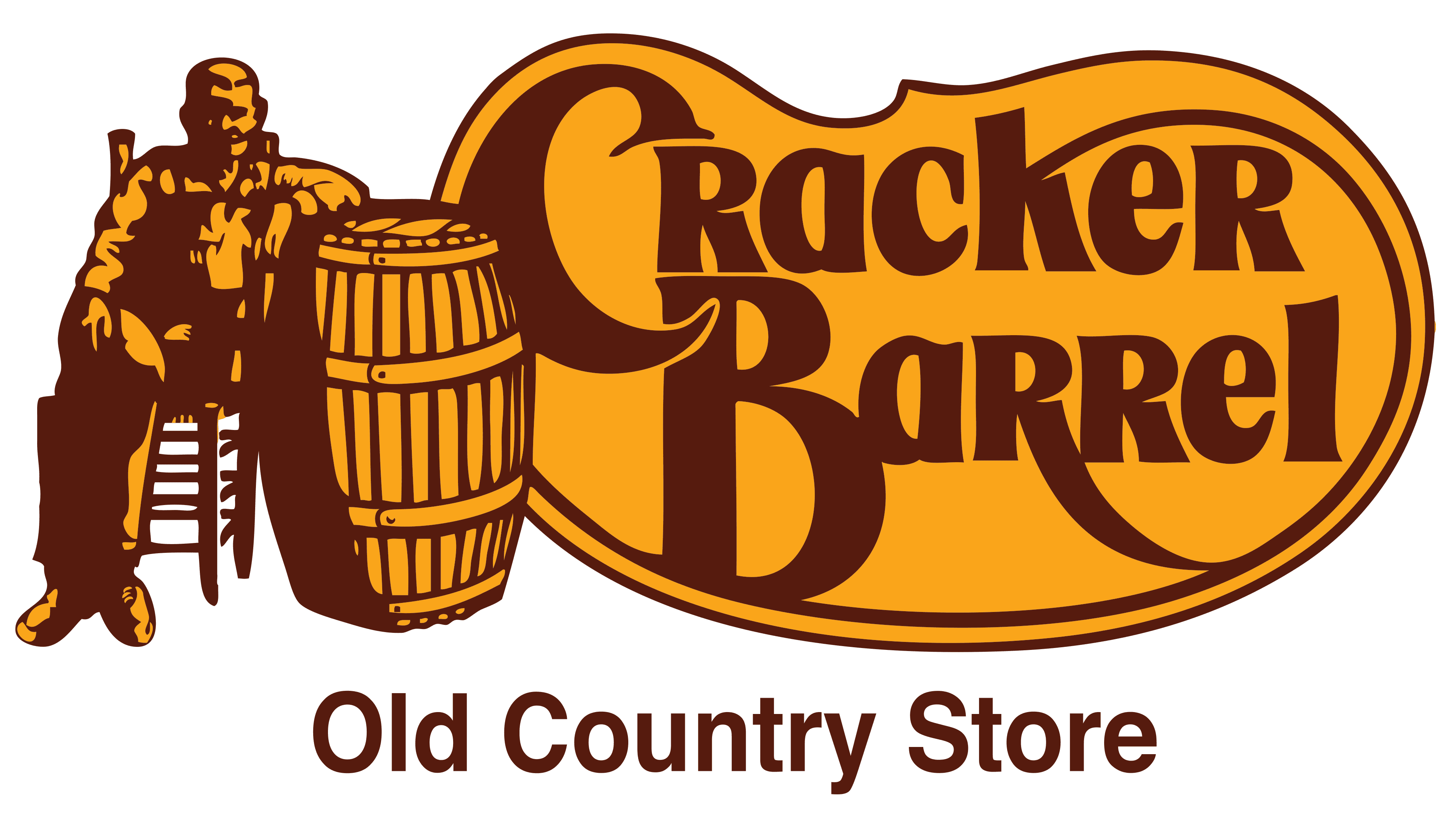
In 2006, the restaurant chain modernized its emblem, making it more distinct. However, the concept remained the same: designers kept the old man on the chair, the large barrel, and the unique lettering. Only minor details were changed to enhance the image’s clarity.
- Bold dark outlines were added to the light elements. This allowed the logo to be resized in digital environments without losing clarity.
- The shadows on the character’s face and clothing deepened. This made him look darker, but it’s a positive change since his image is now harder to associate with any specific individual, which was the designer’s intention.
- The “Cracker Barrel” text appears much clearer and more expressive. To achieve this, the logo’s creators increased the spacing between the letters, smoothed the corners, slightly curved the “l,” and widened the apertures on all four “r” characters.
- The decorative base was outlined in dark, adding a sense of completion to the emblem.
- The words “Old Country Store” in the bottom line became more readable due to increased spacing.
Yet, all these details are less noticeable than the color change. The brown in the new logo is less bright than before, and the orange has taken on a pale yellow hue. This increased the contrast between dark and light elements, positively affecting the brand’s recognizability.
2015 – today
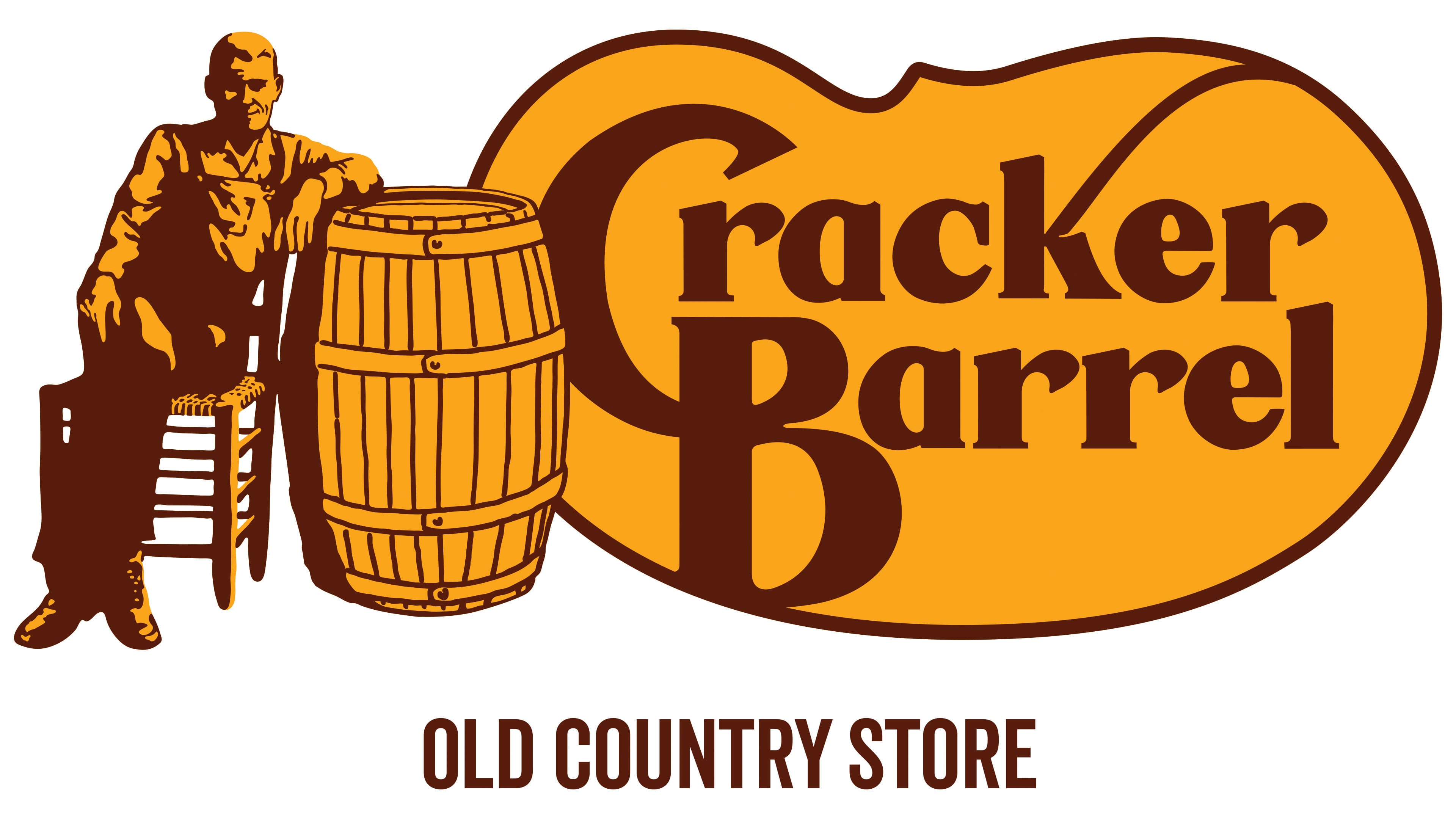
The updated logo differs from previous versions by the absence of a long, elegant stripe that used to stretch from the “k” to the right, smoothly curve around the text, and drop down to follow the border of the orange base. This swirl went right through the “B” and was connected to one of the “r” characters with an additional curved line. Now, the “k” and “B” are directly connected to the outer outline of the sign containing the name Cracker Barrel.
The company had to remove the meaningless stripe from its emblem because some African Americans believed it represented a slave whip. Opponents of the brand invented a myth that the man sitting in the chair was a slave owner and that the barrel next to him held tools for punishing slaves. This scandalous conspiracy theory emerged due to the ambiguous perception of the word “cracker,” which is used as slang for a whip.
Fortunately, these accusations are untrue, as whips were never stored in barrels; they would have just gotten tangled there. The man is a farmer, a typical visitor of old country stores. In the 2015 logo, designers changed the seated figure’s appearance, making him slightly taller and removing shadows that obscured his work overalls and his kind smile.
The barrel’s outlines became smoother and clearer, and the side shadow was reduced, making the drawing less dark. For this same purpose, the colors were given a pleasant, warm hue. The logo still uses orange and brown, which are associated with rural comfort and accurately reflect the restaurant chain concept. However, the style of both inscriptions has changed significantly.
The phrase “Cracker Barrel” has become more compact, as the letters are no longer stretched vertically. All “r” characters that previously appeared in uppercase have been changed to lowercase. The serifs have lost their former sharpness and now resemble short mini-rectangles. There is no clear boundary between the initial “C” and “B,” so they merge, forming a monogram. This new element creates a sense of antiquity, which was the designers’ intention: the emblem’s deliberate aging brings it closer to the brand’s rustic style.
The inscription “OLD COUNTRY STORE” is now composed entirely of capital letters and uses a narrow font stretched vertically. It is connected to the previous version by its lack of serifs and its rather strict style, which visually balances the playful feel of the upper part of the text.
The logo suggests the restaurant chain’s simple, welcoming nature, where guests can enjoy good food, spend time in an old-fashioned, friendly atmosphere, and listen to country music.
August 19-26, 2025

On August 19, 2025, Cracker Barrel introduced a new mark that proved among the shortest-lived in the brand’s history. Less than a week later, on August 26, the company returned to the previous version. In the days leading up to the rollback, market capitalization declined by USD 143 million, pushing the launch into discussion well beyond professional circles.
The update was part of a country-style rebrand of the restaurant chain. Menu changes and the renovation of 40 of 660 locations were carried out in parallel. Prophet led the project, while the mark itself was largely assembled by the company’s internal team. From the previous version, the golden brown color and a similar type style were retained. At the same time, the visual image was almost completely rebuilt.
The most pronounced break with the past was the removal of Uncle Hershel, the character depicted as a rural shopkeeper next to a barrel. His name was removed as well. The illustrative motif was replaced with a restrained mark on a gold background, and the Cracker Barrel name was set within a barrel shape. This design differed sharply from the chain’s familiar identity and became a source of debate.
Audience reaction was sharp. Many viewed the update as another example of excessive simplification in contemporary branding, and the removal of the Hershel figure further frustrated regular guests. The outcome was predictable. The company quickly returned to the previous mark, recording one of the briefest episodes in Cracker Barrel’s visual history.