


 Jollibee Logo PNG
The Jollibee logo visually conveys the fast-food restaurant’s friendly, welcoming image. Its graphics emphasize family orientation, accessibility, and the company’s positive customer-service approach.
Jollibee began in 1975 in Quezon City, Philippines, when Tony Tan Caktiong opened a small Magnolia ice cream shop. Customers soon asked for hot meals, pushing the business away from desserts and toward fast food. In 1978, Jollibee Foods Corporation was formally established. Its bee mascot, dressed in red and yellow, became closely associated with the chain and remained part of its identity for decades.
The company faced much stronger international competition in the early 1980s, when McDonald’s and KFC expanded in the Philippines. Jollibee focused on local eating habits and built its menu around Filipino tastes. Chickenjoy, Jolly Spaghetti with sweet-style sauce, and Yumburger became core products. By the mid-1980s, Jollibee had surpassed its main American rival in restaurant count and domestic sales.
International growth followed in the 1990s, with restaurants opening in the United States, Hong Kong, and Middle Eastern countries with large Filipino communities. The chain initially relied heavily on migrant customers familiar with the brand from home, then reached a broader audience.
Jollibee Foods Corporation later expanded through acquisitions. Its portfolio later included Smashburger, The Coffee Bean & Tea Leaf, Yonghe King, and Tim Ho Wan. By the mid-2020s, the group operated more than 6,500 restaurants across 34 countries, reflecting its transformation from a local Philippine chain into a large international restaurant company.
Meaning and History
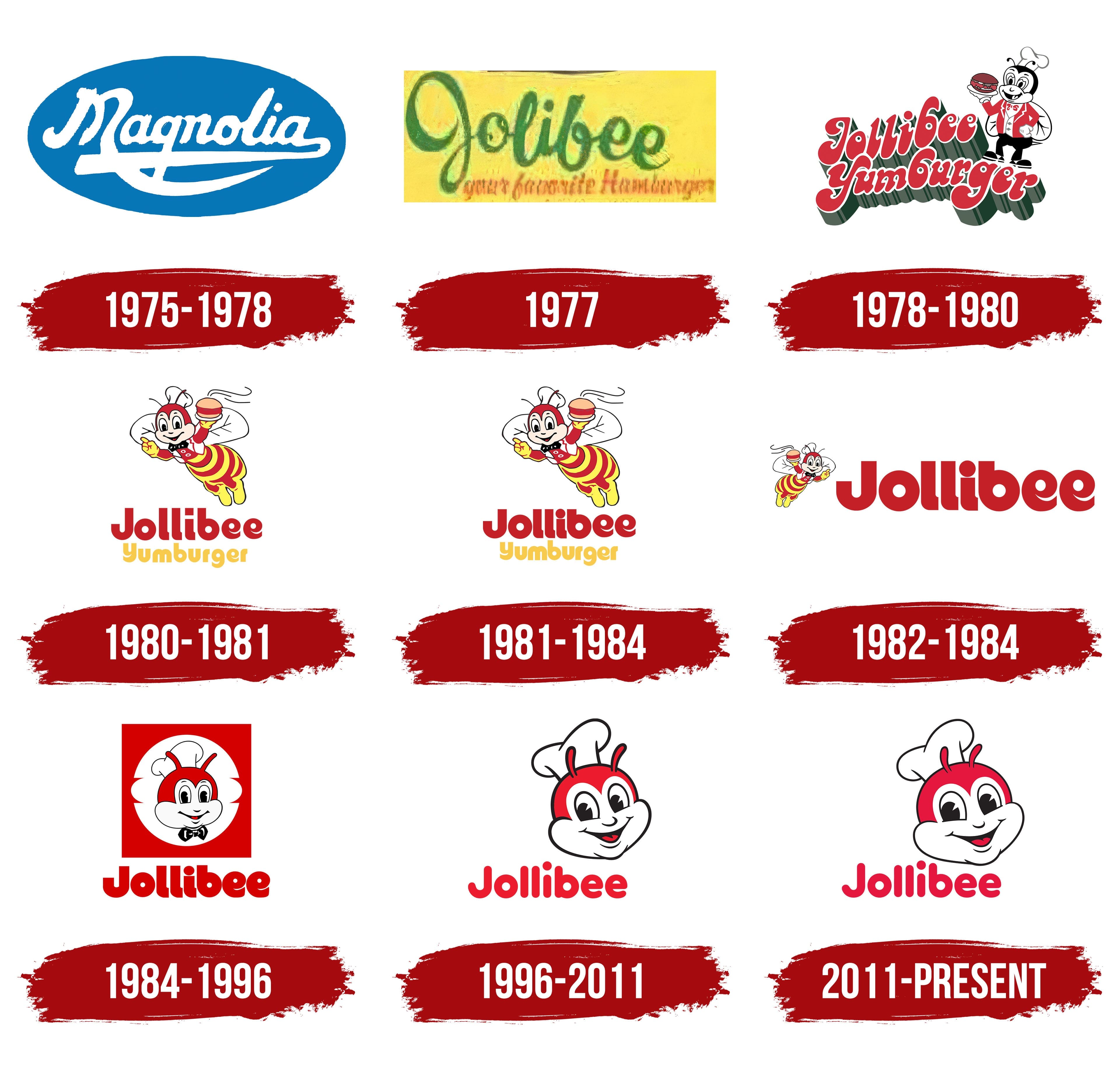
What is Jollibee?
It is the largest fast-food chain in the Philippines, known for its distinctive menu and mascot, a bee dressed in a red tuxedo. Signature dishes include crispy chicken with rice and sweet sauce, as well as Filipino-style spaghetti with hot dogs and cheese. Competing with global chains, it offers burgers and pineapple-and-yam pies. As it expands internationally, new locations often draw large crowds of locals and the Filipino community.
1975 – 1978

The beginning of the future Jollibee story is tied to a small, cold-dessert outlet, Magnolia Ice Cream House, which Tony Tan Caktiong opened in Quezon City with his family in 1975. The establishment operated under the Magnolia Dairy Ice Cream franchise and, during its first years, offered only ice cream. Gradually, customers began asking for hot meals and sandwiches, and unexpectedly, those became the main items on the menu. The turning point came in 1978, when the format was rethought, and the café was transformed into a fast-food restaurant, marking the start of the Jollibee chain, which later became a leader in the fast-food market.
The visual concept of those years drew inspiration from the Magnolia franchise. The basis was a horizontally stretched blue oval with the white inscription “Magnolia” placed on it. The proportions of the oval created a smooth frame for the word, and the closed form provided unity of perception. In the composition, the sign and the word were not separated: the oval served as the background, and the calligraphic inscription was the only meaningful element.
The font was executed in a handwriting style. The letters had soft connecting strokes and light flourishes. The initial “M,” with its elongated stroke, and the final “a,” with the line continuing into a horizontal flourish that became an underlining element, looked expressive. The sans-serif typeface, with its flowing stroke rhythm, conveyed a sense of fluidity and lightness.
1977

In 1977, the company’s name appeared in printed materials as “Jolibee.” The inscription was italic with elements of calligraphic plasticity. The letters were connected by smooth lines, their strokes thin and at times curved. The visual gesture resembled an experiment by a young company seeking to express individuality as it transitioned from a dessert café to a fast-food restaurant.
The font featured a handwritten character, with italic glyphs exhibiting smooth transitions and soft flourishes. There were no serifs, which emphasized a live handwriting style and reinforced the association with a personal signature.
1978 – 1980

In the spring of 1978, the Tan Caktiong family ended its cooperation with Magnolia and launched its own chain, Jollibee Yumburger. The author of the first comprehensive identity was the founder himself, who invited consultant Manuel Lumba to the project. His idea to make a bee the mascot proved decisive: the character anchored the brand’s emotional image and set the direction for future visual development.
The composition combined the wordmark and the character. The “Jollibee Yumburger” inscription was made in red, outlined in white, and deepened with a green shadow. The construction created the illusion of volume and movement. For the first time, a character appeared alongside it, a smiling bee in a red jacket and vest, white gloves, and a tall chef’s hat. In its paw, it held a burger on a plate. The inspiration came from Disney’s studio style and from drawings made by Lumba’s daughter, which suggested some details for the image.
The font retained italic plasticity but looked more orderly. The glyphs had soft slanted strokes, and the connections looked smooth. The letter “b” stood out, its form resembling the number “6.” There were no serifs; the style leaned toward handwriting but with a more stable rhythm.
The palette was built on a triad: bright red set an energetic tone, the white outline enhanced legibility, and the green shadow added depth. The combination created a cheerful, rich visual image associated with the mass food industry.
The logo became the first step toward a unified image for Jollibee, in which the name and character worked together to strengthen the association with accessible fast food and a joyful atmosphere. The sign with the bee in a chef’s hat holding a burger on a plate symbolized hospitality and friendliness.
1980 – 1981

When the Jollibee chain had only five branches, the company emphasized a visual update meant to highlight the brand’s growth and emerging ambitions. The new emblem combined the text and the mascot, creating a unified image for future expansion.
The key element was the mascot, a bee in a bright outfit that included a jacket, vest, bow tie, and a signature chef’s hat. In its paw, the character held a burger, linking the sign to the product. Unlike previous versions, the bee was depicted in flight, which added a sense of liveliness and energy.
The wordmark was arranged in two lines. The top row contained “Jollibee,” and the lower one read “Yumburger.” A custom font was developed, featuring dense, bold lettering with rounded outlines and smooth stroke connections. The text’s geometry was orderly and balanced, distinguishing the composition from the freer early logos.
The palette was built on three anchors. Red formed the base, highlighting the lettering and elements of the mascot’s outfit. Yellow was used for stripes on the uniform and in the second word, “Yumburger.” Black served as a contour and an accent.
The combination of textual structure and character solidified Jollibee’s emotional style. The brand projected a friendly, positive, and family-oriented image.
1981 – 1984

Minor adjustments to the Jollibee logo marked the early 1980s. The company did not change the mascot symbol, preserving the image of the bee in a jacket, a chef’s hat, and a burger in its paw. The updates focused on the text, which became the main focus of revision in 1981.
The inscription “Jollibee Yumburger” received heavier lines. The contours of the glyphs lost the elegance of the previous version but gained density. The dot above the letter “i” changed from a square to a round shape, softening the overall rhythm of the typeface and making the inscription visually more harmonious.
The composition still combined the word block and the character. The geometry relied on balanced proportions without radical changes: the bee kept its place and appearance, while the text part gained stronger weight.
The type system was based on a dense sans-serif style. The rounded shapes were preserved but became less refined. Letter spacing was tightened, reinforcing the text’s perception as a unified block.
1982 – 1984
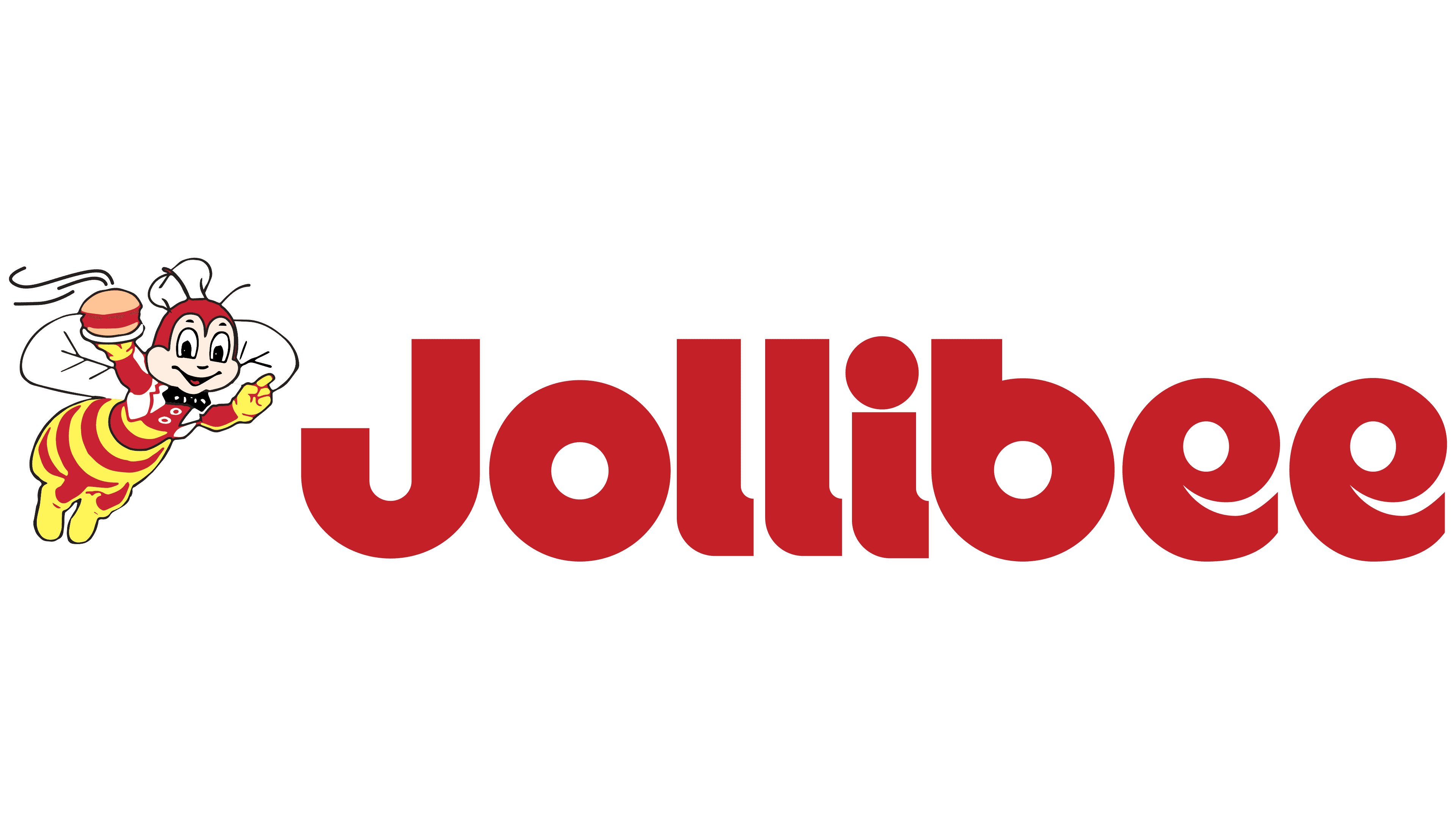
In the early 1980s, the company took a step toward simplifying the brand name. Starting in 1982, the word “Yumburger” was dropped from the logo, and the brand adopted the shorter name Jollibee. This allowed the focus to be on the main name and strengthened its presence in the audience’s minds.
The text part maintained continuity with the 1981 version but appeared even weightier. The typeface was built on rounded sans-serif forms, with thicker lines and bold shapes that conveyed stability. The visual construction grew in size and projected confidence.
The redesign affected the mascot’s placement. The bee, still in its traditional outfit with red coat, white vest, bow tie, gloves, and tall hat, was mirrored and moved to the left of the text. The character’s gaze was directed to the right, toward the word “Jollibee,” creating a sense of movement and dialogue between the symbol and the wordmark. The burger in its paw continued to emphasize the image’s connection to the company’s core product.
The palette preserved its bright balance: red dominated in the character’s clothing, and the word block, white strengthened details and outlines, and the contrast made the composition energetic.
1984 – 1996
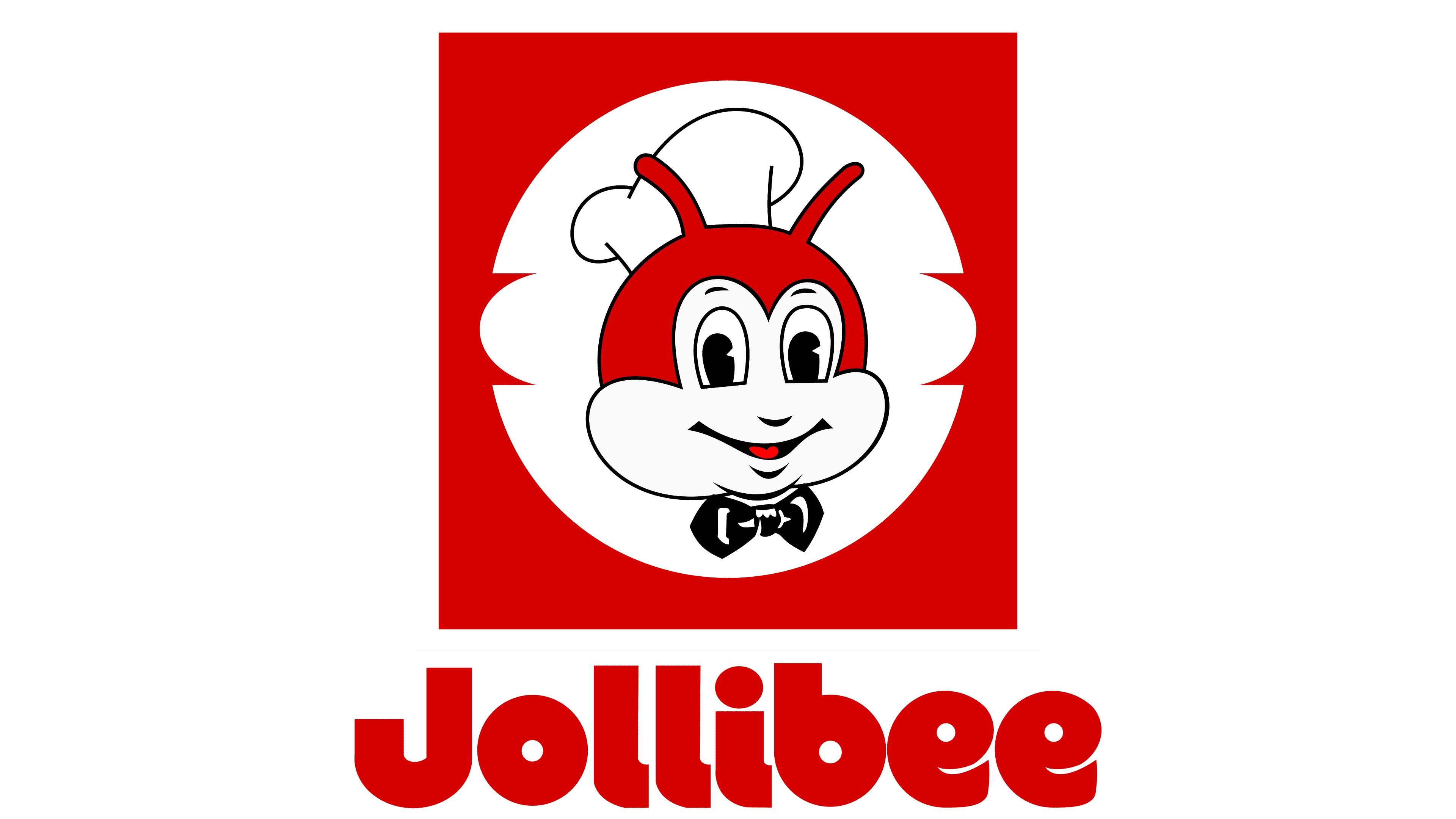
The mid-1980s marked a change in Jollibee’s visual strategy. Instead of a full-figure character, the company reduced the image to a bee’s head inside a white circle that fit within a red square. Below the sign, the inscription “Jollibee” appeared in a custom-designed font.
The text was set in dense, rounded, sans-serif type. The lettering looked balanced and rhythmic, continuing the typographic direction of the early decade but in a more simplified form.
The mascot itself was also updated. The lines softened, the face took on friendlier features, and the smile widened. The visual style was reminiscent of Disney animation, evoking a sense of optimism and warmth within families.
The palette relied on the contrast of red and white. The red background set the energy, while the white circle emphasized the mascot’s head and served as the base for the text, maintaining clarity and balance.
This version of the logo strengthened the brand’s image as family-oriented and positive. It proved long-lasting: in some locations, it remained for decades. Among the last recorded examples was the NCCC Mall VP in Davao, where the 1984 sign remained until the complex closed in September 2019.
1996 – 2011
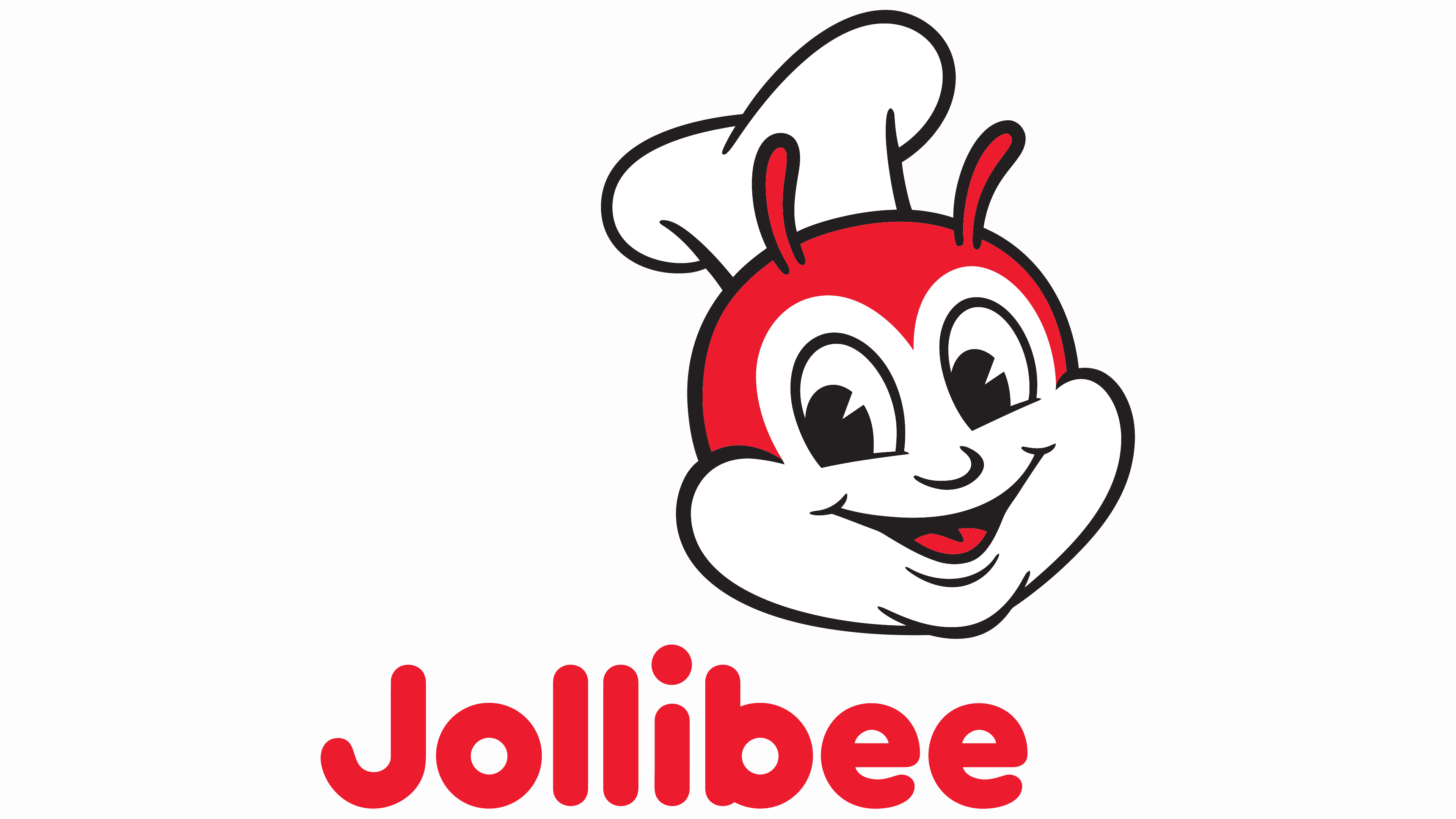
In the mid-1990s, the company revised its identity, removing overloaded elements and focusing on simplicity. In 1996, the frame and the white, burger-shaped circle were removed from the composition, and the main focus shifted to the mascot’s head, which became the brand’s primary symbol.
The bee’s image was refreshed: the lines became softer, the facial expression friendlier, the smile wider, and the gaze more expressive. The traditional hat remained, while the bow tie disappeared, making the character less formal and closer to a family audience. The head was slightly turned to the right, as if the character were greeting the viewer.
In the text, the corporate font was introduced as an adapted version of VAG Rounded Black. Its rounded, warm shapes created a sense of accessibility and friendliness.
The color system retained the red-and-white combination, but the red became more saturated. This gave the Jollibee emblem an energetic tone and enhanced its emotional effect.
2011 – today

In 2011, Jollibee updated its identity to better align with the demands of the digital environment. The process was supervised by company founder Tony Tan Caktiong, who continued to personally oversee the development of the visual identity.
The compositional structure preserved recognizability: the mascot’s head was placed to the right and above, and the brand name was positioned below. However, several elements were redesigned. The bee’s image was refined, with softer contours, a more elegant nose and antennae, a wider smile, and a more welcoming facial expression. The mascot appeared lighter and more contemporary while maintaining positive energy and appeal to family audiences.
The text part was set in a modified version of VAG Rounded Black. The letters retained smoothness and rounded forms but became more orderly. The glyph “b” has been given a reworked shape.
The palette shifted to a lighter pinkish-red shade, replacing the previous saturated red. The new tone made the Jollibee logo appear lighter and created a more comfortable perception.
