


 Hershey Bears Logo PNG
The Hershey Bears hockey club logo demonstrates athletic stability and a connection to the city of Hershey. Its graphic design highlights the team’s character and commitment to hockey traditions and the local community.
The Hershey Bears were founded in Pennsylvania in 1932 by chocolate manufacturer Milton Hershey. The team formed part of the community he developed around his company, alongside housing, schools, medical services and recreation. It moved into the purpose-built Hersheypark Arena in 1936, where it remained for many decades.
In 1938, the club joined the American Hockey League (AHL) and became one of its longest-standing franchises. Unlike many minor-league teams, the Bears remained in the same city throughout their history. They won their first Calder Cup in 1947. During the following decades, coach Frank Mathers helped establish a disciplined team culture. He guided Hershey through one of its strongest periods.
The Bears continued adding championships while developing players for different NHL organizations and competing with clubs such as the Springfield Indians. In 2002, they left Hersheypark Arena for the larger Giant Center, retaining their local base while gaining a modern home. An affiliation with the Washington Capitals began in 2005, providing a route for prospects moving between Hershey and the NHL.
Hershey won its 12th Calder Cup in 2023 after defeating the Coachella Valley Firebirds, an affiliate of the Seattle Kraken, in a demanding final series. The same opponents met again in 2024, and the Bears retained the trophy. Their 13th championship extended the league record and completed consecutive title runs more than nine decades after the club’s formation.
Meaning and History
What is Hershey Bears?
It is the oldest professional hockey team based in Hershey, famous for its chocolate production. The club competes in the American Hockey League (AHL) and holds the record for most championships. Home games feature a tradition of throwing teddy bears onto the ice after the team scores its first goal, with the toys being donated to children’s charities.
1938 – 1943
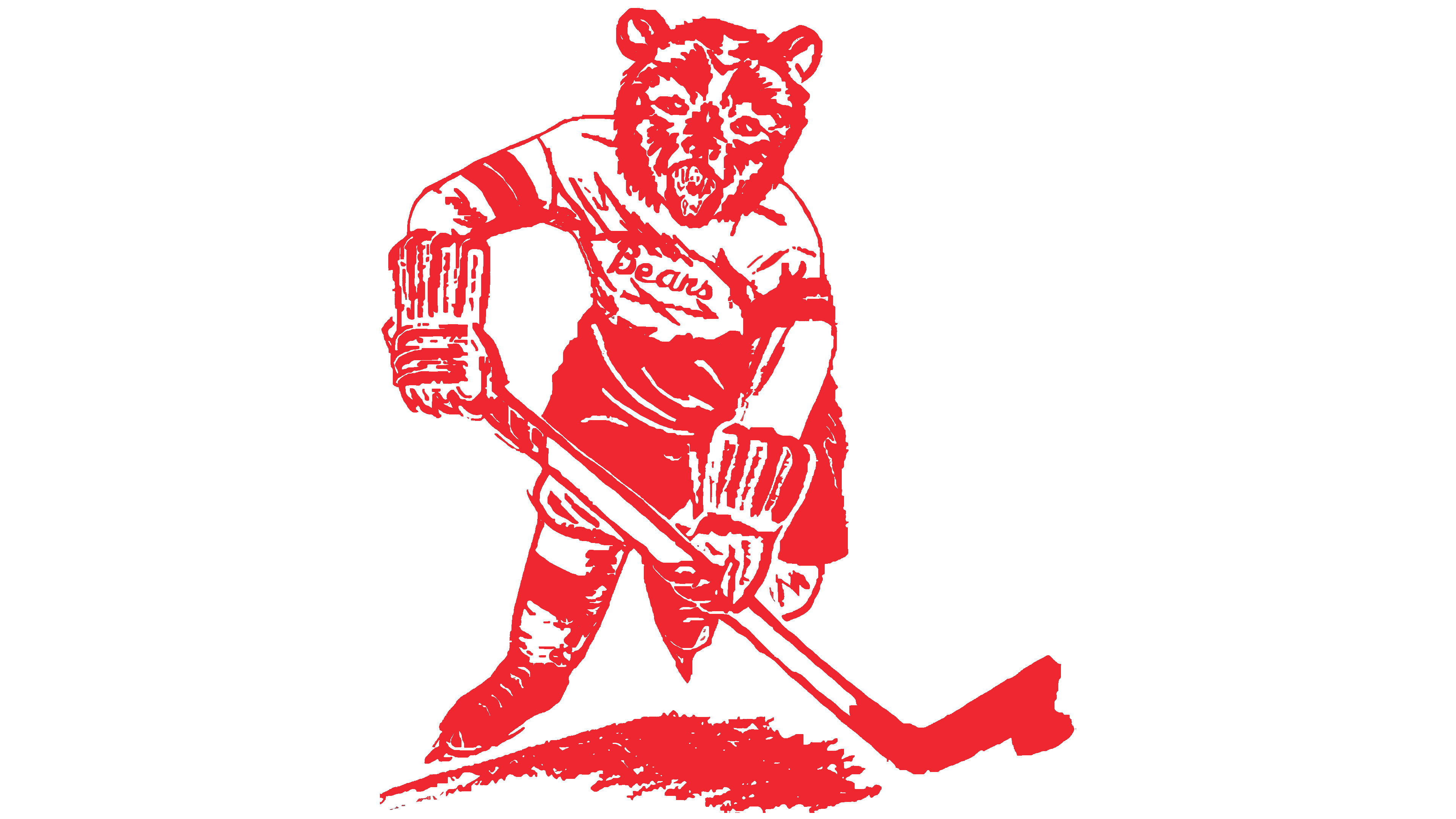
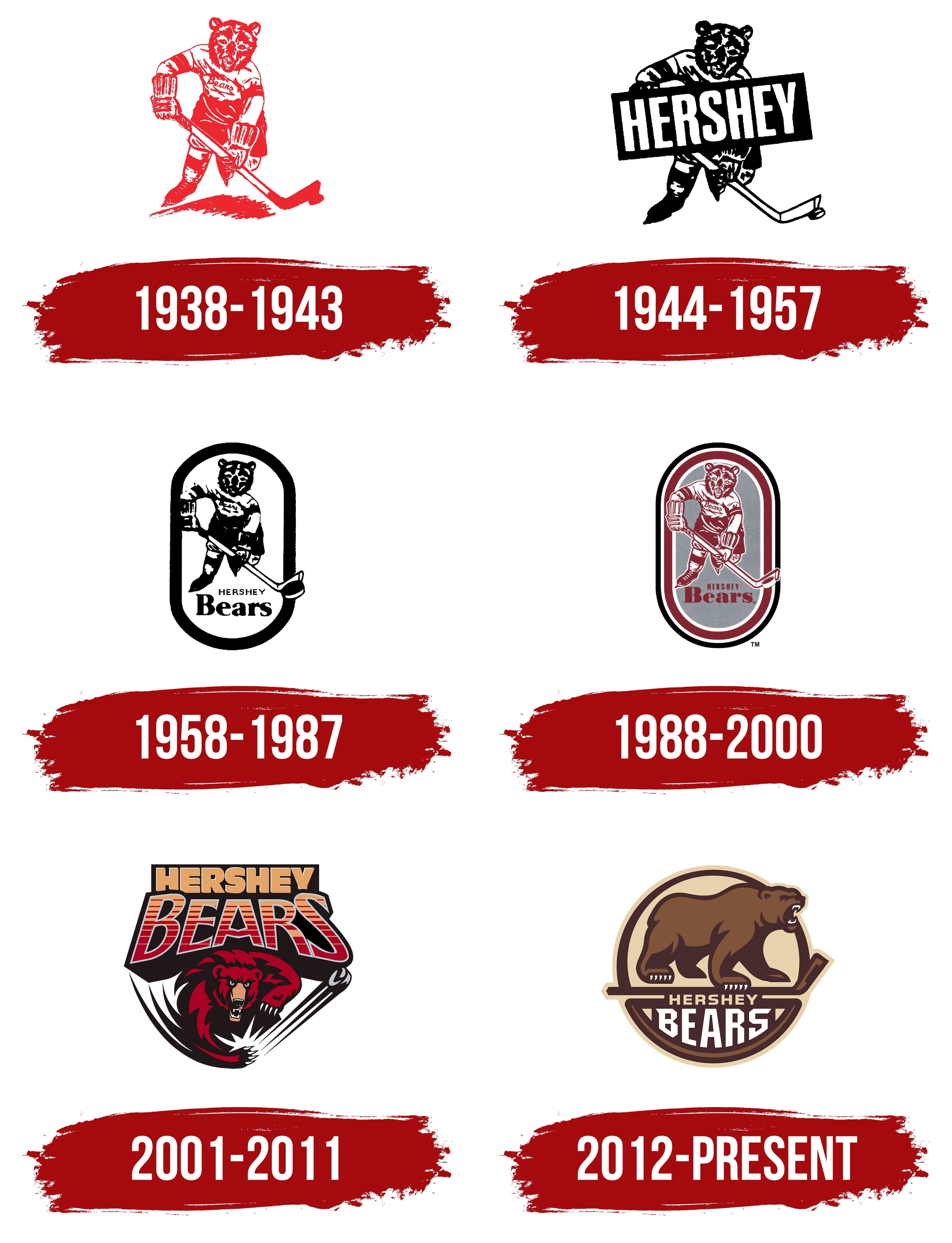
On June 28, 1938, the club officially joined the International American Hockey League (later becoming the AHL), moving up from the lower EAHL. The debut team emblem was introduced on this occasion and served as its official symbol until 1943.
The emblem featured a stylized bear in hockey gear, holding a stick. The image was created in a two-color palette, dominated by red with a white background. The word “Bears” appeared on the player’s jersey in italics, slanted to the right, mimicking handwriting. The font used smooth sans-serif lines with moderate optical adjustments.
The execution of the image had a somewhat naïve, good-natured, sporty character. The visual style reflected the club’s ambition to showcase its move to a higher, more professional level of play. The red-and-white color scheme evoked the era’s athletic aesthetics, creating a recognizable identity among competitors.
The emblem’s symbolism emphasized the club’s profile and new status: the bear represented athleticism and game energy, while the hockey equipment highlighted its connection to the new league and the seriousness of its sporting intentions.
The emblem was used primarily on the team jersey and in printed materials. No additional versions or layout variations of the sign were introduced during this period.
1944 – 1957

The 1944 redesign of the Hershey Bears emblem reflected the team’s aim to emphasize seriousness and corporate solidity, moving away from the softer image of the red bear that characterized previous seasons. The starting point was the shift from red to a strict black-and-white color scheme.
A new feature of the composition was the addition of a diagonal black ribbon carrying the wordmark “HERSHEY.” The text was set in bold sans-serif capital letters with even inter-glyph spacing, ensuring balance and readability. The ribbon was tilted diagonally upward from left to right, creating a sense of upward movement and a stronger visual accent. The bear’s silhouette was retained from the previous version. Still, it was pushed into the background, with the text given priority.
The choice of a black-and-white palette reflected the intent to position the Hershey Bears within the IAHL/AHL context as more serious and authoritative. The restrained color scheme gave the emblem additional firmness and expressiveness, aligning with the club’s new marketing objectives. The emotionally neutral black-and-white option eliminated any associations with the softness of the earlier red image.
The diagonal arrangement and slanted construction of the logo were designed to reflect the dynamism and energy inherent in sports, and to emphasize the team’s forward progress. The wordmark was prioritized in the emblem’s design, making it easier to recognize and identify in the era’s professional hockey environment.
1958 – 1987
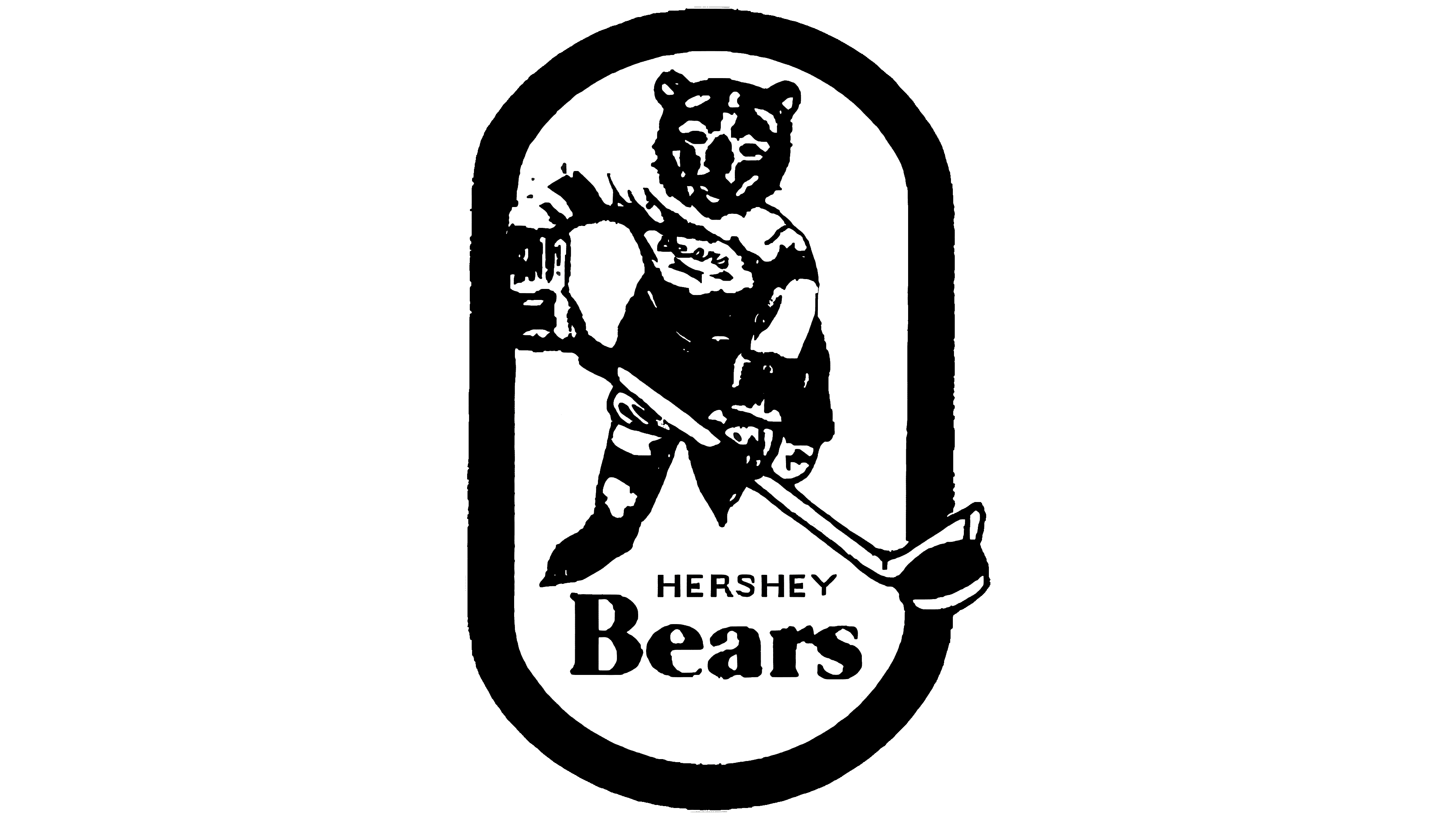
In 1958, the Hershey Bears’ logo was redesigned. The removal of the diagonal black ribbon and the large inscription was intended to create a more finished and unified image. The main change was the placement of the familiar bear figure, without any alteration to its drawing, inside a vertical oval. This gave the composition a closed shape and visual stability.
A two-level wordmark complemented the lower part of the oval frame. On the upper row appeared the name “HERSHEY,” set in small capitals, using a thin sans serif typeface that conveyed balance and restraint. The bottom row featured the word “BEARS,” set in a large, contrasting serif font to emphasize the team’s name.
The scale of the bear figure changed: the image was enlarged and darkened, enhancing the figure’s mass and expressiveness. Additional details, such as the hockey stick and puck extending beyond the oval frame, indicated the club’s sports orientation and underlined its identity with hockey and the AHL.
The use of the oval and the classical typography conveyed associations of reliability and tradition, reinforcing the perception of the club as an authoritative organization in the competitive environment of that period.
1988 – 2000
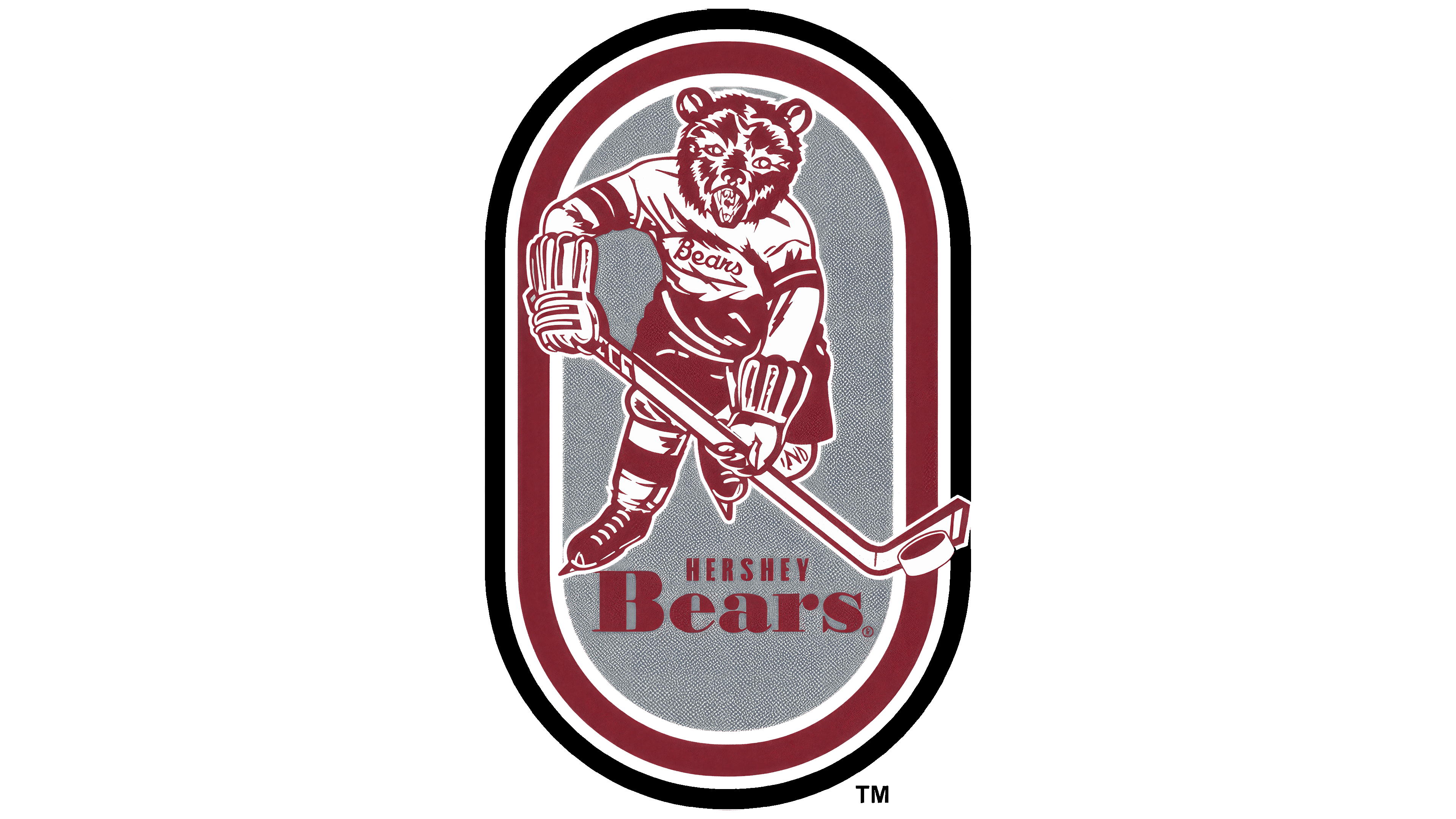
In 1988, the Hershey Bears introduced an updated emblem, adopting a maroon-and-gray palette instead of the previous monochrome scheme. While retaining the general oval shape of the earlier version, the designers altered the interior content, choosing a light gray background with a subtle decorative pattern as a neutral foundation for the composition.
The bear figure was redesigned. Its drawing became more expressive and detailed: the lines grew thicker, the contours were refined, and the open mouth, displaying rage, heightened the symbol’s energy. The image was rendered primarily in a saturated maroon, complemented by white elements that provided contrast and highlighted parts of the figure.
The typography of the inscription in the lower part of the oval (“HERSHEY” above, “BEARS” below) was set in a dense, heavy font. The letterforms acquired stricter and more precise contours. The upper word (“HERSHEY”) was set in a smaller size, establishing a clear visual hierarchy. The lower word (“BEARS”) was larger and more emphasized, dominating the lower part of the composition.
The updated maroon-and-gray palette conveyed solidity, reflecting the club’s intent to present itself as a permanent, reputable league participant. The contrast of saturated maroon with calm gray enhanced the overall impression of strength and professionalism, giving the emblem a sense of durability and substance.
The symbolism retained its hockey ties, presenting the Hershey Bears as a powerful and ambitious team. The bear, with an aggressive expression, highlighted the players’ competitive spirit and determination, remaining the club’s primary identifier.
2001 – 2011

The redesign of the Hershey Bears identity was carried out by the design studio Joe Bosack & Co., based in Pottsville, Pennsylvania. The authors focused on balancing the club’s traditions with modern branding trends in the sports industry. The studio was tasked with emphasizing the club’s new, heightened expression in the context of developing sports merchandising and the mass uniform updates of the early 2000s.
The result was the abandonment of the oval shape of the previous marks and the creation of a composition with a large horizontal wordmark and an illustration of a bear. The new bear was depicted in a dynamic attacking pose, with aggressive details such as sharp white claws and an open mouth, as it struck a hockey puck with its stick. This image emphasized the team’s strength, drive, and athletic character, refreshing its identity.
The bear figure was placed above the word “BEARS,” rendered in large letters with a gradient transition from gold to maroon. “HERSHEY,” in smaller size, was positioned above, highlighted in solid gold on a contrasting dark rectangle. The outlines of the inscription were traced in black, reinforcing the volume and contrast of the elements.
The color scheme was based on deep tones: a maroon bear, a contrasting black background, and golden and maroon accents in the wordmark. The palette created visual depth, underscoring the team’s aggression, stature, and aspiration to dominate on the ice and in the commercial sphere.
The typographic part was executed in two different typefaces. The upper inscription was set in a strict, compact, geometric sans-serif font, emphasizing the city name. The lower word “BEARS” was designed with freer proportions, featuring enlarged first and last letters that reinforce visual dynamism and motion.
Through the bear figure and modern typefaces, Joe Bosack & Co. provided the club with an updated image that combined historical continuity with an active visual stance, aligned with the demands of the new decade.
2012 – today
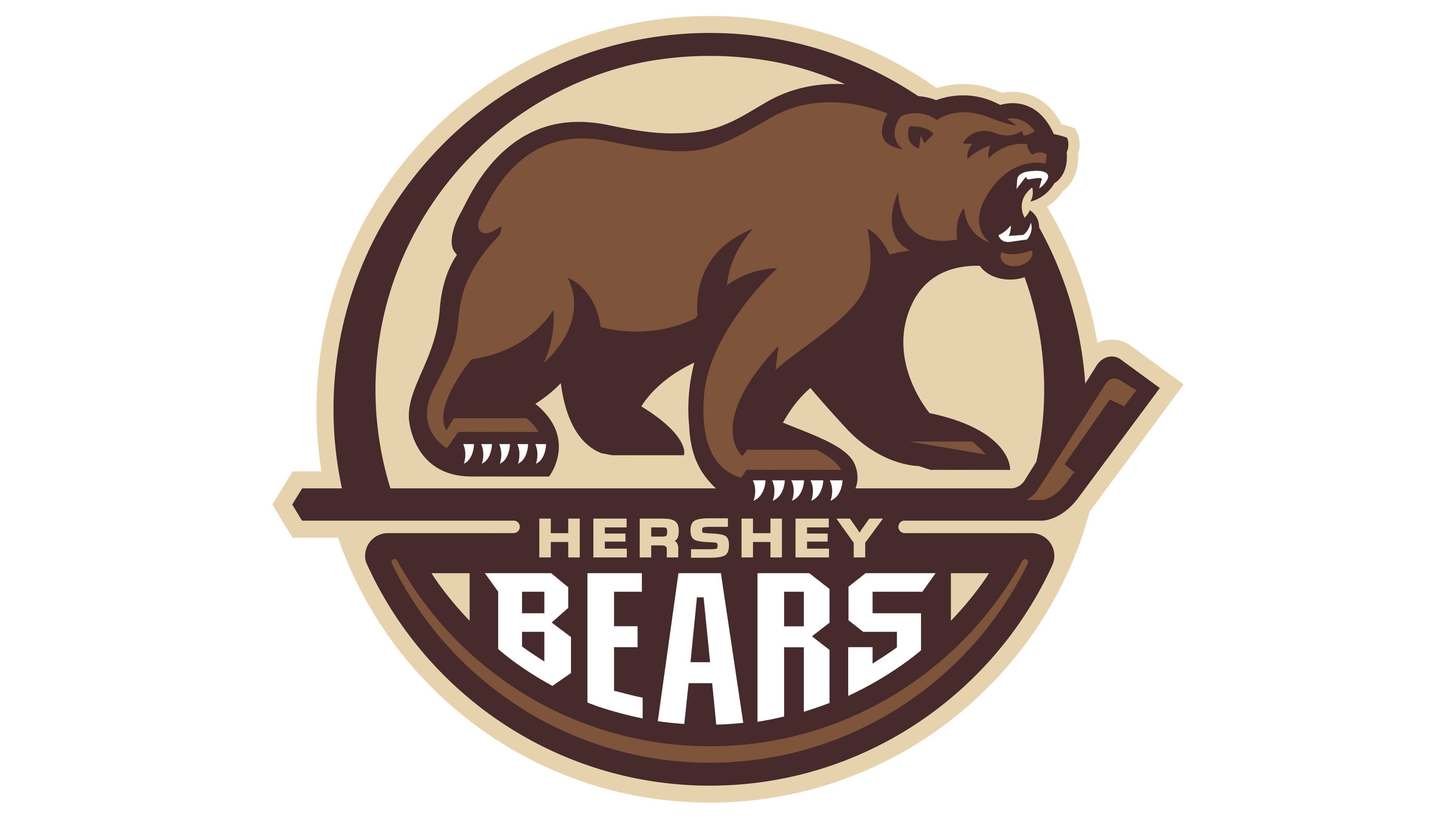
Joe Bosack & Co. carried out a comprehensive rebranding for the Hershey Bears, covering the team’s emblem, player uniforms, and mascot, Coco. The goal was to integrate historical elements from the club’s imagery of the late 1930s and early 1940s with the contemporary style of sports symbols adopted in North American hockey.
The updated logo presents a bear standing on all fours, with its front paw resting on a hockey stick. The animal is placed within a solid circular frame that closes the composition. Beneath the bear is the club’s name, “HERSHEY BEARS.” The emblem evolved into a classic round shape.
The color palette was built from beige and dark brown, evoking associations with chocolate and caramel, which are central to the Hershey brand and the city of the same name. Beige serves as a soft, neutral background. The bear figure and frame are rendered in chocolate-brown tones, and the light-colored club name ensures legibility and contrast within the composition.
The inscription “HERSHEY BEARS” is set in a custom sans serif with a geometric character: the upper part (“HERSHEY”) is simple, with clean straight lines and even spacing between letters, while the lower (“BEARS”) features massive letterforms, thick strokes, and sharp angles.
The bear standing on the ice symbolizes the club’s athletic identity, underscoring the team’s aggression and energy. The bear, the stick, and the circular frame form a balanced, modular structure, making it easy to reproduce across various media, including sports equipment, merchandise, and digital platforms.
