 Indian Army Logo PNG
The Indian Army traces its roots to the 18th century, when the British East India Company recruited local sepoys under British officers. The Bengal, Bombay, and Madras presidencies kept separate armies, often operating independently. Between 1763 and 1805, their numbers grew as the Company expanded control across the subcontinent.
The 1857 sepoy uprising exposed the weakness of that structure. After the revolt was suppressed, India passed from Company rule to British Crown rule. In 1859, the Peel Commission recommended reorganization, reducing high-caste Hindu battalions and increasing recruitment from Sikhs, Gurkhas, and other groups the British classified as “martial races.”
On April 1, 1895, the three presidency armies were merged into one Indian Army with four territorial commands. In 1902-1903, Lord Kitchener replaced the old system with Northern and Southern commands. During World War I, more than 1.5 million Indian soldiers served in Europe, the Middle East, and Africa, with over 60,000 killed. In World War II, mobilization exceeded 2.5 million, the largest volunteer army in history.
After the 1947 partition, the army was divided between India and Pakistan, with six Gurkha regiments staying in India and four going to Britain. The war over Kashmir began in October 1947. Later conflicts followed with China in 1962, Pakistan in 1965, Bangladesh’s independence war in 1971, and Kargil in 1999. In 1971, 93,000 Pakistani troops surrendered on December 16. In Kargil, Indian forces retook the heights after months of fighting, losing more than 500 soldiers.
Meaning and History
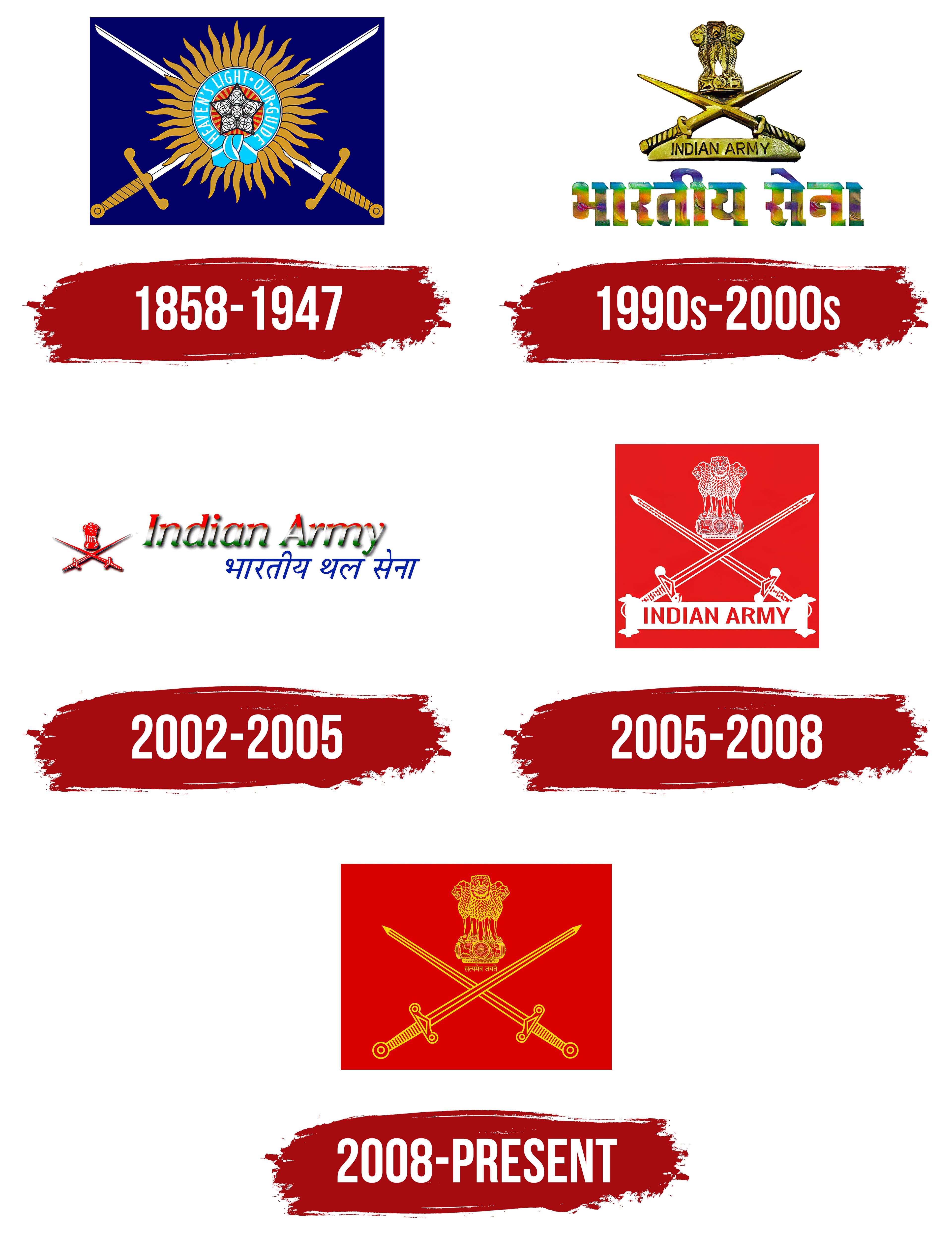
1858 – 1947
1990s – 2000s
2002 – 2005

2005 – 2008
2008 – today