


 iPhone Logo PNG
The iPhone logo is the lightness of lines, purity, and style. This is what defines the brand’s phones. Ease of use and technical excellence make iPhones leaders in the segment, and their stylish design has made them an indispensable status symbol among the wealthy.
The iPhone began inside Apple in the early 2000s, when Steve Jobs started pushing for a new kind of phone. By 2004-2005, the secret Purple project was running in a separate building at Apple’s Cupertino campus, with strict confidentiality rules. Engineers were pulled from inside the company, and even they learned details only after signing extra agreements.
Apple also needed a stronger touchscreen surface. In 2007, Jobs asked Corning to produce thin, tough glass in only a few months. Corning revived its old Chemcor research from the 1960s and supplied what became Gorilla Glass. On January 9, 2007, Jobs introduced the iPhone at Macworld as an iPod, phone, and internet communicator in one device. Nokia and BlackBerry reacted skeptically to a phone without a physical keyboard.
The iPhone went on sale in the U.S. on June 29, 2007, priced at $499 for the 4 GB model and $599 for the 8 GB model. By year’s end, about 1.4 million units had sold, and Time named it Invention of the Year. In July 2008, iPhone 3G arrived with faster networks, GPS, and the App Store, which quickly turned the phone into a software platform.
Later models reshaped the line. iPhone 4 brought the Retina display in 2010, but also the Antennagate issue. The iPhone 4S introduced Siri in 2011, shortly before Jobs died, and Tim Cook took over as Apple’s CEO. The iPhone 5s added Touch ID in 2013, the iPhone 6 and 6 Plus moved to larger screens in 2014, and the iPhone 7 dropped the headphone jack in 2016. In 2017, the iPhone X introduced OLED, Face ID, and a new glass design, while the iPhone 12 brought 5G in 2020.
Meaning and History
Work on a prototype of what eventually became the iPhone began in 2004. Apple recruited a group of highly qualified professionals, especially for this project. One thousand people were invited. Three engineers led the team: Tony Fadell, responsible for software; Sir Jonathan Ive, responsible for design; and Scott Forstall, a programmer. They worked together on Project Purple.
At first, the goal was to create an innovative tablet, but then CEO Steve Jobs shifted priorities toward a multifunctional mobile phone. It eventually emerged through a secret collaboration with Cingular Wireless, which was renamed AT&T Mobility. Since then, the company has launched one device each year that improves on the previous one: smartphones with improved configurations and updated features. One of the latest series is the iPhone 12, which includes several models with the A14 Bionic processor and 5G connectivity.
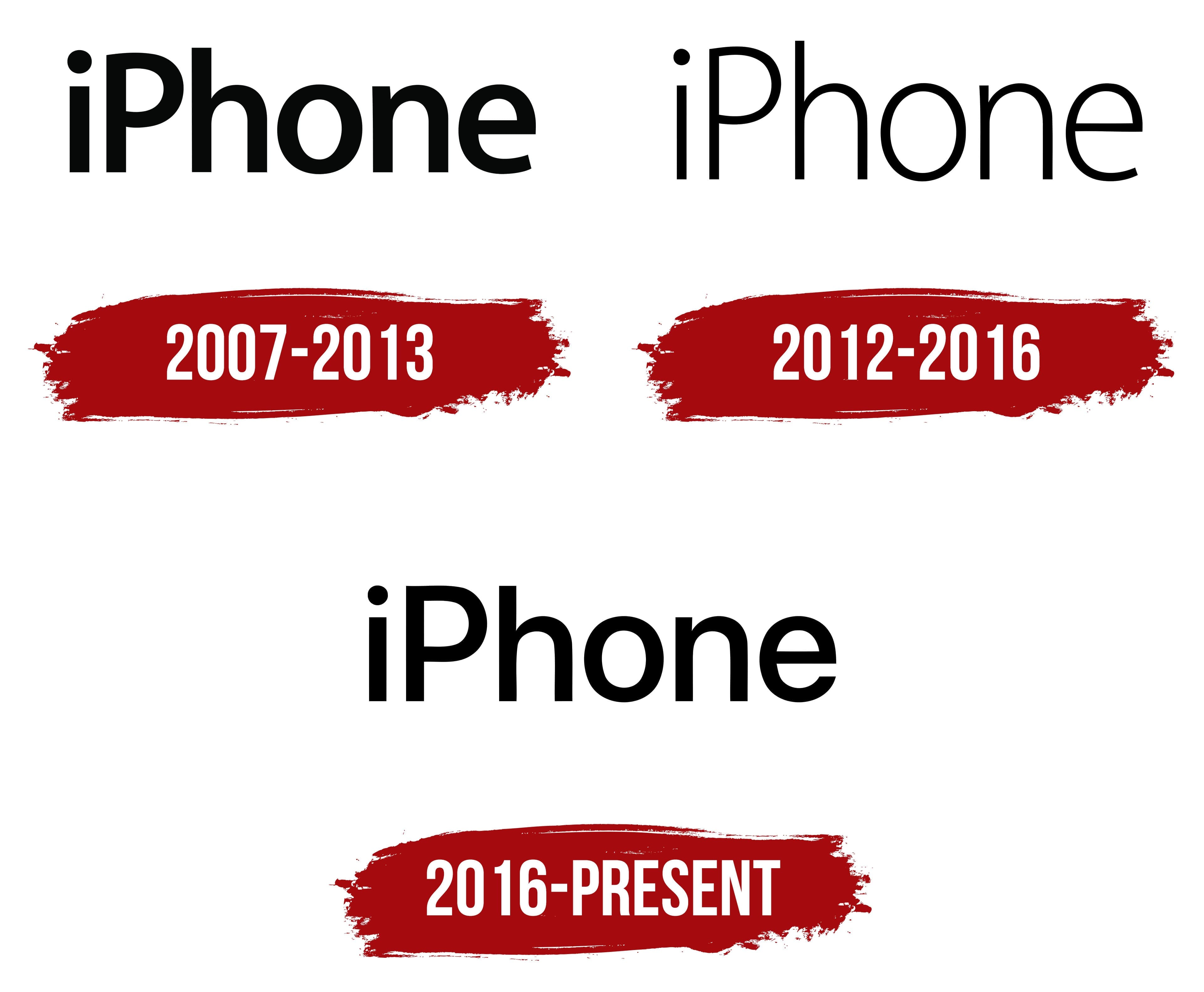
Jobs coined the brand name, which forms the basis of its identity. According to his concept, the word iPhone is derived from such terms as “internet,” “inspire,” “inform,” “individual,” and “instruct. They are indicated by the short “i” sign, which is also used in the names of other Apple products: iMac, iPod, and iPad. The second part is the “phone.” It is taken from the English word “phone.” This mark appears on all branded smartphones. The emblem has three versions.
2007 – 2013
The first models had a bold-type marking. The single “i” was originally lowercase, and the “P” was capitalized to emphasize priority and functionality. The letters are flat, smooth, without serifs. They have a streamlined shape that matches the finger’s smooth movement on a touchscreen. As a result, none of the characters have broken lines or right angles (and even when they appear, they have a less pronounced slope). The logo is text, but to the left is a bitten apple, Apple’s individual designation. In this way, the manufacturer emphasizes that the product belongs to him.
2012 – 2016
The emblem was upgraded alongside improvements to the devices’ functionality and content. It became lighter, simpler, more sophisticated, and more elegant. This is despite the logo’s brevity, which underscores the importance of internal content over external appearance. As a result, in 2012, the lettering became slimmer. The font remains lowercase, except for the “P,” which has always stayed uppercase. The letters are smooth, with uniform height transitions, as if they followed a finger’s trajectory across the display. Thanks to the narrow characters, the inter-letter spacing is slightly larger, which improves readability.
2016 – today
The current logo uses the same word in an accented version: bold letters. They’re not as wide as in the first version but not as narrow as in the second. This font is called SF Pro Semibold. It is moderately subtle but more pronounced. The top of the “h” is now aligned with the height of the “P,” whereas before it sat higher. The lowercase “i” also reaches them. The round dot moved further away from the vertical bar at the beginning of the logo’s creation.
Font and Colors
The main purpose of the iPhone’s visual identity sign is to demonstrate the smartphone’s ease of use. Therefore, the font is unadorned: simple single lines without outlines, frames, or double stripes. This performs a key task, accurately conveying the functionality and purpose of the new generation of mobile devices.
The emblem uses the grotesque typeface family San Francisco Pro for the text. Apple custom-developed it. The official logo palette is monochrome, combining black (lettering) and any background color. Usually, it is white, but it depends on the smartphone model’s shade.