


 Kärcher Logo PNG
The clear and rigorous Kärcher logo floats above the surface. The emblem demonstrates that the company’s developments are ahead of its competitors’. The color scheme conveys a positive message: all mechanisms operate without failure and bring the user only joy.
In 1924, Alfred Kärcher graduated from Stuttgart Technical University and worked in his father’s equipment business. By 1935, he had founded Alfred Kärcher Kommanditgesellschaft in Bad Cannstatt, where he developed industrial heating systems and salt bath furnaces. A patent sold to Siebert GmbH led to the production of over 1,200 units, primarily for aviation use.
On June 1, 1939, the company moved to Winnenden and took on 120 employees. During World War II, production shifted to military equipment, including cabin heaters and de-icing systems for aircraft. After the war, operations returned to civilian use under Allied supervision.
In 1950, Kärcher introduced DS 350, Europe’s first hot-water high-pressure cleaner. The burner design became the company’s long-term technical basis. The product found demand in industry, transport, and construction. After Kärcher died in 1959, his widow Irene Kärcher took over and refocused the company on cleaning technology. Revenue rose sharply, and in 1962 the company opened its first foreign office near Paris, followed by Austria and Switzerland.
In 1974, the company concentrated entirely on high-pressure cleaning systems and adopted yellow as its corporate color. In 1975, production expanded to Brazil. In 1980, Kärcher cleaned the Christ the Redeemer statue in Rio de Janeiro, which marked the start of a series of restoration projects worldwide.
In 1984, the HD 555 became the first portable consumer pressure washer, with over 300,000 units sold. Competitors included Nilfisk and Lavor. In 2002, Kärcher released RoboCleaner RC 3000. In 2006, the term “karcher” was added to the Petit Robert dictionary following a statement by Nicolas Sarkozy. In 2018, “kärchern” appeared in Duden. By 2015, revenue exceeded €2.22 billion.
Meaning and History
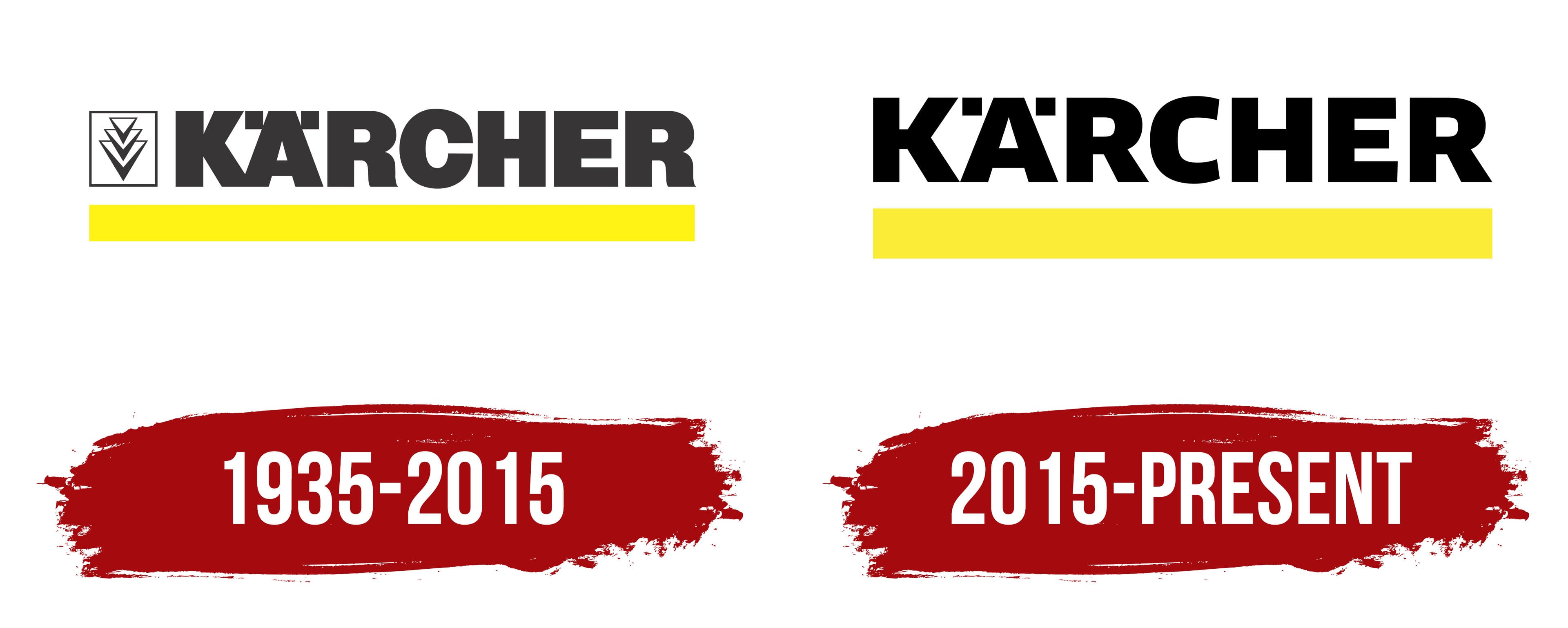
The company entered the market in 1935, introducing innovative heating devices.
The German concern’s famous emblem debuted with its launch. It adorned the first products and appeared across all media, from advertising to business documents. Despite its long history, the company has used a single logo with only minor changes. Clarification: “almost” refers to the manufacturer making a single, insignificant change to the brand logo. In its entire history, the trademark has had two very similar logo options.
What is Kärcher?
Kärcher is a German manufacturer of cleaning equipment and high-pressure washers. It is a leader in the cleaning technology industry and offers a wide range of products. Its representatives operate worldwide, but the head office is located in Winnenden. Alfred Kärcher created the brand in 1935.
1935 – 2015

The debut logo appeared alongside the first products, with the dark gray “Kärcher” lettering above the yellow line. On the left was the original graphic element: three inverted triangles in a square.
The brand name, now a trademark, comes from the surname Alfred Kärcher. He founded and owned an industrial enterprise. His heirs now own the business, so the Kärcher logo reflects the link between generations. Today, the word refers to any high-pressure cleaner.
2015 – today
The firm is remarkable for its consistency: its symbolism has never changed for 80 years. The only redesign came in 2015. The developers removed the geometric shapes, leaving only the inscription and the underline. Alfred Kärcher GmbH & Co. holds the rights to both versions of the logo. KG.
Font and Colors

The 2015 emblem differs from the previous one by omitting the graphic sign and changing the font. For example, the “R” has lost its miniature serifs, and the “C” is more open. The increased indentation between letters: “K” and “Ä” no longer merge. All characters are uppercase.

The changes also affected the color scheme. The inscription is now black, not dark gray, as it used to be. However, variants with a white “Kärcher” on a black background are allowed. The wide rectangular stripe under the word is bright yellow.