


 Lazada Logo PNG
The Lazada logo is not just part of a marketing campaign. It also expresses love, the store’s love for its customers, and the feelings customers have toward the products they buy. The gentle orange-pink gradient shows the intensity of these emotions, and the rounded lettering next to the heart feels friendly.
Lazada is an international online store that sells products worldwide. It is most popular in Southeast Asia. The marketplace was created with the support of Rocket Internet and the direct participation of Maximilian Bittner, Raphael Strauch, Stefan Bruun, and Mads Faurholt. It launched in 2012. Belongs to the largest representative of e-commerce, Alibaba Group. The head office is located in Singapore (Downtown Core).
Meaning and History
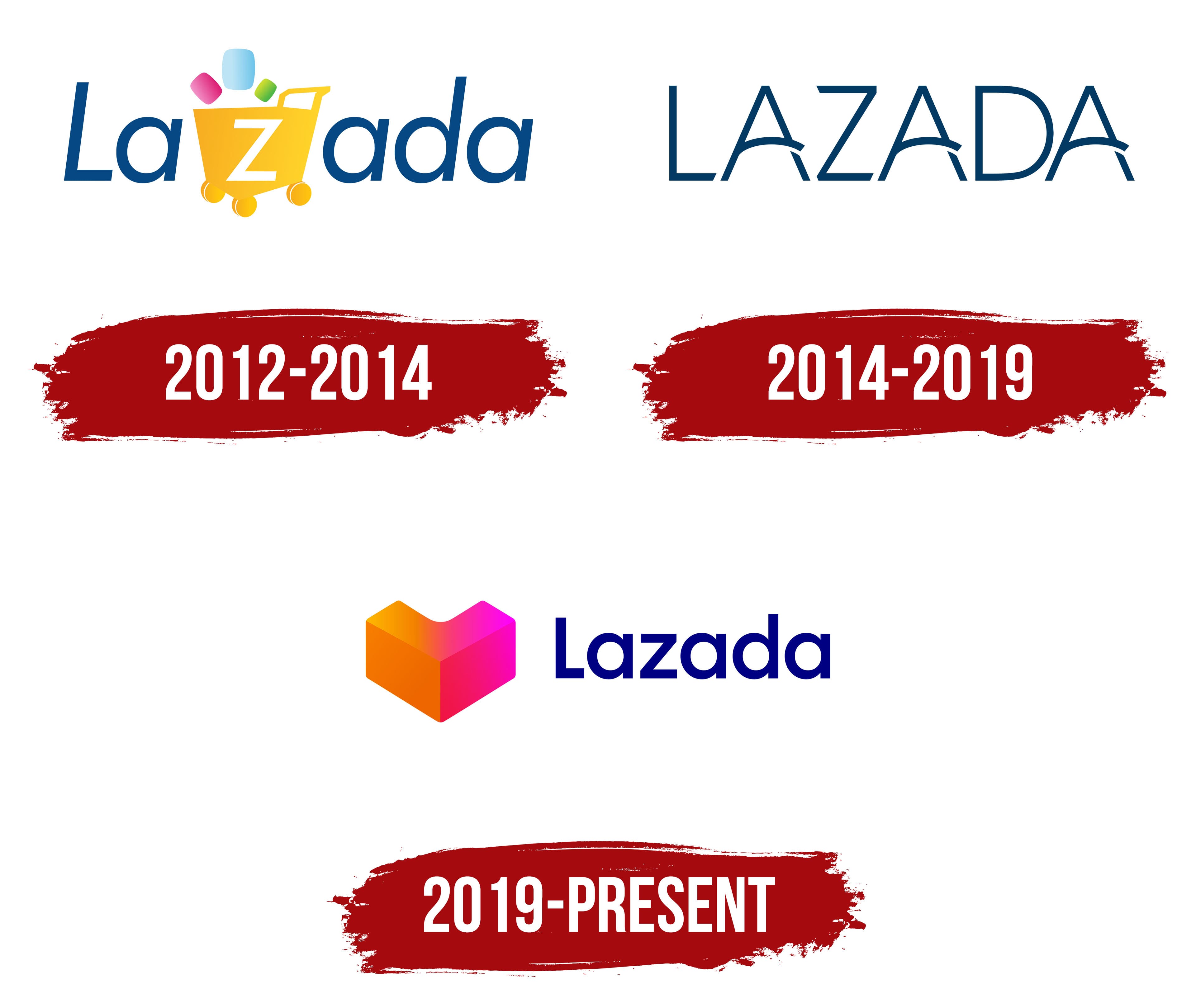
Lazada launched its website in spring 2012 to sell goods from the company’s warehouses. A year later, another commercial model emerged: retailers could sell their goods directly to customers. The web resource became their virtual store. At the same time, he created and launched mobile apps for this purpose, adapted for iOS and Android. As a result, the brand became widely known, and by the end of 2014, it accounted for almost 65% of sales.
The transition to the Alibaba Group took place in 2016, when it began implementing its international expansion plan by acquiring a controlling stake in Lazada. This was also preceded by the rapid growth of the young online platform, which had achieved huge profits in all six Southeast Asian markets by the beginning of that year. As an experienced virtual commerce representative, I have seen my success multiply manifold. For example, in 2018, the online retailer introduced Lazmall, which encourages purchases from authentic brands. It also introduced instant delivery and a 15-day return policy.
This is reflected in the company’s visual style, which aims to position it as a leader in the e-commerce market. Its “heart in a box” is well known to more than 50 million active shoppers. By 2019, it will be Southeast Asia’s leading virtual marketplace. It has changed its logo twice before its success; as of 2022, it has three. They differ in style but share the same message: shopping for everyone, effortlessly and with love.
What is Lazada?
Lazada is an international Internet corporation that operates online marketplaces in several countries. Its priority service region is Southeast Asia. The company has been operating since 2012, when it was founded by Maximilian Bittner, Raphael Strauch, Stefan Bruun, and Mads Faurholt. Since 2016, it has been owned by Alibaba Group.
2012 – 2014
The original logo of the commercial web conglomerate combined text and graphics harmoniously. In the italicized word “Lazada,” the designers depicted a shopping cart. In contrast to the surrounding blue lettering, it was colored yellow, so it stood out clearly against the background. The wheeled cart was located on the side. It was marked with the letter “z” in white, like the neighboring lowercase, sans-serif characters. In keeping with the spelling, the exception was the letter “L,” which came first and was uppercase. Above the basket were hypothetical “purchases” as miniature rectangles in dark pink, blue, and green.
2014 – 2019
Having established itself in the Southeast Asian market, Lazada redesigned its emblem. To do so, it removed the shopping cart and focused on the service name. To add visual originality, the designers set all letters in uppercase and stylized three “A”s. To the left of these glyphs, a triangular element appeared on a long leg, resembling a slingshot. The rest of the signs were flat and thin, with well-defined corners.
2019 – today
The current logo combines a heart (symbolizing a special disposition and love for customers) and the capital letter “L” (the first letter of the online store’s name). That’s why the updated logo is popularly nicknamed “Heartgram.” But before it became official, it appeared in commercials. This happened in 2018. Later, Lazada decided to elevate the marketing symbol into a corporate logo. Superunion, the Singapore studio, was entrusted with the work. The result was a massive, downward-slanting letter “L” that forms a voluminous heart.
Font and Colors
The modern logo looks like two connected rectangles. Visually, they are divided into two color-highlighted fragments. The dividing line angles downward. Due to the rounded recess, the inner part has a boomerang-shaped cross-section. To the right of the graphic mark is the name of the Asian e-commerce representative. It is designed the same as the debut logo.
The current logo uses Moskau Grotesk Medium, a typeface designed by graphic artist Björn Gogalla and first introduced by Letter Edit. In the first logo, the text is italicized, similar to SoftMaker’s Montreal Serial Medium. In the second logo, the typeface is customized to match the original concept. The corporate palette is now bright and memorable. It combines orange and pink with a subtle gradient from light to dark tones.