


 Magnum Logo PNG
The Magnum logo emphasizes the premium quality and sophistication of the ice cream brand. Its strict, elegant style underscores a focus on product quality, flavor, and enjoyment.
A team led by Mogens Vigh-Larsen at Frisko, Unilever’s Danish ice cream business, developed Magnum in Aarhus, Denmark, in the late 1980s. Production began in autumn 1988, followed by the official launch in Germany in 1989. The idea was to create an ice cream aimed at adults, using Madagascar vanilla and a thick Belgian chocolate shell. The name came from the Latin magnus, meaning “large,” reflecting a product roughly twice the size of many standard ice creams of the period.
Expansion was rapid. Magnum reached Belgium, Denmark, the Netherlands, Sweden and Switzerland, and by 1994 was sold in 35 countries with estimated global turnover of about $900 million. Magnum White and Magnum Almond arrived in 1992, followed by cones in 1994, sandwich products in 2002 and Magnum Mini in 2009. The brand competed in the premium segment with Häagen-Dazs and entered the US and Canada in 2011 with six varieties and a campaign featuring Rachel Bilson.
Further launches included India in 2013 through Hindustan Unilever under “Kwality Wall’s” and the Magnum Manila boutique in 2014. Vegan Classic and Almond appeared in 2018 and received a PETA award in 2019. In 2020, Magnum introduced a ruby chocolate version made from ruby cocoa beans.
In March 2024, Unilever announced plans to separate its ice cream business. The Magnum Ice Cream Company was established on July 1, 2025, as an independent public company, with shares listed in Amsterdam, London, and New York.
Meaning and History

What is Magnum?
It is a premium ice cream brand that symbolizes sophistication in frozen desserts. Originally marketed as an adult treat, it features ice cream coated with a thick layer of specially formulated Belgian chocolate, designed to maintain flavor at low temperatures. The delicate vanilla filling and high-quality ingredients established the dessert’s reputation as upscale. Varieties now include almonds, caramel, white chocolate, and vegan options.
1989 – 2003
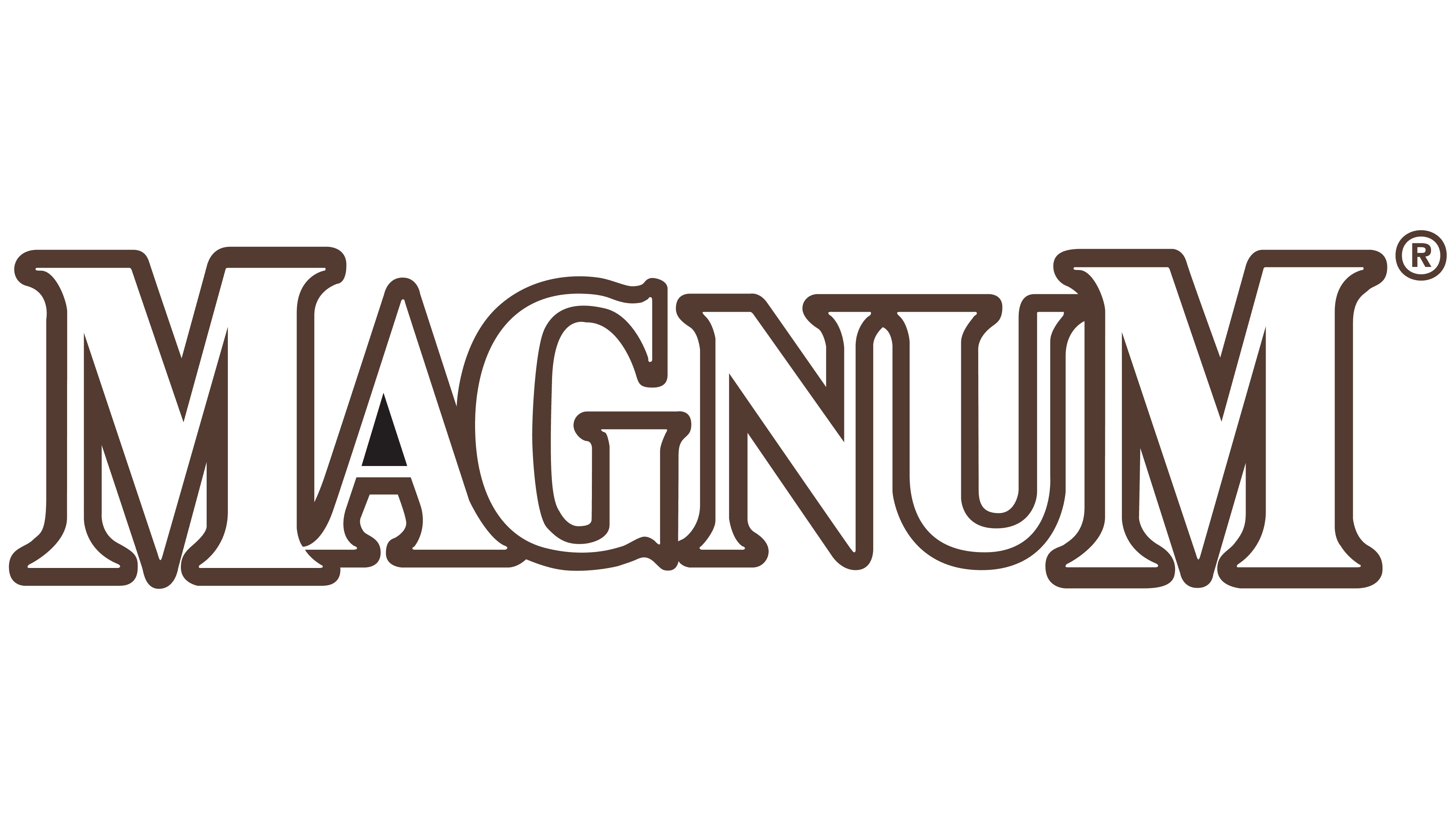
The launch of the Magnum line on the Danish market in 1989, under Frisko’s management, coincided with the emergence of a visual identity focused on premium quality and sophistication for an adult audience. Expressiveness and status were embedded in the logo’s composition through serif typography, conveying traditional ideas of quality and refinement associated with the product.
Capital letters formed the lettering, with visual emphasis on the outer “M” letters, which were the largest. This conveyed strict symmetry and confidence while subtly hinting at the magnitude of taste sensations. The typeface’s structure reflected the classical proportions of old serif fonts such as early Garamond and Times Ten, which are associated with book traditions and an aristocratic style.
The color scheme was based on dark chocolate brown and noble gold, evoking an emotional association with the luxury of taste and the delicacy of ice cream. The shade symbolized the warmth and density of the chocolate coating, underscoring the brand’s high quality and appeal to adult consumers.
2003 – 2006
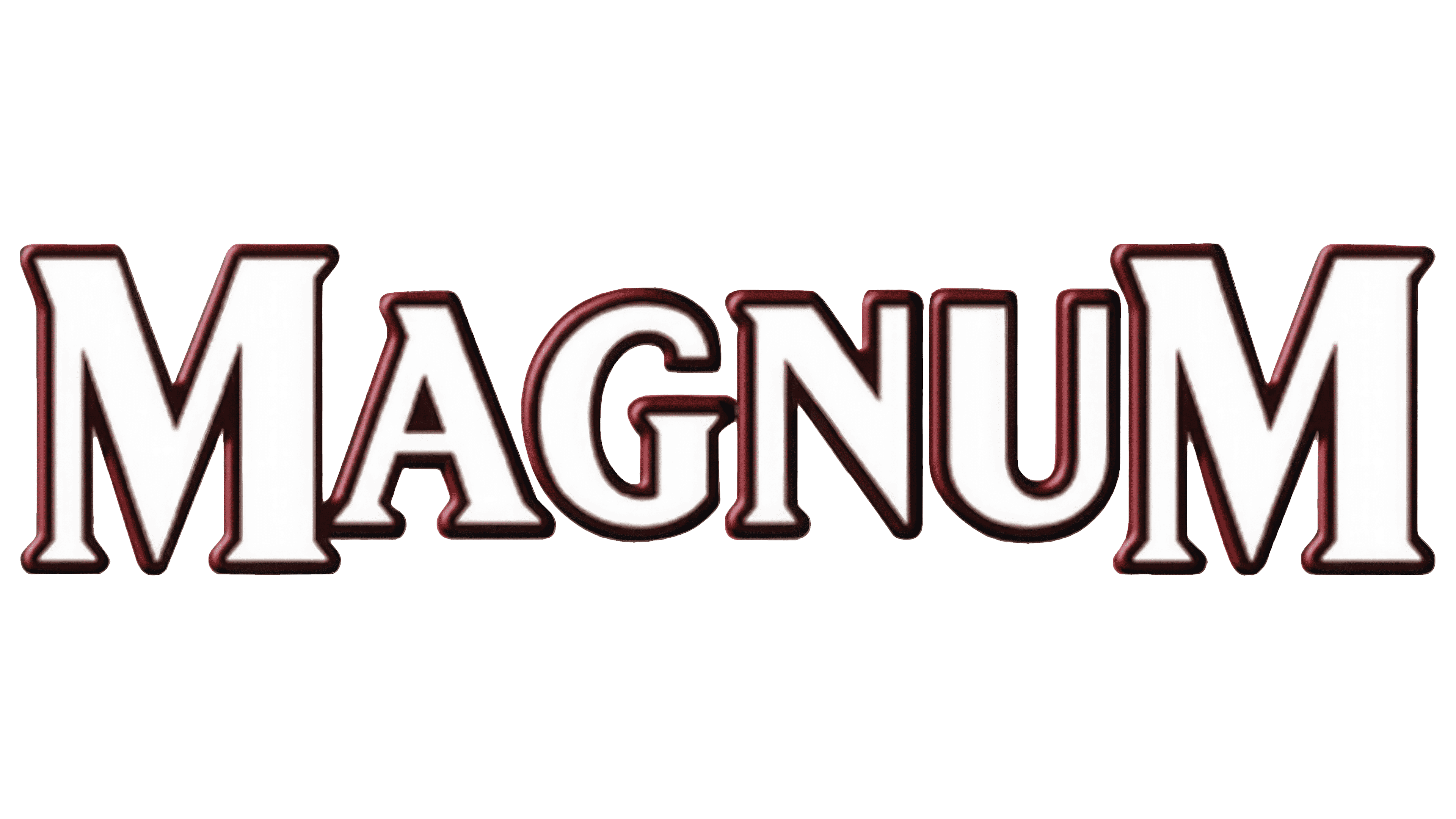
The transition to a three-dimensional design of the Magnum logo in 2003 was subtle yet significant for the brand’s perception. The update primarily focused on the treatment of the symbols’ forms and surfaces, rendered in a volumetric style with highlights and deep gradient shadows. Instead of the previous flatness, a glazed chocolate surface effect appeared, associated with the dessert theme and the main product.
The introduction of three-dimensionality emphasized the depth of the letterforms and strengthened the contrast by adding a rich, almost chocolate-burgundy outline. This shade evoked the chocolate coating of ice cream, highlighting the dessert’s distinct character. The white fill of the characters began to appear embossed, like a raised glaze on a treat, which brought the brand’s visual image closer to a more sensual perception of the product.
The typographic basis of the logo, derived from classical serif antiquas, preserved the previous proportions and glyph forms, remaining symmetrical and strict. At the same time, the contours of the letters acquired smoother, softened transitions between strokes and serifs, which enhanced the overall impression of roundness and smoothness.
The transformation of the Magnum logo was linked to the company’s internal processes. In the early 2000s, Unilever adapted the product to the demands of consumers in Europe and Asia, who required a universal visual communication approach. The new design symbolized the brand’s aspiration to a more modern image that meets the expectations of a modern audience while retaining traditional features and recognizability.
2006 – 2021
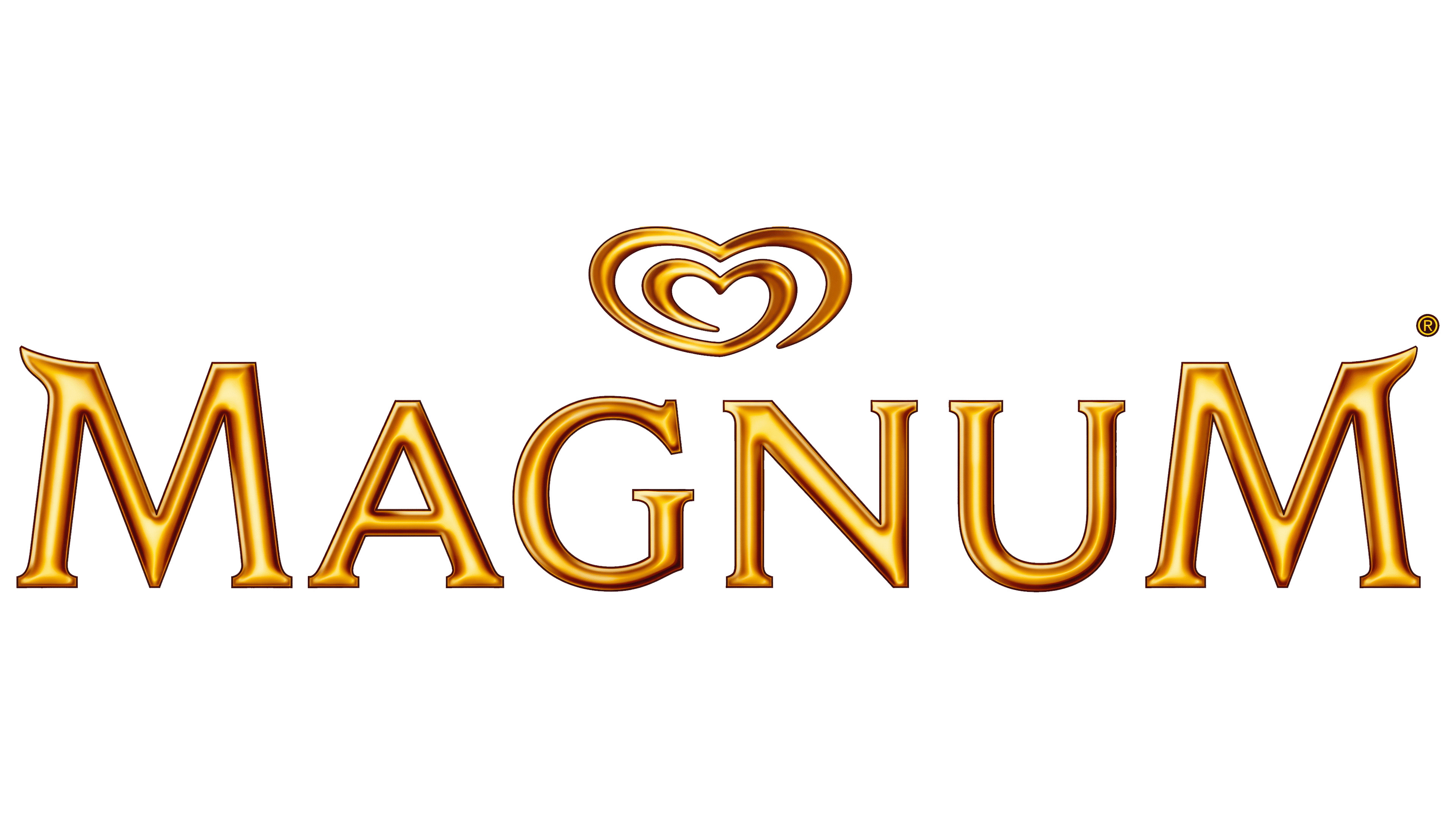
The redesign became a complete transformation of the visual identity, setting the brand’s direction toward premium quality and refinement. During this period, the brand established itself in the dessert segment, targeting adults. The new visual concept turned the brand image into the embodiment of sensual luxury, emphasizing the moment of indulgence and the product’s prestige.
The key innovation was a monogram stylized as a pair of hearts, linked to Unilever’s corporate Heartbrand symbol. The latter, sold internationally under various names, including Algida, Walls, and Frigo, served as the basis for unifying the company’s dessert brands. The meaning of this symbol conveyed emotional pleasure and enjoyment. In this way, the monogram highlighted Magnum’s positioning in the adult indulgence segment.
The logo’s typography underwent a fundamental revision, adopting a refined serif typeface characterized by curved strokes, elongated letterforms, and elegant flourishes. Each letter acquired its own character, expressed in the stylized, pointed upper stroke of the “M,” which gave dynamism and expressiveness to the entire inscription. The use of gold volumetric filling with highlights and shadow effects created an image reminiscent of jewelry or polished precious metals, enhancing the impression of sophistication and exclusivity.
At the same time, Magnum implemented a new packaging approach, incorporating a distinctive design detail: the signature “M” embossed on each item. The “M” symbol became a seal or signature, marking the product’s premium status and reinforcing the consistency of the brand’s visual identity.
The introduction of mirrored “M” letters in the packaging design emphasized balance and symmetry, while the golden color reinforced associations with luxury and mature sensuality. An understanding of changing audience preferences drove the redesign, shifting from mass appeal to an emphasis on everyday luxury through emotional and aesthetic engagement with the product.
2014 – 2021
To mark its 25th anniversary, Magnum refreshed its visual identity by framing the golden “M” monogram within a round chocolate background with a thin golden border. The introduction of the circular shape was motivated by practical goals for the brand’s use across digital and print channels. The new design maintained continuity by clearly linking to the previous version and adopted a more compact layout, making it convenient for digital media and mobile communication.
The chocolate-colored background emphasized the product’s flavor. At the same time, the golden monogram symbolized premium quality and refinement. The contrast created a vivid emotional connection between visual perception and tactile sensation, evoking the chocolate coating’s smooth surface. The Heartbrand symbol above the “M” reinforced the brand’s association with Unilever’s family of dessert brands and enhanced the product’s perception as a source of pleasure.
The lower part of the composition features the name ‘Magnum’, set in the same typeface as the 2006 version, but smaller and with a more restrained placement. The serif typography, with its curved glyphs, gave the wordmark elegance while maintaining stylistic consistency with earlier iterations. Placing the text below the monogram emphasized the dominance of the “M” symbol, which had evolved into an independent visual mark capable of representing the brand without its full name.
2021 – today
Magnum’s 2021 abandonment of glossy three-dimensionality and complex light-and-shadow effects marked the brand’s transition to a modern minimalist aesthetic. In the new version, designer Rob Clark from Sunhouse Creative preserved the symbols’ recognizable forms and previous proportions. Still, he removed visual excess, focusing on simplicity and clarity of reproduction.
The logo’s style demonstrates unity of form and color: the word “MAGNUM” is set in the traditional serif typeface introduced in 2006, but the letterforms are stricter, more restrained, and free of decorative flourishes. The typeface’s overall impression is one of elegant moderation and refined restraint. The Heartbrand symbol has been retained to continue to evoke associations with the brand’s emotional and sensory qualities.
The monogram version of the logo also underwent a color change. The circle is highlighted with a golden gradient, while the “M” and the text below it are set in a soft brown tone that reinforces the brand’s dessert identity. This version proved suitable on both a matching background and a contrasting white background, ensuring versatility across different contexts.
The abandonment of volumetric elements was not merely a fashion statement; it aligned with global shifts in communication channels and the strengthening of the brand’s digital presence. The flat style improved the logo’s readability on smartphone screens, in mobile applications, and on social networks, where minimalism and recognizability became key.
The golden lettering palette emphasizes the product’s premium status. It ensures a clear, pure perception of identity. Sometimes, the word “ice cream,” set in a thin, neutral typeface, complements the inscription unobtrusively, indicating the product category without visually competing with the main symbol.
